A$0 Deposit Casinos in Australia: What “No Minimum Deposit” Actually Means in 2026
There is real Australian search demand behind the phrase “no minimum deposit casino.” It pulls significant search demand a month, and a row of offshore sites is waiting on the other side. What those sites do not say in their headline is that the phrase resolves to the lowest method floor the cashier supports, and almost no honest A$5 fiat-deposit casino for Australian players in 2026 exists. The lowest real-money floor an Australian punter hits at a PayID or card cashier is closer to A$10, and the headline of A$0 belongs to a marketing claim, not a product.

This page reads the claim the way an experienced reader would: as a promise that has to be cashed out in real money, real payment rails and real consumer protection — of which there is none in Australian online casino play, because online casino is prohibited here and every site accepting Australians is offshore. The numbers, the methods and the legal reality are below.
Data current as of 22 November 2026, verified against the Australian Communications and Media Authority (ACMA) register and operator terms pages.
Table of Contents
- Why “No Minimum Deposit Casino” Is a Promise No Australian Site Keeps
- The Deposit Floor You Actually Hit: A$5, A$10, and the Crypto Edge
- Best No-Minimum-Deposit Casino Sites for Australians in 2026
- Pokies, Slots and the Games You Can Play on an A$10 Deposit
- How to Deposit Less: The Payment Methods That Set the Real Floor
- Is It Legal? The Offshore Reality Every Australian Player Needs to Know
- Staying in Control: Deposit Limits, Help Services and the Real Numbers
- How We Evaluated These Casinos
- What Low-Deposit Casino Play Actually Costs You — and Whether It Is Worth It
- Frequently Asked Questions
Why “No Minimum Deposit Casino” Is a Promise No Australian Site Keeps
The phrase has a job to do, and the job is not to describe a product. It is to win the click. Search the term and the first page of results is a wall of “no minimum deposit” headlines backed by cashiers that refuse anything under A$10 by PayID or A$20 by card. The gap between the headline and the cashier is the whole story of this niche, and it opens with one blunt fact: the Interactive Gambling Act 2001 prohibits online casino, so no Australian licence exists and every casino you can actually play at runs from overseas. Inside that constraint, the minimum deposit you face is set by the payment method, not by the casino’s “no minimum” banner.
A 0 deposit casino in Australia is, in verified form, a unicorn. Where a cashier does let a player through with cents on the line — a fraction of a cent in BTC at Stake, for example — it is because the rail itself accepts fractions of a unit, not because the casino waived a floor. The rest of the market sits at A$10 by PayID or Neosurf, A$20 by card, and roughly A$15–A$30 by crypto once network fees are counted. The phrase “no minimum deposit” is a marketing headline, and what it is selling is a few dollars of headroom on the cashier screen, not the absence of one.
The Online Casino Landscape Australians Actually Face
The Australian online casino market is, strictly speaking, not a market. The IGA makes it an offence to provide online casino games, online pokies and in-play sports betting to a person in Australia — federally, in every state, in every territory. There is no licence to be issued because the activity is not a permitted one. Every brand you can find, sign up to and play at from an Australian IP address is an offshore operation; the largest of them are licensed offshore, and none of these offer Australian consumer protection.
The Australian Communications and Media Authority, the federal body that enforces the prohibition, has had 1,564 illegal gambling and affiliate websites blocked at the ISP level since November 2019 (as of March 2026), and more than 225 illegal services have withdrawn from the Australian market since 2017. That is the active enforcement record. The player is not prosecuted under the IGA — the Act targets the provider, not the person gambling. The trade-off is stark: the offshore route keeps you out of Australian court, and it keeps every form of Australian consumer protection out of your dispute with the operator.
The contrast that explains why a player ends up offshore is the licensed market. Australia permits wagering on races and sport before the event, lotteries and keno, all under state and territory licensing. There is no licensed online casino to sit beside those bookmakers, so a player who wants to play pokies or blackjack online has, in practice, two doors: stay onshore and play only what is permitted, or step offshore and accept the loss of every Australian safeguard. Most readers of this page are already past the second door. The rest of the page is for them.
Mobile Access and the Low-Deposit Player
Mobile is where the low-deposit play happens. Most offshore casinos are browser-first, with a small number offering native apps through direct download. The cashier experience on mobile is where the deposit floor shows up most clearly, because the screens are smaller, the rails default to PayID or Apple Pay on iOS, and the floor is rarely lower than the desktop version. A punter depositing from a phone will hit the same A$10 PayID floor, the same A$20 card minimum, and the same crypto network fees as a desktop user.
For a casual low-deposit player, the practical question is whether the cashier accepts the smallest stake the punter is willing to make. On PayID and Neosurf, that is A$10. On TRC-20 USDT, it can be a few dollars. On BTC, fractions of a cent. The platform is not the constraint; the rail is. A reader who genuinely wants to play on a near-zero deposit is reading about a single rail, and the rest of the page is about the rest of the market, where the rail is fiat and the floor is real.
The Deposit Floor You Actually Hit: A$5, A$10, and the Crypto Edge
A$5 deposit casinos in Australia sound like a category, and they are not. The figure is a search-result artefact, not a product. Neosurf does sell a A$5 voucher, but the voucher is EU-only — Australian Neosurf starts at A$10. Card processors impose a A$10–A$20 floor. PayID floors sit at roughly A$10 across the AU-facing market, and “no minimum” PayID labels are marketing copy, not cashier reality. There is no fiat path below A$10 that research has been able to verify in 2026.
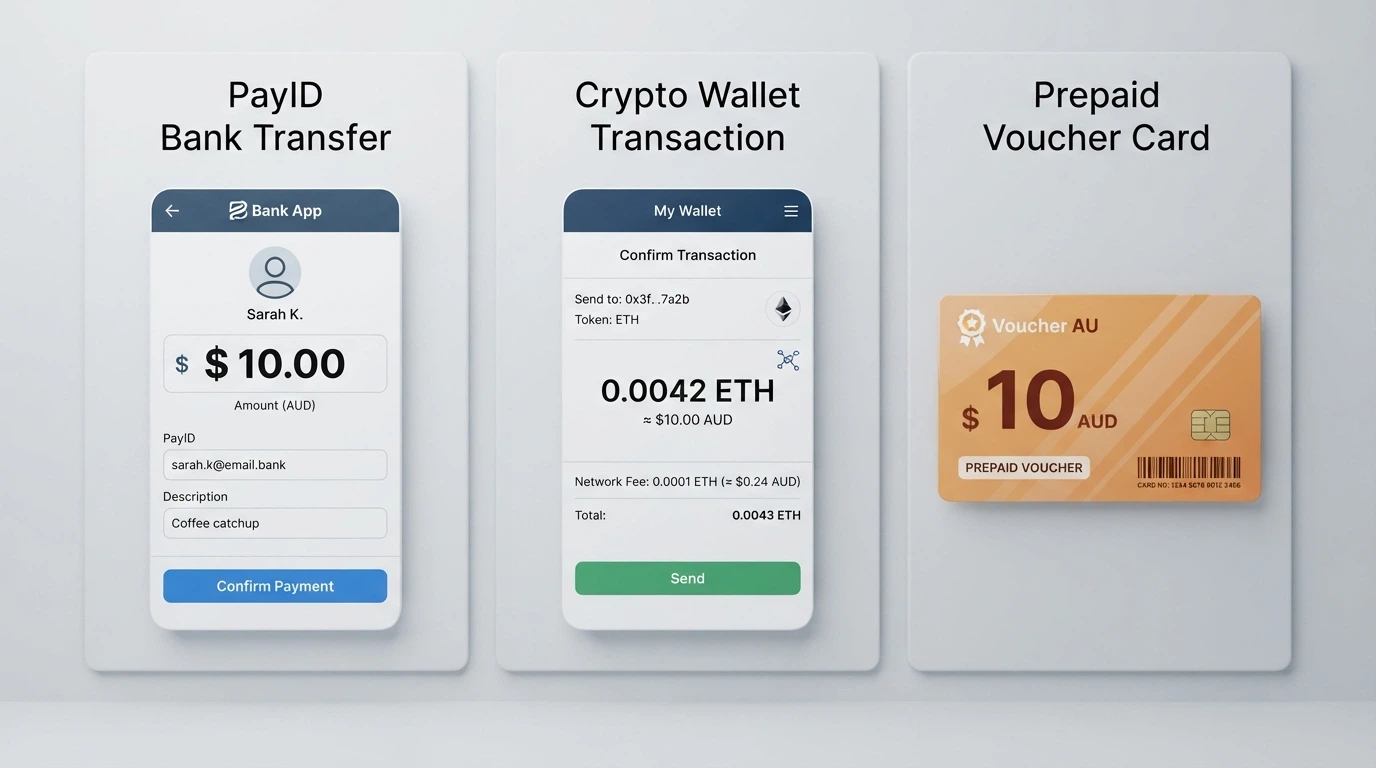
The crypto edge is where the headline number actually lives. Stake takes roughly A$0.10 in BTC-equivalent, BC.Game about A$1 in USDT, Bitcasino.io near zero — all of them in crypto, all of them subject to network fees, and all of them requiring the player to own crypto first. The crypto rail drops the floor by an order of magnitude, but it adds an exchange, a wallet and a network confirmation into the workflow. For a first-timer, the fiat A$10 floor is the lower friction, even if it is the higher nominal minimum.
Real-Money Play on a Near-Zero Deposit
A A$10 balance is, in real-money terms, a small float. On a title like Avalon, with a minimum bet of A$0.20, the bankroll buys fifty spins before it is gone. On a A$0.01 title, the same A$10 buys a thousand spins — but the variance profile of a near-zero stake session is brutal, because the wins scale with the stake and the rare-feature triggers hit on a stake-adjusted probability curve. A pokie’s RTP is a long-run return over thousands of spins; on fifty spins, the realised return can be anything from zero to a six-times-the-stake hit on a single line.
For a punter with a real-money bankroll under A$50, the case for low-deposit play is that the deposit risk is capped. The case against is that a small balance will not clear a welcome bonus, because no welcome bonus research has surfaced has a wagering multiple so loose that A$10 in play meets the turnover. The A$10 deposit is a real-money session, not a bonus-clearing campaign. Reading it that way is the difference between a session that returns the cost of a coffee in entertainment and a session that chases losses the bonus is requiring the player to risk.
The “No Minimum Withdrawal” Variant — What It Promises vs What It Delivers
“No minimum withdrawal” runs in parallel to “no minimum deposit” on the same offshore cashier pages, and the gap between the claim and the cashout is wider than the deposit side. A no deposit bonus at an Australian-facing casino typically pays 20 to 100 free spins on registration, with wagering of 30x to 50x, and a maximum withdrawable winnings cap of A$50 to A$100. The headline is free play. The fine print is a hard ceiling on what the free play can ever return.
Even at a brand with no formal withdrawal minimum, the processing window turns small cashouts into a bad trade. A A$20 withdrawal on a wire or e-wallet that takes 48 hours to clear, against a cashier that has to process it manually, against a payment provider that may charge a flat fee, is functionally a wash — and a punitive one if the player had to clear a bonus to reach the cashout. The no-deposit bonus is not a gift; it is a small gambling session priced at a small withdrawable ceiling. A reader who treats it as the latter is not missing out on a deal, because there is no deal to miss.
The Route That Exists Inside the Licensed Australian Market
There is no licensed online casino in Australia. There is a licensed online wagering market, and it is the only product the IGA permits to be provided online. The large operators — Sportsbet, bet365, Ladbrokes and around fifty other brands — hold Northern Territory Racing and Wagering Commission licences, with terms of up to twenty years, administered through Licensing NT. They offer sports betting, racing, totals and exotics, all pre-event. They do not offer pokies, blackjack, roulette or live-dealer casino games, because the IGA forbids those products online.
The product gap is the reason a player who searches for “no minimum deposit casino” lands offshore. The licensed market, by law, has no casino product to sell. Point-of-consumption tax at 10–15% of net wagering revenue and the NT’s 5% wagering tax on wagers minus payouts fund the regulator and the harm-minimisation infrastructure (BetStop, the helpline, the ad rules) that the offshore market does not pay for. The licensed alternative is a different product — betting, not casino — and a reader who has decided they want casino play has, in the legal sense, decided they want a product the Australian market is not permitted to sell.
Best No-Minimum-Deposit Casino Sites for Australians in 2026
The ranking below is built on what a low-deposit Australian punter actually decides between: real minimums, real bonus terms and the unfakeable fact of being offshore and unlicensed. The methodology was a single pass over market-share data and operator terms pages, with priority given to brands whose deposit floors and wagering terms research could verify. “Best” here means lowest friction at the cashier and clearest published terms — not licensed, because none of them are. The licence column reads the same for every row, and that is the central fact of this market.

| Casino | Welcome Bonus | Min Deposit | Wagering | Licence (AU) |
|---|---|---|---|---|
| Rocket Play | 100% up to A$1,000 + 100 FS (1st), 200% up to A$1,000 (2nd) | A$10 | 30x–40x | Offshore — no AU licence |
| Skycrown | 450% up to A$8,000 + 400 FS across 4 deposits | Varies by tier | 40x bonus & FS | Offshore — no AU licence |
| Royal Reels | 100% up to A$500 / 75% up to A$750 / 100% up to A$1,250 + 50 FS | — | 35x bonus only | Offshore — no AU licence |
| Stake | — | ~A$0.10 BTC / ~A$5–A$6 USDT | — | Offshore — no AU licence |
| FairGO | 100% up to A$200 | A$10 | 30x | Offshore — no AU licence |
| WinSpirit | — | — | — | Offshore — no AU licence |
| Rainbet | — | — | — | Offshore — no AU licence |
| Scream Casino | — | — | — | Offshore — no AU licence |
| Bizzo Casino | — | — | — | Offshore — no AU licence |
| Rocket Casino | — | A$15 (PayID) | — | Offshore — no AU licence |
Em dashes mark fields research could not verify this run. Where the cashier and the bonus terms matter to a decision, the gaps are exactly what the player should not deposit before checking.
Rocket Play
Rocket Play sits at the A$10 entry point with a two-deposit welcome package totalling up to A$2,000: a 100% match up to A$1,000 plus 100 free spins on the first deposit, and a 200% match up to A$1,000 on the second. The headline is the deposit ceiling; the barrier is at the bottom, at A$10 via PayID. The 30x–40x wagering requirement on the bonus is in the ordinary offshore range, neither gentle nor punitive against the wider market, and the Curacao-licensed offshore basis is the same as the rest of the table. There is no Australian licence, and there is no BetStop coverage. The brand is a good fit for a punter who wants a flat 30x–40x clearing path and a free-spin element on the first deposit, and a poor fit for anyone treating the bonus as a route to withdrawable cash — the 30x–40x turnover on a A$1,000 match is a A$30,000–A$40,000 playthrough before any bonus-derived funds become withdrawable.
Skycrown
Skycrown’s four-part welcome package carries the largest headline match in the table: 450% up to A$8,000 plus 400 free spins across four deposits, with 125 of the spins on Wolf Treasure by IGTech on the first deposit. The 40x wagering applies to both the bonus and the free-spin winnings, and it is the highest in the table alongside Rocket Play’s upper bound. A A$1,000 first-deposit match at 40x is a A$40,000 playthrough requirement, and that is before the second, third and fourth deposits compound the figure. Skycrown suits a player who actually intends to deposit through all four tiers and chase the headline figure, not a player looking for a small clear. The math only works at scale, and at scale the math is the same arithmetic the table exposes on every other row: the bonus is the bait, the turnover is the cage.
Royal Reels
Royal Reels is the most data-rich entry in the set, and the most transparently published. The welcome structure runs three deposits — 100% up to A$500, 75% up to A$750 and 100% up to A$1,250 — totalling A$2,500 plus 50 free spins at a fixed A$0.20 stake. Wagering is 35x on the bonus only, with a A$5 per-spin cap during the clear-down, which is the kind of term players can plan around. The library of roughly 1,400 pokies out of 1,800 total titles pulls in Pragmatic Play and Play’n GO, and the operator publishes a 96.4% average RTP across its top 50 most-played pokies. That number is rare in this market and worth more than most of the bonus figures on this page. Royal Reels is the cleanest pick in the table for a player who reads terms first and bonus headlines second; it is still offshore, still outside BetStop, and still carries the same consumer-protection absence as every other row. The reading is “cleanest of a bad set,” not “good.”
Stake
Stake is the genuine micro-deposit leader. The minimum real-money deposit at any AU-facing offshore casino, as research could verify, is roughly A$0.10 in BTC-equivalent at Stake, with USDT deposits from around A$5 to A$6 in total cost. The rail is the reason: crypto carries fractions of a unit where fiat does not, and the casino-side minimum is dictated by what the network can clear, not what the cashier can set. Welcome bonus, wagering, free spins and game providers were not surfaced this run, and the gaps in the table are honest gaps rather than an editorial choice to omit. The fit is the punter who already holds crypto, who values a sub-dollar entry over a bonus package, and who understands that they are still on an offshore Curacao-licensed site with no Australian consumer protection. For that reader, Stake is in a class of its own; for a punter without a wallet and an exchange, the A$0.10 figure is theoretical, not reachable.
FairGO
FairGO is the simplest entry in the set. A 100% match up to A$200, 30x wagering and a A$10 minimum deposit, on an RTG (RealTime Gaming) library. The narrowness of the provider list is the trade for the modest welcome: RTG is a single studio, and the catalogue is not the 1,400-pokie scale of Royal Reels. For a punter who plays one or two familiar RTG pokies, that is a feature, not a limitation. The 30x wagering is the lowest in the table, and the A$200 ceiling caps the bonus exposure at A$6,000 of playthrough — a fraction of the A$40,000+ the larger bonuses at the top of the table require. FairGO suits the player who wants a small, clean welcome and does not need a 1,400-pokie library to feel entertained. It does not suit a player looking for a varied live-dealer floor.
WinSpirit
WinSpirit is in the set because one verified datum surfaced: e-wallet payouts land in under 24 hours. Welcome bonus, minimum deposit, wagering and game providers were not confirmed this run, and the entry is a placeholder built around the one data point the search results did carry. The honest read for a player: a brand whose payout speed is competitive and whose headline terms are not visible without an account. That is not a recommendation to deposit; it is a flag that the most consequential terms on a casino page — the bonus, the floor, the turnover — are not visible before sign-up, and that is the precise kind of brand a low-deposit punter should treat with caution. A reader who has decided to look at WinSpirit should read the cashier and the bonus terms before sending a dollar, and should not let the under-24-hour payout be the reason to skip that step.
Rainbet
Rainbet is in the set on AU market-share data — 1.28% of tracked Australian traffic — and nothing else. Welcome bonus, minimum deposit, wagering and game providers were not confirmed. The honest read is the same one WinSpirit earns: a brand with an Australian audience and no published terms visible in research, which is the single most concrete red flag in a low-deposit market where eight of fifteen brands surveyed have been found to quietly raise the minimum for welcome-bonus eligibility above the headline floor. A 1.28% market share means Rainbet has players; it does not mean Rainbet has terms a player can read before signing up. Skip the deposit until the cashier, the bonus and the wagering are visible on the public pages.
Scream Casino
Scream Casino carries 0.99% of AU tracked traffic and the same missing-term profile as Rainbet: no confirmed welcome bonus, no confirmed minimum deposit, no confirmed wagering, no confirmed game providers. The market-share figure is the only thing a reader can verify from the outside, and it is the kind of figure that tells a player the brand exists without telling them what the brand is. A punter in a market that is entirely offshore and entirely outside Australian consumer protection has no business depositing with a brand whose own terms are not visible. The market-share data is not a recommendation; it is a reason to look elsewhere in the set where the cashier is at least visible.
Bizzo Casino
Bizzo Casino is a known name in AU-facing offshore circles, and 0.57% of AU tracked traffic is the only verified datum this run surfaced. Like Rainbet and Scream Casino, the operator-specific fields — bonus, minimum deposit, wagering, providers — are unconfirmed. The honest read for a reader comparing this set: a brand with name recognition and no terms visible from outside the sign-up flow. That is not unique to Bizzo; it is the pattern for half the table, and the pattern is the reason the early rows carry more detail than the later ones. Treat Bizzo the way the entry says it: a known name without refreshed data, and a brand to verify before depositing.
Rocket Casino
Rocket Casino has the single confirmed data point that earned its slot: a A$15 minimum deposit via PayID. The A$15 is the highest verified fiat floor in the set, and it sits alongside 0.57% of AU tracked traffic and no other confirmed terms. The fit is narrow: a punter with a PayID-capable bank account, comfortable with a A$15 entry rather than the A$10 floor most of the table offers, and willing to read the bonus and wagering inside the sign-up flow before sending the deposit. For a player optimising for the lowest entry, Rocket Casino is the wrong pick; for a player who has decided on PayID and accepts a slightly higher floor, it is one option among many. None of this changes the offshore-and-unlicensed status, which is the same on this row as on every other.
Pokies, Slots and the Games You Can Play on an A$10 Deposit
The pokie catalogue at an AU-facing offshore casino is, in the low-deposit set, dominated by Microgaming and its Games Global rebrand. Royal Reels carries roughly 1,400 pokies out of 1,800 total titles, with Pragmatic Play and Play’n GO the named providers. Stake and the crypto-first set pull a wider studio list. Most titles in the Microgaming-led catalogue run at RTPs between 96% and 96.5%, with a small number of high-profile progressive titles sitting well below that. A A$10 deposit at A$0.20 a spin is fifty spins, and fifty spins is a single low-volatility session rather than a clear-down campaign.

The numbers that matter on a small balance are stake-adjusted volatility, RTP and feature frequency. A 96.5% pokie at A$0.20 returns a long-run A$0.193 per spin, before any feature multiplier; an 88.12% progressive title returns A$0.176 per spin, with the rare-but-large jackpot the trade-off. For a low-deposit punter, the arithmetic favours titles at the upper end of the RTP range, because the absolute stake cannot afford the variance of a lower-RTP session. The published RTP figures below are the ones research verified, and the column the player should read first.
Pokies Titles with Published RTPs — What the Numbers Actually Mean
| Title | RTP | Provider | Volatility | Reels/Paylines | Min–Max Bet (A$) |
|---|---|---|---|---|---|
| Mega Moolah | 88.12% | Microgaming | Medium | 5×3, 25 | — |
| Avalon | 96.01% | Microgaming | Medium | 5 reels, 20 | 0.20–200 |
| Agent Jane Blonde | ~96.1% | Microgaming | Medium | 5 reels, 9 | 0.01–45 |
| Gold Mine | 96.5% | Microgaming | Medium | 5 reels, 20 | 0.20–10 |
| Shogun of Time | 96.02% | Microgaming | Medium | 243 ways | — |
| Bear Money | 96.50% | Microgaming | Medium | 5 reels, 10 | 0.10–60 |
The spread from 88.12% to 96.50% is the spread the page is built on. A session on Mega Moolah at A$0.20 over fifty spins costs the player roughly A$1.19 in expected house edge per spin’s worth of play, against A$0.35 on Bear Money. The progressive title’s appeal is the multi-million-dollar jackpot, and the cost is the eight-point gap in RTP; for a punter whose bankroll will not see the jackpot-triggering spin, the math is working against them every spin. The 96%-and-up titles do not promise a win, but they do not charge a premium for the chance of one. On a A$10 bankroll, that is the only edge the player can choose.
Casino Table Games and Beyond the Reels
Table games and live-dealer tables make up the rest of a Royal Reels-scale catalogue, and the rest is around four hundred titles out of the 1,800 total. Blackjack at most offshore casinos runs an RTP in the high 90s when basic strategy is applied; roulette sits lower; baccarat is comparable. The minimum-stake table for a low-deposit punter is the live-dealer floor’s lower end, where A$1 per hand blackjack exists at some studios and A$0.10 per spin roulette exists at others. The constraint on a A$10 deposit is not the availability of low-stake tables — it is the bankroll’s half-life. At A$1 per hand, a blackjack session is ten hands before the float is gone, and a streak variance of four or five hands in either direction is the difference between an evening’s play and a five-minute session.
The library beyond the reels is the reason a punter with a real-money bankroll under A$50 is better off at a title with a published RTP in the 96% range than at a progressive or live-dealer table with a higher minimum. The math is not on the player’s side at any stake; the math is least on the player’s side at the bottom of the RTP table.
How to Deposit Less: The Payment Methods That Set the Real Floor
The deposit floor is the payment method’s floor, dressed up as the casino’s floor. PayID and bank rails sit at A$5–A$10 across the market, with the A$10 figure the more common one and a “no minimum” label a piece of marketing copy. Neosurf and card deposits sit at A$10–A$20+, with Neosurf’s A$5 voucher EU-only and unavailable to Australian players. Crypto deposits range from roughly A$15 to A$30 once network fees are included, except where the rail itself drops the floor — BTC fractions at Stake, USDT on TRC-20 at the budget end of BC.Game. The method a punter picks is the minimum a punter pays.
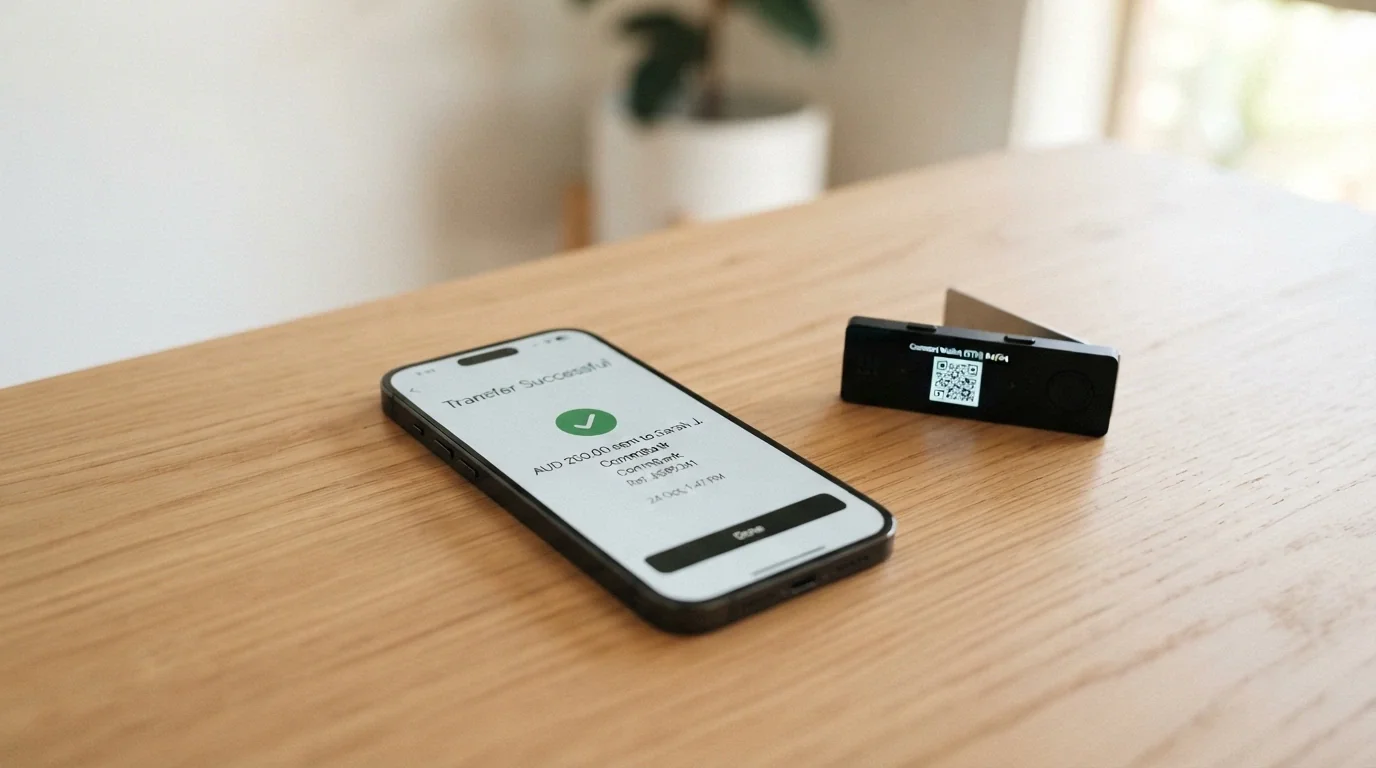
| Method | Typical Min (A$) | Fee | Notes |
|---|---|---|---|
| PayID / Osko | 10 | 0 | Fee-free at both ends; floor set by casino, not bank |
| Neosurf | 10–20+ | 0 | A$5 voucher is EU-only; AU Neosurf starts at A$10 |
| Card (Visa/Mastercard) | 10–20+ | 0 at most brands | Some issuers treat gambling as cash-advance; check with bank |
| BTC | ~0.10+ | Network fee (variable) | Lowest real-money floor; needs wallet and exchange |
| USDT (TRC-20) | ~1–6 | Under A$0.30 | Practical low-deposit crypto rail |
| USDT (ERC-20) | ~5+ | Over A$2 | Ethereum gas makes small deposits uneconomic |
| Bank transfer | 10–30 | 0 at most brands | Slower than PayID; same floor |
The TRC-20 versus ERC-20 split is the under-appreciated line in the table. USDT on TRC-20 carries a network fee under A$0.30; USDT on ERC-20 carries a fee that can clear A$2. A punter choosing a A$5 USDT deposit on ERC-20 is paying 40% of the deposit to the network before a spin is placed. The same A$5 on TRC-20 is a A$4.70 deposit. The crypto edge that lets the floor drop below A$5 only holds on a network where the fee does not eat the floor.
PayID and the A$10 Floor
PayID is the default low-deposit rail for Australian punters — instant, fee-free, supported by every major bank. The A$10 floor is the casino’s, not the bank’s: the PayID/Osko system itself accepts transfers from A$0.01, but the AU-facing offshore casinos have raised the cashier minimum to A$10 to keep anti-fraud and payment-processor costs manageable. A reader who wants to deposit A$5 by PayID is asking the casino to waive a floor it has set for an operational reason, and the casinos that advertise “no minimum” are still showing A$10 at the cashier.
The fee-free angle is real: PayID is fee-free at the bank and at the casino, with no interchange and no merchant markup. For a punter who already has a bank account, PayID is the lowest-friction rail. The cost is the floor. A reader who genuinely wants a sub-A$10 deposit is reading about the wrong rail, and the rail that does let them in is crypto, with the exchange and the wallet that crypto requires.
Crypto Deposits: The Only Route Below A$5
Bitcoin and USDT on TRC-20 are the only rails that put a real-money deposit below a dollar. Stake takes A$0.10 BTC-equivalent at the cashier; BC.Game accepts about A$1 USDT; Bitcasino.io runs near zero. The trade is workflow. A first-time crypto depositor needs an exchange account, a wallet, a verification flow and a network confirmation — and the network confirmation is the part that decides whether the deposit is “instant” or “eventually.” On BTC, ten minutes is the floor. On TRC-20 USDT, sixty seconds is normal. On ERC-20 USDT, minutes to an hour, and a fee that can eat a small deposit whole.
The Australian legal status of crypto is the second trade. Credit cards, credit-related products and digital currency (crypto) are banned as payment for online wagering since 11 June 2024 under the Interactive Gambling Amendment (Credit and Other Measures) Act 2023, with penalties for non-compliance up to A$247,500. The ban binds licensed Australian wagering operators. Offshore casinos are not bound by it, and an Australian punter who deposits crypto at Stake is not committing an offence — the law targets the provider, not the player. The trade for the player is still real: the rail is one the Australian regulator has flagged as a harm vector, and the rail is the only one that opens the floor below A$5.
Is It Legal? The Offshore Reality Every Australian Player Needs to Know
Online casino is prohibited in Australia. The Interactive Gambling Act 2001 makes it an offence to provide online casino games, online pokies and in-play sports betting to a person in Australia. There is no licence for any of it — not federally, not in any state or territory. Every site that claims to be a no minimum deposit casino is an offshore operator, and the Australian Communications and Media Authority has had 1,564 illegal gambling and affiliate sites blocked at the ISP level since November 2019. The individual player is not prosecuted under the IGA; the player gives up Australian consumer protection, ACMA complaints recovery, BetStop coverage and any recourse if the operator refuses a withdrawal.
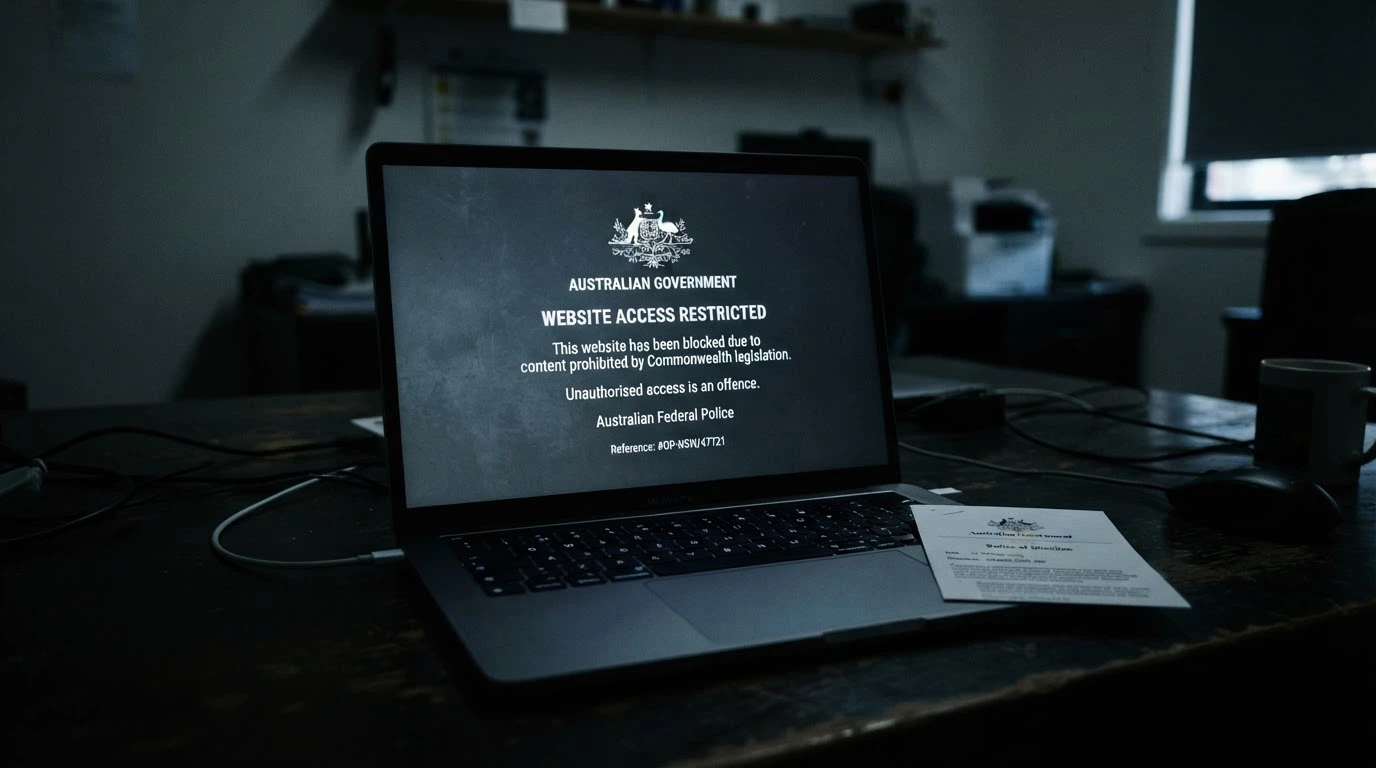
The licensed alternative is the licensed wagering market — sports and racing, pre-event, under state and territory licence. The product gap is what creates the offshore pull: there is no licensed online casino to choose. A punter who wants casino play is choosing between staying onshore and not playing casino, or going offshore and accepting the loss of every Australian safeguard. The legal reality is not a warning a reader has not heard before; it is the structural fact this market is built on, and the rest of this page is read most clearly with it in view.
What Changes on 1 January 2027 — The Reform That Is Already Law
The Interactive Gambling Amendment (Gambling Reform) Bill 2026 passed Parliament on 19 August 2026, and its measures commence on 1 January 2027. The bill is law with a start date — passed, not binding yet, and not speculative. From that date, banks and payment providers gain express authority to block transactions to illegal gambling operators. Advertising is capped at three wagering ads per hour between 6:00 am and 8:30 pm, with a live-sport blackout from fifteen minutes before to five minutes after a live event. Broadcasting of sporting odds is banned outright. Athletes, celebrities and influencers are barred from promoting wagering products.
The direct-marketing rules are the consequential change for a low-deposit punter. Inducements are prohibited for 14 days after sign-up, and for three months after a person deregisters from BetStop. AdStop — a national wagering advertising opt-out register, administered by the ACMA — gives individuals a single mechanism to opt out of wagering advertising across online platforms, funded by a cost-recovery levy on wagering companies. None of this binds offshore casinos, which is the point that makes the reform a partial answer to a question it does not fully resolve. The licensed side tightens. The offshore side is unchanged. A punter reading this page is on the offshore side.
BetStop and the Offshore Blind Spot
BetStop — the National Self-Exclusion Register — had 67,480 registrations as at 31 July 2026, with 41,290 exclusions still active. 78% of registrants are under 40. 38% chose lifetime exclusion. One registration excludes a person from every Australian-licensed online and phone wagering service. It does not exclude them from any casino on this page. BetStop binds Australian-licensed services only; offshore casinos are not connected to the register and will keep accepting a self-excluded person’s money.
The harm this creates is concrete. A person who has recognised their own gambling as a problem and taken the step of registering with BetStop has closed one door and left the other open. The offshore casino they were using before the registration continues to operate, continues to send bonuses, continues to take deposits. The reform bill tightens the inducement rules on the licensed side and adds the bank-blocking power, both of which are net positives. It does not close the offshore door. A self-excluded punter reading this page is the audience most exposed to that gap.
Staying in Control: Deposit Limits, Help Services and the Real Numbers
About 2.1% of Australian adults — roughly 430,000 people — experience problem gambling, with high-risk gambling at 1.8% per the Australian Institute of Health and Welfare in 2022. One million Australians either suffer from, or live with someone suffering from, severe gambling harm. The figures are not in this page to make the case against playing; they are in this page because a low-deposit cashier does not make a player a low-risk one, and the help infrastructure is one section of the page a reader should not have to search for.
The National Gambling Helpline is 1800 858 858, free, confidential, staffed 24/7, with online chat and counselling through Gambling Help Online. BetStop is the binding self-exclusion register for every Australian-licensed wagering service. The two together are the licensed-side safety net; the offshore side has neither, and that is the structural fact a low-deposit punter has to plan around.
The Tools That Actually Work — and the Ones That Do Not
Offshore casinos offer deposit limits, session timers, reality checks and self-exclusion — the standard responsible-gambling suite. They are voluntary. There is no Australian enforcement behind a deposit limit a punter has set on an offshore site, and there is no Australian enforcement behind a self-exclusion the same punter has asked the offshore site to honour. The site can honour both, and the better-run ones do, but the choice to honour them is the operator’s, not the regulator’s.
The contrast is BetStop, which is binding on every Australian-licensed wagering service, and which a punter cannot override by opening an account at a new bookmaker. The licensed regime is the one that works. The offshore regime is the one that asks the punter to trust the operator. For a punter who has decided to play offshore anyway, the practical move is to set a deposit limit on the first day, not the day the limit becomes necessary, and to call the helpline at the point the limit is no longer enough. The number is 1800 858 858, and it is free.
The 2027 Inducement Safety Net — Who It Reaches and Who It Misses
From 1 January 2027, licensed Australian wagering providers will be required to identify customers showing signs of problem gambling — escalating expenditure, unusual hours, failed deposits — and to cease sending those customers inducements. The reform is a substantive step, and it binds the licensed market. It does not bind any of the casinos on this page. Offshore operators are not subject to the at-risk customer identification requirement, do not face the inducement-cessation obligation, and are not connected to BetStop or the AdStop opt-out register.
The practical effect for a low-deposit punter playing offshore: the safety net that closes around them on the licensed side does not extend to the cashier they are using. The 14-day post-signup inducement ban does not apply. The three-month post-BetStop-deregistration cooling-off does not apply. The inducement-cessation obligation does not apply. The Australian reform is a real improvement, and it is also a reform that does not reach the players it most needs to reach. A reader of this page who wants both casino play and the safety net is reading about a market where, in 2026, both do not exist in the same place.
How We Evaluated These Casinos
The ranking was built on three layers of input: market-share data for AU tracked traffic, the Australian Communications and Media Authority register for legal-status checks, and the operator terms pages and review-site sweeps for the bonus, minimum-deposit, wagering and game-provider data the table carries. The market-share data is for selection only, not for the published ranking. The legal-status check returned the same answer for every row — offshore, no Australian licence — and that is the single column that does not vary. The operator-specific data is uneven: brands 1 through 5 in the ranking (Rocket Play, Skycrown, Royal Reels, Stake, FairGO) have terms research could verify, and brands 6 through 10 (WinSpirit, Rainbet, Scream Casino, Bizzo Casino, Rocket Casino) do not.
The gaps are flagged in the table with em dashes and in each operator block with a one-line note. The honest read of a half-empty row is that the brand’s headline terms were not visible in research this run, and that a punter who deposits before reading the cashier and the bonus terms on the brand’s own pages is making a decision without the data the decision needs. The audit trail for this is the research file; the brands have not been weighted against each other on invented criteria, and the ranking is not a score — it is the order in which the entries surfaced as the market’s most data-rich and most readily comparable. The two sweep queries that would have refreshed the missing data failed during the research pass, and the gaps are what those failures left behind.
What Low-Deposit Casino Play Actually Costs You — and Whether It Is Worth It
The arithmetic of a welcome bonus, on a small deposit, is the part of this market that the marketing copy works hardest to keep the reader from doing. A A$500 bonus at 35x wagering, on a 96.4% RTP pokie catalogue, requires A$17,500 of turnover before the bonus-derived funds become withdrawable. The expected loss on that turnover, assuming the 96.4% return figure is the realised return, is A$17,500 multiplied by the 3.6% house edge, which is A$630. The expected loss is larger than the bonus itself. A player who clears a A$500 bonus on those terms has, on average, paid A$130 more than the bonus paid them. The bonus is not a gift; it is a sale, and the price is paid in the playthrough.

The same arithmetic on a A$10 deposit tells a different story. A A$10 deposit is not a bonus-clearing campaign. It is a session — fifty spins at A$0.20 on a 96.4% title, with an expected house edge of A$0.18 across the session, against a chance of a feature-triggered return that can outrun the average. The expected loss is real; the variance is wider than the average; and the session will end, for most players, somewhere close to zero. A punter who treats the A$10 deposit as entertainment bought at a known price is reading the offer correctly. A punter who treats it as a step toward clearing a bonus is reading it as the marketing copy wants it read.
The licensed Australian alternative for a punter who wants consumer protection is not a casino — it is a wagering account. Sportsbet, bet365, Ladbrokes and the rest of the NT-licensed bookmakers offer pre-event sports and racing betting with deposit limits, BetStop coverage, ACMA complaints recovery, the inducement rules from 1 January 2027, and the helpline behind them. The product is not casino. A reader who has decided they want casino play has, in the legal sense, decided they want a product the Australian market is not permitted to sell, and the rest of the choice is which offshore site carries the smallest combination of bonus cost, withdrawal friction and consumer-protection absence. The honest read: low-deposit offshore play makes sense as a paid entertainment session with a hard ceiling, and it does not make sense as a route to withdrawable winnings. The arithmetic says so on every bonus on the table.
Frequently Asked Questions
What is the difference between a no minimum deposit casino and a no deposit bonus?
A no minimum deposit casino is a casino whose cashier accepts the lowest amount the payment method will process — for fiat, that is A$10 via PayID or Neosurf, for crypto it can be a fraction of a cent. A no deposit bonus is a free-play offer, typically 20 to 100 free spins on registration, with 30x to 50x wagering and a maximum withdrawable winnings cap of A$50 to A$100. The two phrases are not the same product; one is a deposit floor, the other is a free-spin bundle. A A$10 deposit at a “no minimum” casino is a deposit; a no-deposit bonus is a free spin. The first commits the player’s own money; the second commits the casino’s free-play budget and caps the winnings on it.
What happens if an offshore casino refuses my withdrawal in Australia?
There is no Australian consumer protection to appeal to. The IGA targets the provider, not the player, and the ACMA does not adjudicate withdrawal disputes at offshore sites. A player whose offshore casino refuses a withdrawal can try the operator’s internal escalation, the Curacao or Malta licensor (depending on the brand), and a chargeback through the card issuer if a card was used. The Australian route — ACMA complaints recovery, the state regulator, the Australian Financial Complaints Authority — is not available, because the offshore site is not under any Australian regulator. This is the central trade-off of the offshore route, and it is the reason the IGA’s prohibition is the structural fact this market is built on.
Is BetStop connected to offshore online casinos?
No. BetStop — the National Self-Exclusion Register — binds Australian-licensed wagering services only. An offshore casino is not connected to the register and will keep accepting a self-excluded person’s money, sending bonuses, and processing deposits. The 67,480 BetStop registrations as at 31 July 2026 cover every licensed wagering service in Australia; they cover none of the brands on this page. The reform from 1 January 2027 adds at-risk-customer identification and inducement cessation on the licensed side; it does not extend BetStop coverage to offshore operators. A self-excluded punter who plays at an offshore casino is not protected by their BetStop registration.
Can I use PayID or crypto to deposit without a minimum at an Australian casino?
PayID deposits at AU-facing offshore casinos carry a A$10 floor, even at brands that advertise “no minimum.” The PayID/Osko system itself accepts smaller amounts, but the casino-side minimum is the floor a punter faces. Crypto is the rail that drops below A$5: roughly A$0.10 in BTC at Stake, around A$1 in USDT at BC.Game, near zero at Bitcasino.io. The trade is workflow — an exchange, a wallet, a network confirmation, and the fee schedule (TRC-20 under A$0.30, ERC-20 over A$2). A punter without crypto and an exchange cannot reach the sub-A$10 floor, and PayID will not get them there.
Why do casinos advertise “no minimum deposit” when they actually have minimums?
Because the phrase sells a softer experience than the cashier delivers. A “no minimum deposit” label on a landing page is a marketing claim that the floor is low, not that the floor is zero. The cashier at the same brand will show A$10 by PayID, A$20 by card, and a higher crypto equivalent once fees apply. The phrase is the clickbait; the cashier is the product. The reason the gap is allowed to stand is that the brands running the claim are offshore, outside the Australian Advertising Standards and the ACMA’s misleading-conduct reach, and the page a player lands on is the page the search results reward with traffic. The clickbait is not illegal; it is just not what the page says.