
Real money pokies on Android in Australia: what is actually legal, what is not, and what the search results do not say
The first thing an Australian Android user notices when they search for “real money pokies” is how clean the results look. Lists of recommended apps. Comparison tables. Free-spin counts. The second thing they notice — usually a moment later — is that every Play Store link takes them to a social casino where the coins are not money, and every “real money” option points at an operator with no Australian licence. The gap between what the search term promises and what the law allows is the reason this page exists.

As of 13 September 2026, this page was reviewed against the public guidance published by the Australian Communications and Media Authority and the Interactive Gambling Act 2001.
Table of Contents
- Real money pokies on Android — why the search results don’t tell you the full story
- Australian-licensed apps vs offshore pokies sites — the difference that keeps your money safe
- How pokies actually reach your Android phone — browser, APK and the setup that works
- Free pokies on Android — the no-risk way to play without spending a cent
- Aristocrat — the Australian pokies giant and its most-searched mobile title
- The offshore operators targeting Australian Android players — ranked and compared
- Australian pokies law — what the Interactive Gambling Act means for the app on your phone
- Staying in control — the tools, limits and warning signs every Android player needs
- How we selected and ranked the operators on this page
- What you should actually do next — the safer path through Australian pokies on Android
- Frequently asked questions
Real money pokies on Android — why the search results don’t tell you the full story
The phrase “real money pokies Android Australia” pulls together three ideas that the Australian market does not actually combine in a single product. A real-money wager. A pokies-style slot game. A way to reach it from an Android handset inside Australia’s borders. Each of those exists, but the licensed combinations are narrow: an Australian-licensed wagering app may offer real money on races and sport, never on casino-style slots; an offshore casino site may offer real money on pokies, but it does so without an Australian licence and outside the protections that licence would carry; the Google Play Store, meanwhile, is full of pokies-style apps that look like the real thing but are free-to-play social casinos with no real-money withdrawal at all.
What an Australian Android user sees when they search is, in the main, a curated set of offshore sites that have no Australian licence. They are marketed as if they were ordinary consumer products. They are not. The ACMA has put it plainly: “Online casinos are illegal in Australia. They are not licensed or regulated and they are not safe.”
What “real money pokies” actually means on an Android phone in Australia
To an Australian reader the term is intuitive: slot machines you can play on a phone for actual cash stakes. Real-cash wagers on reel-style games, with the chance of a withdrawable payout. The legal picture turns that intuition on its head. The Interactive Gambling Act 2001 makes the provision of online casino games and online pokies to anyone physically in Australia an offence. The player is not the target of the law — the provider is — but the product the player is looking for is, by statute, illegal to offer here.
That is why the Play Store shows nothing but social casino apps under “pokies”. Those apps are free-to-play by design: virtual credits, in-app purchases, no cash-out. They look and feel like the real thing because the same studios often build both versions. They are not, and never have been, real-money gambling products, and their presence in a search result does not contradict the law. The contradiction is in the “real money” part of the phrase, and it sits one layer below the surface.
App vs browser — why your Play Store search comes up empty for real-money play
The technical reason the Play Store search comes up empty is straightforward: real-money pokies on Android are universally delivered as browser-based HTML5 sites or, less commonly, as direct APK downloads distributed by the offshore operator itself. There is no native real-money pokies app on Google Play for Australian users, because Google Play’s content policies and the IGA point in the same direction.
What this looks like in practice: a player opens Chrome, types the operator’s URL, signs in, and plays. The reels render in HTML5, optimised for the screen, with touch-friendly spin buttons and a portrait-mode lobby. No install. No permissions. No app icon on the home screen. Some operators do offer an Android app file — an APK — sent by email or hosted on a download page. Sideloading an APK works on Android, but it bypasses Google Play Protect and the app-store vetting that comes with it. The convenience of an install is real; the security trade-off is also real, and the rest of this page returns to it.
The legal reality every player searching for pokies apps needs to hear first
Australia’s Interactive Gambling Act 2001 prohibits the provision of online casino games and online pokies to a person in Australia. That is the headline. Three things follow from it that matter to an Android player.
First, the law targets the provider, not the player. The IGA is enforced against operators who offer prohibited products to Australian customers — fines, civil penalties, criminal exposure, and the ACMA’s blocking powers. Individual players are not prosecuted for placing a wager on an offshore site. The legal risk sits on the supply side.
Second, the protection gap is wide. A wager placed with an Australian-licensed operator comes with responsible-gambling tools, dispute pathways, advertising limits, and BetStop self-exclusion. A wager placed with an offshore operator comes with none of those. If the operator withholds funds, closes the account, or simply disappears, the Australian player has no local regulator to complain to and no Australian consumer law to fall back on.
Third, the ACMA’s response is the visible signal that enforcement is real. As of 18 March 2026, the ACMA had blocked 1,564 illegal gambling and affiliate websites since November 2019, and over 225 illegal services have withdrawn from the Australian market since 2017. In a single 2026 directive, 12 additional sites — 7Signs, Freshbet, Wildsino among them — were blocked. The domains stop loading; the apps do not install cleanly. That is the practical reality an Australian player meets when one of these operators is added to the list.
Australian-licensed apps vs offshore pokies sites — the difference that keeps your money safe
Two product categories share the term “gambling app” on an Android screen, and only one of them is legal to provide in Australia. Australian-licensed wagering apps — TAB, Sportsbet, Ladbrokes, the racing and sports brands most Australians will already recognise — are built around betting on horse races, harness races, greyhound races, and sporting events, with lotteries and keno also permitted under the licensing framework. They are licensed at state and territory level, with the bulk of online wagering licences concentrated in the Northern Territory under the NTRWC. They are integrated with BetStop, the national self-exclusion register. They accept deposits through methods that comply with Australian law.
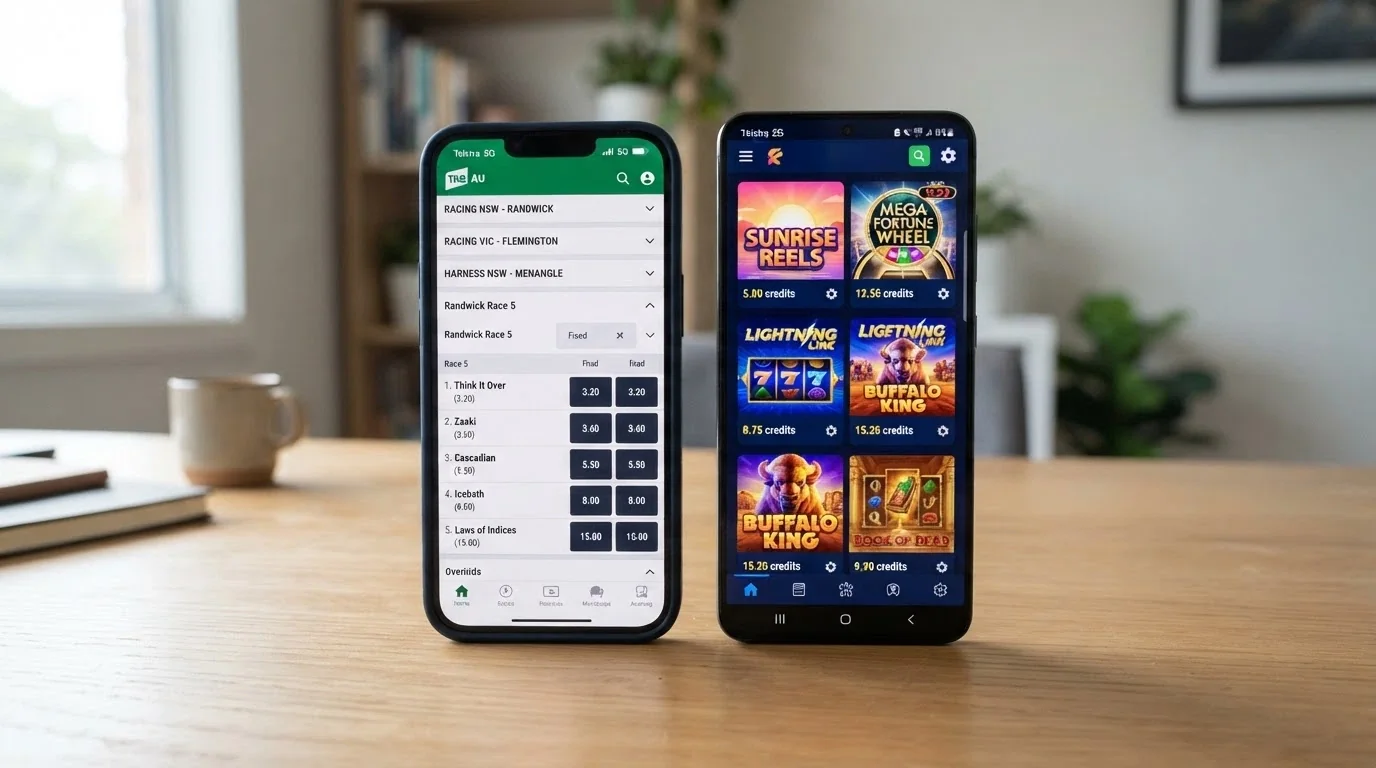
The pokies that an Australian searches for on Android are not part of any of those licences. Online casino games, online pokies, and in-play sports betting are the products the IGA specifically prohibits. So every operator that offers a real-money pokies lobby to an Australian customer is, by definition, unlicensed in Australia. The comparison between “licensed” and “offshore” is not a comparison between good and bad versions of the same product — it is a comparison between two different products, only one of which the law permits.
What a licensed Australian wagering app gives you — and the pokies-sized gap it leaves
An Australian-licensed wagering app does what its licence permits. It takes bets on races and sport placed before the event begins. It sells lottery entries through licensed lottery operators. It offers keno. It applies deposit limits at the level a player sets for themselves. It delivers activity statements on request. It integrates with BetStop so a player who has self-excluded cannot reopen an account or place a new wager through any other licensed channel. It is overseen by state and territory regulators — primarily Licensing NT — and is subject to Australian consumer law, dispute resolution, and advertising rules.
What it does not do is run a pokies lobby. The product gap is not a feature the licence forgot to enable; it is the licence’s central boundary. If a reader is searching for “real money pokies” specifically, the licensed Australian app does not have what they are looking for. That is a frustrating answer, but it is the honest one, and it shapes every other section of this page.
Five tell-tale signs you are on an offshore pokies site, not a licensed Australian service
A practical checklist for the player who is already on a site and wants to know whether they have wandered onto the wrong side of the law.
Payment method. Credit cards, credit-related products, and digital currency have been banned as payment methods for online wagering in Australia since 11 June 2024. If the deposit screen asks for a Visa or Mastercard number, or for a crypto wallet address, the site is not operating within Australian rules. That alone is enough to walk away.
Licence claim. A legitimate Australian wagering service will state its licence — usually Northern Territory — and link to a regulator. An offshore site will claim a Curaçao licence, an Anjouan licence, or sometimes nothing at all. The presence of a foreign licence is not by itself a crime; the offering of real-money pokies to an Australian customer under it is.
Product mix. A licensed Australian wagering service does not offer a casino lobby. If the site has slots, table games, and live dealer alongside racing markets, the operator is mixing products the IGA does not permit.
BetStop integration. Licensed services participate in BetStop; offshore sites cannot. If self-exclusion from every Australian-licensed service does not stop the site from taking your deposits, the site is outside the system.
Domain. Australian wagering operators overwhelmingly run on .com.au. Offshore operators run on .com, obscure country TLDs, or short vanity domains. The TLD is a small tell, but combined with the others it is reliable.
No Australian consumer protection — what you lose when you play outside the licensed system
The protection gap is not a slogan. It is a list of things that licensed Australian wagering services are required to provide and that offshore pokies sites are not.
BetStop is the most concrete. Live since August 2023, BetStop lets a player exclude themselves from every Australian-licensed online and phone wagering service in a single step. As at 31 July 2026, the register held 67,480 registrations with 41,290 exclusions still active. For someone who has decided to stop, BetStop is the one tool that closes every Australian door at once. Offshore sites are not part of it. They do not see the exclusion and they are not bound to honour it. Self-exclusion from the licensed system does not, on its own, exclude a player from the offshore pokies lobby they were already using.
The ACMA’s blocking power is the second gap. The regulator can order Australian ISPs to block access to illegal gambling domains, and has done so on a large scale — 1,564 sites blocked since November 2019, 225+ services withdrawn since 2017. That action removes the site from Australian view, but it does not compensate a player who has already lost money to an operator that subsequently disappears or refuses to pay. There is no Australian dispute resolution service that reaches into Curaçao.
Consumer law is the third gap. An Australian who is defrauded by an Australian-licensed operator can turn to the regulator, to AFCA-style dispute resolution, and to the Australian Consumer Law. An Australian defrauded by an offshore operator has none of those pathways in any practical sense. Domain blocking, formal warnings, and ACMA investigations are aimed at the operator, not at making individual players whole.
How pokies actually reach your Android phone — browser, APK and the setup that works
Every real-money pokies session on an Australian Android phone happens through one of two routes. Either the player opens a browser, navigates to an offshore casino site, and plays in HTML5 — this is the dominant path. Or the player downloads an APK directly from the operator, sideloads it onto the device, and installs it — this is the secondary path, used by operators whose apps are not available through Google Play and who want an app-shaped experience anyway.

Both routes lead to operators that do not hold an Australian licence. Both routes mean the consumer protections discussed in the section above do not apply. The mechanics of each are worth walking through, because the choice between them is not a matter of taste — it is a choice between two different security profiles.
Browser-based play — the setup that works on any Android without downloading a thing
HTML5 instant play is the default. A player opens Chrome — or Firefox, or Samsung Internet — types the operator’s URL, watches the lobby load, taps a game, and plays. No install. No permissions. No app icon cluttering the home screen. The reels render inside the browser viewport, scaled for the device, with portrait and landscape modes both supported on most modern Android builds.
The account flow is the same as on desktop. Email, password, the standard fields. Some operators allow login through a wallet-style SSO; most do not. Verification — submitting ID, proof of address, occasionally a source-of-funds check — is a separate step that most operators trigger at withdrawal rather than at deposit. From the player’s perspective, the setup is identical to signing up for any other online service.
For operators, the browser route has a structural advantage they rarely discuss with players: an HTML5 site cannot be blocked by app-store removal, because there is no app to remove. When the ACMA issues a blocking directive against the operator’s domain, the site goes dark at the ISP level for Australian customers. The operator then typically spins up a new domain, the ACMA blocks that, and the cycle continues. The browser is the medium because it is the most resilient one for the operator. That resilience is not in the player’s interest; it is in the operator’s.
APK downloads — why the direct-install route carries more risk than convenience
An Android APK is the package file the operating system installs. Normally a player never sees one — Google Play distributes and installs apps automatically, after a review process. APK sideloading is what happens when a player downloads the package file from somewhere else and installs it manually. The phone will ask for confirmation, the user accepts, and the app appears on the home screen.
The convenience of an APK is the app-shaped experience: a launcher icon, push notifications, a full-screen play mode, sometimes a slightly more responsive feel than the browser version. The risk sits in the same place. Sideloaded software does not go through Google Play Protect’s review. It does not get the continuous scanning that Play Protect applies to installed apps. It can request any permission the player grants at install time — contacts, storage, camera, microphone — and a player who taps through the permission prompts without reading them has handed the app a wide mandate. Casino-themed malware has historically been a vector for exactly this kind of sideload, and even where the operator’s APK is legitimate, the distribution chain is harder to verify than an app-store download. The honest summary: it works, and the security trade-off is steeper than the marketing suggests.
Account setup, depositing and the credit-card rule every Australian player needs to know
Offshore operators typically accept a mix of deposit methods that varies by operator but tends to include debit cards issued by some Australian banks, a handful of e-wallets, and increasingly cryptocurrency. What they do not accept, by law, is credit cards or credit-related products for Australian customers — that prohibition has been in force since 11 June 2024.
A site that asks an Australian player for a credit card number is not compliant with Australian law. That is not a fine-print point. It is the simplest single signal an Australian player has for the site’s status. Combined with the licence-footer check and the product-mix check from earlier in this page, the credit-card prompt is one of the clearest tells. Crypto is in the same boat: it has been banned as a payment method for online wagering under the same 2024 rules. An operator asking for a Bitcoin or USDT deposit is outside Australian compliance for the same reason.
The corollary is worth stating. A deposit method that the offshore site does accept — a debit card that the bank allows through, a permitted e-wallet, a bank transfer — is not a sign that the operator is legitimate. It is a sign that the operator’s payment screen has not yet been updated, or that the operator is willing to process Australian transactions through channels that the Australian banks tolerate without actively blocking. The legality of the wager itself does not depend on the deposit method; the deposit method is one tell among several, not a substitute for the others.
Free pokies on Android — the no-risk way to play without spending a cent
For players who want the pokies experience without the offshore-licence problem, free play is the answer that does not involve one. Three paths exist, all of them legal in Australia, all of them without real-money withdrawal.
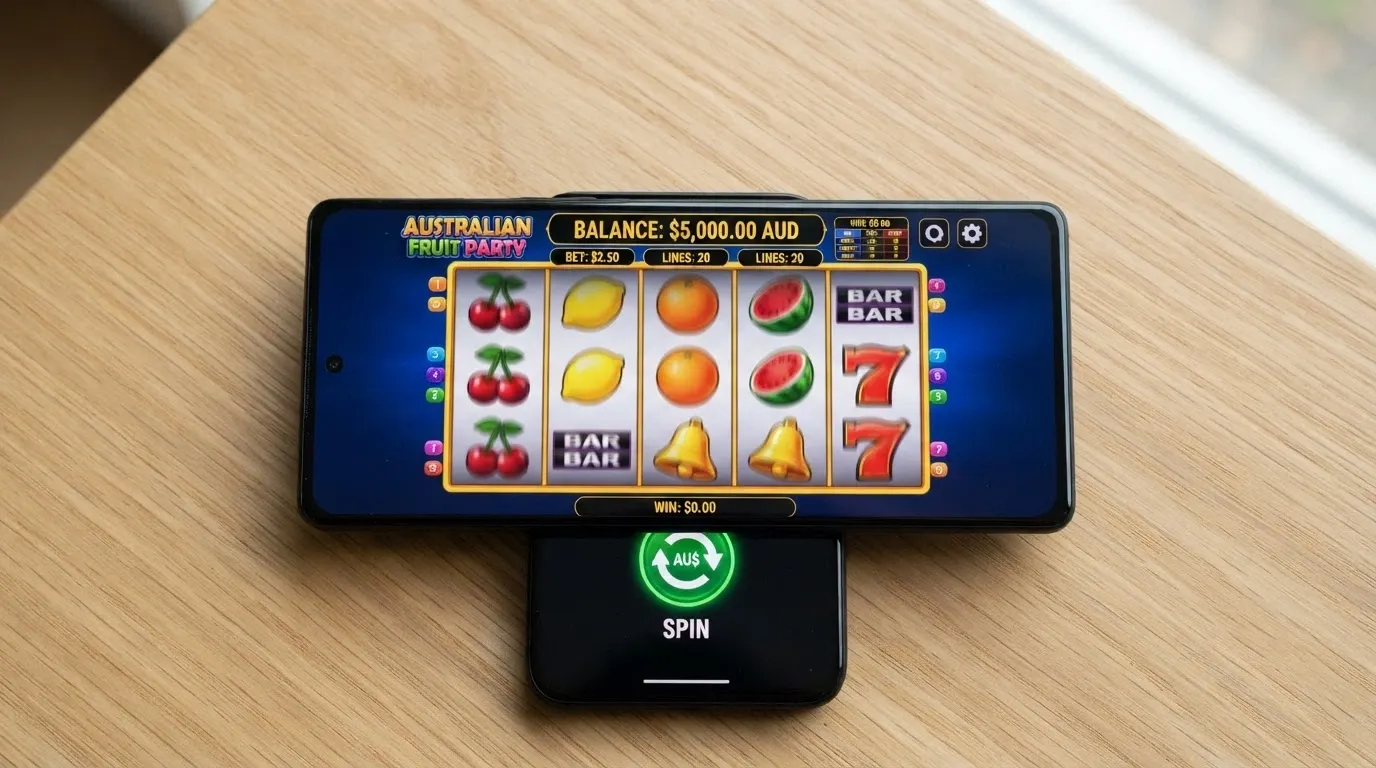
Demo mode on offshore casino sites is the first path. Most HTML5 pokies sites offer a “practice” or “demo” toggle that swaps real-money play for virtual credits. The reels, the RTP, the volatility profile, the bonus features — all of it is the same game underneath. The only difference is the balance is not withdrawable, and no real money moves in either direction. Demo mode is the right tool for evaluating a game before deciding whether the offshore-licence trade-off is worth it, which on this page’s analysis it generally is not.
Social casino apps from the Google Play Store are the second path. Every pokies app a player finds on the Play Store is, in practice, a free-to-play social casino. Virtual credits, in-app purchases, leaderboards, no cash-out. They are designed for the engagement loop, not for real-money wagering, which is why they coexist with the IGA. They are legal to distribute in Australia because they are not offering real-money gambling products.
Aristocrat free-play titles on browser-based platforms are the third path. Some of the same Aristocrat games that dominate Australian club and pub floors appear in demo form on offshore casino sites, occasionally with free-to-play apps attached. Where the licence to the title is held and how it is distributed varies, but the no-real-money version is genuinely accessible from an Android device.
Demo-mode pokies — how free play works on browser-based casino sites
Demo mode is a switch inside most HTML5 pokies. The player loads a game, looks for a “Practice”, “Demo”, or “For Fun” toggle, and the reels reset to a virtual balance. From the player’s perspective the game looks identical to real-money mode. The paylines, the symbols, the sound design, the bonus triggers — all of it is the same game running on the same server.
What demo mode does and does not replicate is worth being clear about. It does replicate the math: the RTP, the volatility profile, the hit frequency. Indian Dreaming’s 98.99% RTP applies in demo mode in the same way it applies in real-money mode, because the underlying random number generator is unchanged. It does not replicate the emotional shape of real-money play: a virtual balance that never depletes because the game keeps topping it up is not the same experience as a real balance that can run out. Demo mode is the right tool for learning the mechanics of a title — when the wilds trigger, how the bonus round pays, whether the volatility profile suits the player’s appetite — and it is the wrong tool for predicting what real-money play will feel like over an evening.
Social casino apps from the Play Store — free pokies with no real-money pressure
The Google Play Store is full of pokies apps. Every one of them is a free-to-play social casino, by design and by app-store policy. They are built around the engagement loop: daily bonuses, level-up rewards, in-app purchases for additional credits, social features like leaderboards and gifting. They are not real-money gambling products, and they do not pretend to be in their terms of service. Some are well-made, some are thin, and the difference shows up within the first few minutes of play.
The reason they exist alongside the IGA without contradiction is that the law targets real-money wagering products. A free-to-play slot machine, even one that uses the Aristocrat or Pragmatic Play brand under licence, is not an “online casino game” in the sense the IGA uses the term. There is no wagering, no withdrawal, no consumer harm in the form the law addresses. The legal line is sharp, and it sits exactly at the presence of real money.
For a player who wants to play pokies on Android in Australia without going offshore, social casino apps are the most accessible of the free-play paths. The catalogue is large, the install friction is low, and the experience is consistent with what the player was searching for in the first place — minus the real-money wager.
Aristocrat — the Australian pokies giant and its most-searched mobile title
Aristocrat Leisure is the Australian company that built the pokies many Australians grew up playing in clubs and pubs. Founded in Sydney in 1953, it is one of the world’s largest slot manufacturers by unit volume, and its titles dominate Australian gaming floors to a degree that no other studio matches locally. For an Android player searching for pokies in Australia, the default mental image of a pokie is more often than not an Aristocrat game — even if the player has never played in a pub, the visual vocabulary carries over.

Aristocrat’s digital distribution is more complicated. Some of its titles are licensed to offshore casino operators for real-money online play. Some appear in social casino apps under licence. Some have demo versions accessible through HTML5 platforms. Indian Dreaming is the title that sits at the centre of the search traffic for Australian Android users, and it is the one most consistently available across these channels.
Why Aristocrat matters — the Australian company behind the country’s most-played pokies
Aristocrat Leisure’s footprint in Australian gaming is structural. Walk into a club or pub in any Australian state and the majority of the pokie machines on the floor carry Aristocrat branding. The company’s history, from its 1953 founding in Sydney to its current global footprint, is the history of Australian pokies as a product category. The titles that came to define the local market — Queen of the Nile, Big Red, Where’s the Gold, Indian Dreaming — were built for Australian players first, and the visual and mechanical vocabulary they established is the one Australian players carry into any search for “pokies” online.
What that means for an Android search is that the player’s expectations are tilted toward Aristocrat-shaped experiences. The reels, the symbols, the bonus rounds, the volatility profile — they are looking for the same thing they would have seen on a club floor, rendered on a phone. The fact that the online distribution of these titles runs through offshore operators is a function of the legal environment, not of demand. The demand is there; the supply, in its legitimate form, is not.
Indian Dreaming — 243 paylines, 98.99% RTP and the outback theme players keep searching for
Indian Dreaming is Aristocrat’s most-searched pokies title among Australian Android users, and the numbers behind it explain why.
The slot runs on a 5-reel setup with 243 paylines — a structure that, when it was released in 1999, was at the leading edge of pokies design and has since become a familiar format. The 243-payline structure means wins register across a wide net of symbol combinations rather than a fixed line pattern, and the game’s volatility sits in the Medium range. That profile means payouts are neither the rare-but-large of high-volatility titles nor the constant-but-small of low-volatility titles; it is a balance that suits a player who wants a session to last without swinging dramatically in either direction.
The RTP is the figure that does the most work in any honest description. Indian Dreaming’s stated RTP is 98.99%. To put that number in context: a 98.99% return-to-player means the game, over a long enough sample of spins, returns A$98.99 of every A$100 wagered. That is an exceptionally high figure by industry standards — most pokies run in the 94–96% range — and it is part of why the title has the reputation it does. The wild multipliers in the game reach up to 15x, which means a single winning combination can multiply by an order of magnitude if the right symbol lands. The maximum payout is up to 10,000 coins — equivalent to 9,000x the stake depending on the version in play.
Indian Dreaming’s RTP comes with a caveat the marketing rarely mentions. Different versions of the game run different RTP configurations, and the lower configurations sit below the headline figure. A player evaluating the game on an offshore site should check the version they are looking at. The 98.99% figure is the one Aristocrat is associated with; it is not the only configuration the title ships in.
| Slot Title | RTP | Provider | Volatility |
|---|---|---|---|
| Indian Dreaming | 98.99% | Aristocrat | Medium |
Other Aristocrat titles you can find on Android-facing casino sites
Beyond Indian Dreaming, the Aristocrat catalogue available on offshore casino platforms accessible from Android is broader than any single title’s reputation suggests. Players searching for Australian-style pokies on their phone tend to recognise the brand more than they recognise individual titles, and the search for “Aristocrat pokies” returns a wider catalogue than the search for one specific game.
The titles most commonly found on offshore platforms overlap heavily with the titles that have historically been popular on Australian club and pub floors. The features and mechanics vary across the catalogue — different reel setups, different volatility profiles, different bonus structures — but the player looking for an “Aristocrat experience” on Android will find several options rather than a single game. The pattern is consistent across offshore operators: a handful of marquee titles are present on every platform, a longer tail of secondary titles is present on some, and the overall availability favours the games that Australian players already know by name.
The honest note here is that specific per-title data — RTP, volatility, maximum payout for the secondary Aristocrat catalogue — is less consistently reported than for Indian Dreaming. The headline figure Australian players search for is Indian Dreaming, and the marketing around it is correspondingly more developed.
The offshore operators targeting Australian Android players — ranked and compared
Every operator on the list below is unlicensed in Australia. They are ranked on what each one offers despite that shared status, because the question a reader actually has is: if I am going to use one of these sites anyway, which one is doing what?

The licence column does the work it can: every row carries the same answer. The providers column is where the differences show up. Pragmatic Play, NetEnt, Playtech, Hacksaw Gaming, RealTime Gaming — these are the studios whose games appear on these platforms, and the catalogue a player sees is shaped by which of them the operator has integrated.
| Operator | Licensed in Australia | Game Providers |
|---|---|---|
| Rocket Play | No | Pragmatic Play, NetEnt |
| Skycrown | No | Pragmatic Play, Playtech |
| Royal Reels | No | Various (Aristocrat exclusives sometimes featured) |
| FairGO | No | RealTime Gaming (RTG) |
| WinSpirit | No | Various |
| Bizzo Casino | No | Various |
| Scream Casino | No | Various |
| Rocket Casino | No | Various |
| Stake | No | Pragmatic Play, Hacksaw |
| Rainbet | No | Various |
What the table does not show is the bonus structure. Every operator on this list advertises a welcome bonus and free spins; the marketing is consistent across the set. What is not consistent — and what research could not verify at the level an Australian player would need — is the wagering requirement, the validity period, the maximum cashout, and which slot the bonus is restricted to. Those four specifications are the difference between an offer that costs the player a small amount of expected play and an offer that costs a great deal. They are exactly the specifications a reader is looking for, and they are exactly the ones the offshore operators do not publish in a way that can be verified before deposit. The table is honest about that gap. The row beneath it is honest about why.
Rocket Play
Rocket Play is an offshore casino carrying Pragmatic Play and NetEnt — two of the largest studio names in the online slot market. Pragmatic Play is the studio behind many of the high-profile slot releases of the last several years; NetEnt’s catalogue includes some of the most-recognised branded slots in the industry. For a player who wants a familiar, mainstream slot experience on Android, the provider mix is the right shape.
Rocket Play is unlicensed in Australia. The welcome bonus and free spins it advertises to Australian players are offered in a product category that the IGA prohibits. The wagering requirement, validity period, maximum cashout, and bonus-restricted slot are not stated in any verifiable form. A player evaluating Rocket Play is choosing an offshore product without consumer protection, on bonus terms that cannot be checked before deposit. That is the trade-off the provider mix does not address.
Skycrown
Skycrown pairs Pragmatic Play with Playtech, which puts a different shape on the catalogue. Playtech’s strengths sit in branded content and progressive jackpot networks — the kind of slots where a single spin can carry a seven-figure payout. Combined with Pragmatic Play’s release pace, Skycrown’s library has the breadth a player who rotates across multiple titles would want.
Skycrown is unlicensed in Australia. The same caveat applies: welcome bonus and free spins are advertised, the wagering and validity specifics are not stated, and the consumer protection gap is identical to every other row on this table. The provider mix is what differentiates Skycrown; the regulatory position is not.
Royal Reels
Royal Reels is the operator that most consistently features Aristocrat titles in its catalogue, which is the differentiator for an Australian player whose search has Aristocrat-shaped expectations. Aristocrat’s marquee titles — Indian Dreaming included — appear on Royal Reels more reliably than on most other offshore operators, although “more reliably” should be read with the usual caveats about licensing arrangements and the fact that the operator is outside the Australian regulatory framework.
Beyond the Aristocrat content, the provider mix is described as “various” — the catalogue runs broader than a single studio, with the specifics varying by jurisdiction and by availability. Royal Reels is unlicensed in Australia. The bonus structure is the same pattern: welcome bonus and free spins advertised, the wagering specifics not stated, the protection gap unchanged.
FairGO
FairGO is the single-studio operator on this list, running exclusively on RealTime Gaming. RTG has a long history in the Australian-facing market, and its catalogue includes many of the pokies-style slots that Australian players have historically sought out — though RTG’s library is built around its own design vocabulary rather than the Aristocrat shape.
FairGO is unlicensed in Australia. The single-studio provider mix means the catalogue is narrower than the multi-provider operators, which can be a feature (predictable game quality, familiar mechanics) or a limitation (less rotation, fewer new releases). The bonus terms follow the same pattern as the rest of the list: welcome bonus and free spins advertised, the specific wagering, validity, and cashout terms not verifiable before deposit.
WinSpirit
WinSpit carries a broad provider mix — the catalogue is described as “various”, which in this market means a multi-studio aggregation typical of the mid-tier offshore operators. The breadth gives a player access to a wider range of slot mechanics and themes than the single-studio operators offer, without the specific provider-name recognition that Rocket Play, Skycrown, or Stake carry.
WinSpirit is unlicensed in Australia. The same set of caveats applies. The breadth of the provider mix is the differentiator; the regulatory position is identical to the rest of the list.
Bizzo Casino
Bizzo Casino runs a varied catalogue across multiple providers, with the specifics of the mix less consistently disclosed than the operators above. Bizzo’s positioning in the offshore market is that of a generalist — a broad library, a standard welcome bonus structure, no single studio as the headline feature. For a player who values rotation across many titles over depth in any one provider’s catalogue, this shape can work.
Bizzo Casino is unlicensed in Australia. The bonus structure follows the market pattern: welcome bonus and free spins advertised, the underlying terms not verifiable to the standard an Australian player would need. The consumer protection gap is unchanged.
Scream Casino
Scream Casino’s library is broad — described as “various” — and its market position is similar to WinSpirit and Bizzo: a multi-provider aggregator without a single studio as its anchor. The catalogue shape favours breadth over signature, which is the mainstream offshore pattern.
Scream Casino is unlicensed in Australia. The same caveats apply throughout. The provider mix is not the differentiator; the regulatory position is.
Rocket Casino
Rocket Casino carries a varied provider mix and a standard offshore bonus structure. The brand name overlap with Rocket Play is incidental — these are separate operators, not the same company under different names — but the catalogue shape is similar.
Rocket Casino is unlicensed in Australia. The welcome bonus and free spins it advertises sit in the same product category as the rest of the list. The wagering, validity, and cashout specifics are not stated in verifiable form. The protection gap is the protection gap.
Stake
Stake is the highest-profile operator on this list, with a brand recognition that the others do not match. Its provider mix — Pragmatic Play and Hacksaw Gaming — is narrower than the multi-provider aggregators but sharper in identity. Hacksaw Gaming’s catalogue has grown rapidly over the last several years and now includes a meaningful share of the new-release slots that drive engagement on offshore platforms.
Stake is unlicensed in Australia. The same regulatory caveats apply. The provider mix is sharper than most of the list; the bonus structure is the same pattern as the rest. The brand recognition does not translate into an Australian licence, and the consumer protection gap is unchanged.
Rainbet
Rainbet rounds out the list with a varied provider mix and a standard offshore bonus structure. Like the other multi-provider aggregators on this table, the catalogue favours breadth over signature.
Rainbet is unlicensed in Australia. The welcome bonus and free spins are advertised, the wagering terms are not verifiable to the standard an Australian player would need, and the consumer protection gap is the same as the rest of the list.
Australian pokies law — what the Interactive Gambling Act means for the app on your phone
The Interactive Gambling Act 2001 is the framework that makes the rest of this page necessary. It is the law that draws the line between licensed Australian wagering and offshore online casinos, that gives the ACMA its enforcement powers, and that underpins every protection discussed in the sections above. The 2017 amendment strengthened the regulator’s tools; the 2026 reform bill tightens the advertising and disruption regime further.

The 2026 reform is the most recent change to the framework. The Interactive Gambling Amendment (Gambling Reform) Bill 2026 passed Parliament on 19 August 2026. The advertising and wagering reform measures commence on 1 January 2027. The reforms include strict caps on wagering advertising — three ads per hour between 6:00 am and 8:30 pm — a ban on wagering ads during live sporting events (from 15 minutes before until 5 minutes after), and a requirement that online platforms take “reasonable steps” to prevent under-18 users from viewing gambling ads. The net effect is to reduce the visibility of wagering advertising in Australian media and to extend the regulator’s disruption toolkit.
The Interactive Gambling Act 2001 — the law that made online pokies illegal to provide
The IGA 2001, as strengthened by the 2017 amendment, sets the boundary. Online casino games, online pokies, and in-play sports betting are prohibited products. Wagering on races and sport placed before the event begins, lotteries, and keno are permitted products. The distinction is product-specific: it is not about who is offering the product or where they are based, but about what the product is.
Licensing under the framework is state and territory based, with the Northern Territory holding the bulk of online wagering licences through the NTRWC. A service that holds an NT wagering licence can offer pre-event betting on races and sport; it cannot, under that licence, offer online casino games. The boundary is enforced because the licence itself does not authorise the prohibited products.
The 2026 reform bill — passed on 19 August 2026, with measures commencing on 1 January 2027 — adds the advertising caps and platform-responsibility measures described above. The reform does not change which products are prohibited; it changes how the prohibited products are advertised and how platforms that carry those ads are held to account. The change is downstream of the IGA’s existing prohibition, and the IGA’s core prohibition remains in force.
How the ACMA blocks, warns and forces offshore operators out of the Australian market
The ACMA’s enforcement is the visible signal that the IGA’s prohibition is real. Three tools make up the bulk of the regulator’s work: blocking, formal warnings, and disruption through withdrawal.
Blocking is the most visible. Under the IGA, the ACMA can order Australian ISPs to block access to illegal gambling domains. The cumulative count is large: 1,564 websites blocked since November 2019, and the count continues to grow. A single 2026 directive added 12 sites — 7Signs, Freshbet, Wildsino among them — to the blocked list in one action. When a domain is blocked, Australian customers see a regulator-style notice rather than the casino lobby.
Formal warnings are the next layer. In the October to December 2025 quarter, the ACMA issued formal warnings to multiple offshore operators — Dama N.V. and NovaForge Ltd among them — for providing prohibited interactive gambling services to Australian customers. A formal warning is a step on the path to civil penalties; it is not a toothless letter.
Investigation throughput gives a sense of the regulator’s workload. In Q1 2026, the ACMA reviewed 422 gambling enquiries and complaints, completed 25 investigations into 60 gambling sites, and found 44 IGA breaches. The scale of the activity — hundreds of enquiries, dozens of investigations, dozens of breaches — is the reason the offshore operators’ domain rotation has to be so aggressive to stay reachable.
BetStop — one register, one step, and every licensed Australian service locks you out
BetStop is the National Self-Exclusion Register, and it is the single most practical tool a player who has decided to stop has inside the licensed Australian system. Live since August 2023, BetStop lets a player exclude themselves from every Australian-licensed online and phone wagering service in a single registration. One form, one exclusion, every licensed door closed.
The numbers behind the register give a sense of how widely it has been used. As at 31 July 2026, BetStop held 67,480 registrations, with 41,290 exclusions still active. 78% of registrants were under 40 at the time of registration; 38% chose a lifetime exclusion rather than a fixed-term one. The age skew is significant: the heaviest concentration of self-excluding players is below 40, which is consistent with the broader trend toward risky gambling behaviour increasing sharply in younger cohorts.
The limit of BetStop is that it works only against licensed services. Offshore pokies sites are not part of the register. A player who has registered with BetStop cannot place a wager with TAB, Sportsbet, Ladbrokes, or any other licensed wagering service — but the offshore casino they were using last week is unaffected. The tool is comprehensive inside the licensed system and silent outside it. For a player who is using offshore sites, BetStop is a partial measure, not a complete one.
Staying in control — the tools, limits and warning signs every Android player needs
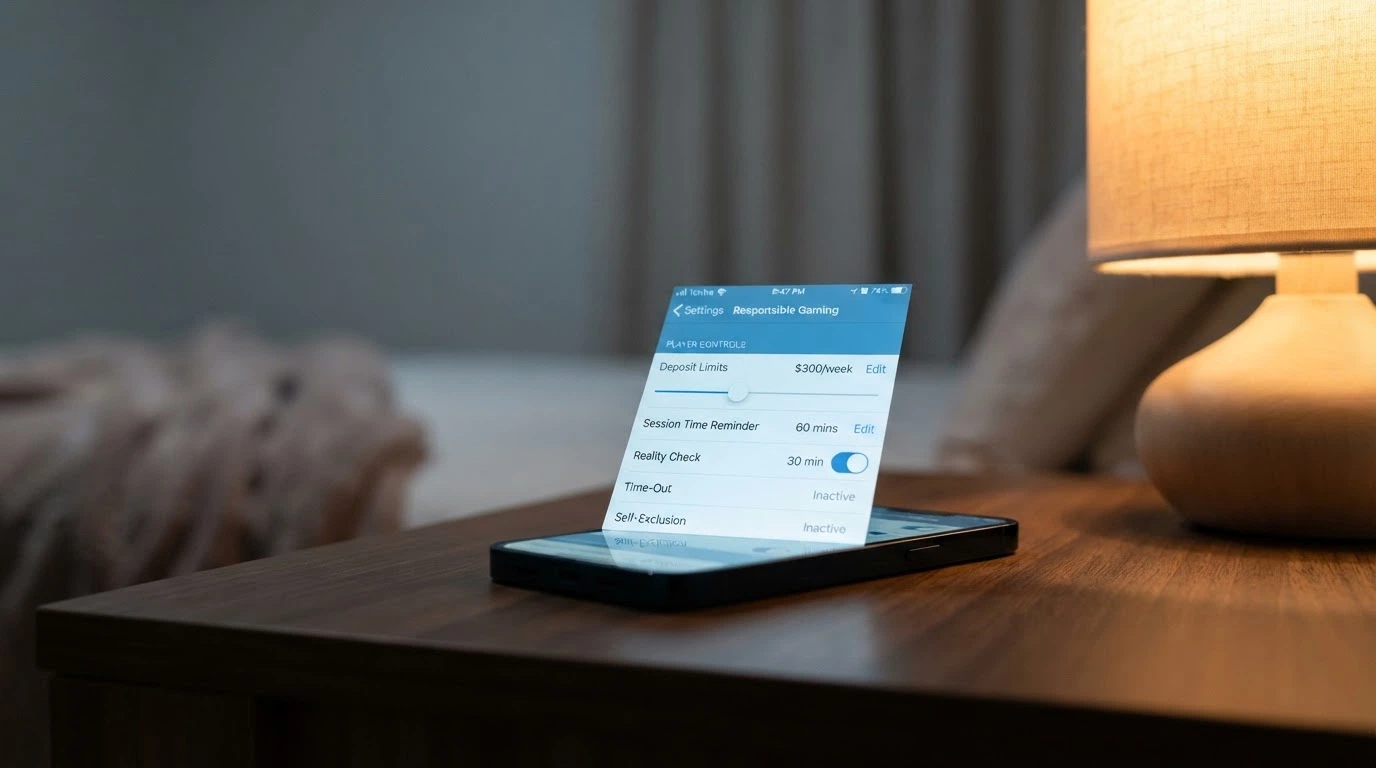
The framing of responsible-gambling tools on this page is shaped by the legal landscape above. Inside the licensed Australian wagering system, deposit limits, activity statements, reality checks, and BetStop are mandatory or standard features. Outside it — on the offshore pokies sites the rest of this page has described — those tools are typically absent, optional, or inconsistently applied.
The scale of gambling harm in Australia is the reason these distinctions matter. The figures are large, the trend is worsening, and the cohort most at risk is younger than the cohorts the public conversation has historically focused on.
Deposit limits, activity statements and reality checks — the controls licensed services must offer
Australian-licensed wagering services are required to offer deposit limits and activity statements to their customers. A deposit limit is what it sounds like: a cap on the amount a player can deposit over a set period, set by the player themselves and adjustable downward at any time. An activity statement is a record of the player’s wagering activity — deposits, withdrawals, net position — that the operator provides on request. Reality checks are session-time notifications that interrupt play at set intervals to remind the player how long they have been active.
These tools are mandatory on the licensed side. Offshore pokies sites are not subject to the same requirements, and the practical reality is that most do not offer equivalent controls. Where an offshore site offers a deposit limit, it is a voluntary feature, not a regulatory minimum; the player can usually raise it at any time without a cooling-off period. Activity statements, where they exist, are typically less detailed than the licensed equivalent. Reality checks are rare. The protection gradient between the licensed and offshore sides of the market is steep, and it runs in the direction a reader would expect.
For a player who is using an offshore site and wants to bring some of these controls into their own play, the practical options are external: a banking app’s spend notification, a separate budgeting tool, or — for someone who has decided to stop — BetStop plus a deliberate decision to stay inside the licensed system for any future wagering activity.
Gambling harm by the numbers — what the latest Australian data actually shows
The harm statistics are the figure-set that explains why the tools above matter and why this page has spent so much space on the legal landscape. The numbers are from Australian research bodies, drawn from surveys, modelling, and government health data.
| What was measured | The figure | Source |
|---|---|---|
| Total gambling losses (12 months to March 2026) | A$36.0 billion | The Australia Institute |
| Australians experiencing harm from own gambling | 2,857,000 (13.0%) | Roy Morgan Research |
| Australians affected by own or another’s gambling | ~3,290,000 | Journal of Gambling Studies |
| Adults at-risk or problem gambling | ~1,970,000 | Journal of Gambling Studies |
| Problem gambling prevalence | ~2.1% of adults | AIHW |
| Risky gambling rate (2024 → 2025) | 13.7% → 19.4% | ANU (Polis) |
The total loss figure is the largest in the table and the one that frames everything else. A$36.0 billion in twelve months is a 75% increase from 2020 — that is the trajectory. The 13.0% of the population experiencing harm from their own gambling translates to 2,857,000 people. The 3.29 million figure captures the wider circle — anyone affected, directly or through another person’s gambling, in any twelve-month period.
The risky-gambling rate is the figure that has moved most sharply. From 13.7% in 2024 to 19.4% in 2025 — a 5.7 percentage-point jump in a single year. That is a substantial shift, and it is the data point that has reframed the public conversation about who is at risk and how quickly the picture can change. The cohort most affected skews younger than the historical gambling-harm population, which is one reason the 2026 reform bill’s advertising restrictions target the channels younger Australians actually use.
The National Gambling Helpline and where to turn when the play stops being fun
The National Gambling Helpline — 1800 858 858 — is free, confidential, and staffed 24 hours a day, 7 days a week. Online chat is available through Gambling Help Online. The service is for anyone affected by their own gambling or by someone else’s: players, family members, friends. There is no cost, no requirement to identify yourself, and no obligation to follow through on any next step after the call.
For a player who has decided to stop, BetStop is the practical follow-on. Register once, and every Australian-licensed wagering service is closed at once. The 67,480 registrations on the register at 31 July 2026 — 41,290 still active — give a sense of how many Australians have taken that step. For someone whose gambling has extended into offshore pokies sites, the BetStop registration does not close those doors, and that limitation is worth being honest about. The combination of the Helpline call, the BetStop registration, and a deliberate decision to stay inside the licensed system for any future wagering is the most complete set of steps a player can take from this side of the problem.
The harm statistics in the table above are the reason these tools exist. They are not alarmism. They are the data the Australian research community has published in the last twelve months, and they describe a market in which the easy-money marketing of offshore pokies sites is meeting a population that is, on the latest figures, gambling more riskily than it was a year ago.
How we selected and ranked the operators on this page
The ten operators on this page were selected on a single criterion: they are the offshore operators most visibly targeting Australian Android users for real-money pokies. The selection is descriptive, not promotional. None of the operators are recommended to a reader; the comparison below is what the data research could verify, not a ranking of which one a player should choose.
The data sources were the ACMA’s published register and enforcement record, the operators’ own published terms, and the publicly available provider catalogues. The AU licence whitelist — the set of services licensed by an Australian state or territory regulator — was the reference point against which each operator’s status was checked. Every operator on the list fails that check.
The criteria applied to the comparison are narrow. The AU licence status is binary — every operator on the list is unlicensed in Australia, so the column carries no discriminating information and exists only to make the shared status visible. The game providers are the variable that does the discriminating work; the table is structured around that column because it is the column with the most variation. The bonus structure is described qualitatively across the operator profiles, because the specific wagering requirements, validity periods, maximum cashout limits, and bonus-restricted slots could not be verified to a standard that would let a player evaluate them before deposit.
The limitation of this ranking is shared by the operators themselves: there is no Australian licence to check bonus terms against, no regulator to escalate disputes to, and no consistent record of how each operator has treated Australian customers over time. The ranking describes what each operator offers; it does not adjudicate which one a reader should use. The page’s position on that question is summarised in the section that follows.
What you should actually do next — the safer path through Australian pokies on Android
The picture this page has built up is consistent, and it is consistent in a way that does not depend on which operator a reader was considering. There is no licensed real-money pokies app in Australia. There is no licensed way for an Australian Android user to play online pokies for real money from inside the licensed system. Every option that delivers real-money pokies to an Australian Android phone does so through an offshore operator that does not hold an Australian licence, that does not participate in BetStop, and that operates outside the ACMA’s dispute resolution framework.

The safer paths through that picture are three, and each one trades something different.
The first path is to stay inside the licensed Australian wagering system and accept that real-money pokies are not part of it. Australian-licensed apps deliver real-money wagering on races and sport, with the consumer protections, deposit limits, and BetStop integration that come with a licence. They do not deliver pokies. For a reader who was searching for pokies specifically, this path is a redirection rather than an answer, but it is the path the law leaves open.
The second path is to play pokies for free. Demo mode on a browser-based site, or a social casino app from the Play Store, gives the player the pokies experience — the reels, the mechanics, the bonus rounds — without the real-money wager. The RTP is the same as the real-money version; the difference is the balance is virtual. For a player who wants the experience of the game without the offshore-licence trade-off, this is the answer that does not require one.
The third path — and the one this page returns to because the harm statistics above make it the relevant one — is to recognise when the play has stopped being fun and to act on it. The National Gambling Helpline is 1800 858 858, free, confidential, and 24/7. BetStop is one registration that closes every licensed door at once. The ACMA’s enforcement record shows the regulator is actively disrupting the offshore sites that target Australian players, and the 2026 reform bill tightens the advertising and platform-responsibility regime from 1 January 2027.
The honest summary. The term at the head of this page promised a product that does not legally exist in the form the search results suggest. Real money pokies on Android in Australia are real, but they are reached through operators that operate outside the law the player lives under. The numbers — A$36.0 billion in losses, 2,857,000 Australians in harm, a 5.7-point jump in risky gambling in a single year — are the cost of the gap between what is searched for and what is permitted. The closer the play gets to the line between entertainment and harm, the more those numbers matter, and the more the tools in the section above are the right next step.
Frequently asked questions
Can I get in trouble for playing real-money pokies on my Android phone?
No. The Interactive Gambling Act 2001 targets the provider of online casino games and online pokies to a person in Australia, not the player. There is no criminal penalty for an individual who places a wager on an offshore pokies site from an Android phone inside Australia. The enforcement is on the operator — blocking, formal warnings, civil penalties, and forced withdrawal from the Australian market.
Which pokies app should I actually download on my Android in Australia?
No real-money pokies app exists in the Google Play Store for Australian users. The Play Store carries social casino apps only — free-to-play titles with virtual credits and no real-money withdrawal. For real-money pokies, Australian players access offshore sites through a mobile browser or, less commonly, by sideloading an APK distributed by the operator directly. None of those routes operates under an Australian licence.
Does Aristocrat’s most famous title work on a mobile with real cash?
Indian Dreaming, Aristocrat’s 243-payline 5-reel title from 1999, runs on real-money offshore casino sites accessible from Android browsers. It carries a stated RTP of 98.99% with Medium volatility, wild multipliers reaching 15x, and a maximum payout of up to 10,000 coins or 9,000x stake. The operator hosting it is unlicensed in Australia. The game is genuine Aristocrat; the regulatory framework around it is not Australian.
What happens when the ACMA blocks a gambling site — can I still get to it?
When the ACMA orders an Australian ISP to block an illegal gambling domain, the site becomes inaccessible to most Australian customers through standard residential internet connections. The ACMA had blocked 1,564 such websites by 18 March 2026, with a single 2026 directive adding 12 sites — including 7Signs, Freshbet, and Wildsino — to the list. Offshore operators typically respond by rotating to new domains, which the regulator then blocks in turn.
How do I know if the app I am using is a legal Australian service or a banned offshore one?
The fastest tells are the payment method, the licence footer, and the product mix. A site that asks for a credit card or crypto is not compliant with Australian law — those have been banned as payment methods for online wagering since 11 June 2024. A site claiming a Curaçao or other offshore licence, or offering no licence claim at all, is operating outside the Australian framework. A site mixing casino or pokies products with wagering is offering products the IGA prohibits. And a site that continues to take deposits after a BetStop registration is, by definition, outside the licensed system.
Can you play Aristocrat’s classics for free on your Android?
Aristocrat’s catalogue is the one Australian players tend to search for by name. Indian Dreaming in particular. The free-play path exists, but its reach depends on how each title is licensed for digital distribution.
Demo mode on offshore casino sites is the most consistent route: most major Aristocrat titles, including Indian Dreaming, appear in demo mode on a range of offshore casino platforms. The player does not need to deposit to access them; the game runs on virtual credits in the browser. What that practice session gives the player is a real sense of the game’s mechanics — the 243 paylines, the wild multipliers, the bonus round structure — without any financial exposure.
Social casino apps offer a smaller subset. Not every Aristocrat title makes it onto the Play Store; the licensing terms vary, and the social casino publishers pick the games that fit their engagement model. Indian Dreaming has appeared on social casino apps in the past, but availability is not guaranteed across the catalogue. Where the title is available, the experience is the standard free-to-play loop — virtual credits, daily bonuses, no withdrawal.
The honest summary: free-play access to Aristocrat classics on Android exists, the experience is genuine, and the gaps in the catalogue are a function of digital-licensing arrangements rather than anything the player can control.