
In 2026, the bitcoin rail changes the payment, not the legal risk
 Available in AU
Australian players can find offshore crypto casinos that market bitcoin pokies, but the product remains online casino gambling. Under the Interactive Gambling Act 2001, online casinos and online pokies are prohibited services in Australia. Bitcoin changes how money moves, not the legal category of the game. This page separates the payment rail from the wagering product, compares ten offshore sites on the terms that were actually available, and sets out the protections an Australian player does not receive offshore. The result is blunt: a site accepting Australian traffic may be reachable, but it is not an Australian-licensed casino.

Data current as of 18 October 2026; the offshore-licence claims were checked against ACMA’s published blocking and enforcement information and the Interactive Gambling Act 2001.
Table of Contents
- Bitcoin Pokies Explained: What Changes When the Reels Run on Crypto
- The Bitcoin Pokies Sites Australian Players Can Access in 2026
- Why Your Bitcoin Pokies Site Isn’t Licensed Anywhere in Australia
- Responsible Gambling When the Safety Net Was Built for Someone Else
- From AUD to BTC: How Deposits and Withdrawals Actually Work
- How We Selected and Ranked These Bitcoin Pokies Sites
- What Australian Players Should Actually Do About Bitcoin Pokies in 2026
- Frequently Asked Questions
Bitcoin Pokies Explained: What Changes When the Reels Run on Crypto
A bitcoin pokie is a real-money pokie whose cashier accepts bitcoin rather than, or alongside, Australian dollars. The reels, paylines, symbols and random outcomes are not transformed by the currency symbol. A player still stakes money on an uncertain result, and the casino still builds a house margin into the game through its return to player, or RTP, structure. The useful distinction is underneath the game: deposits and withdrawals move through a blockchain and a crypto wallet instead of a card, bank transfer or other conventional payment rail.
That distinction explains the appeal and the risk. An Australian-facing site can display AUD balances, use familiar pokie language and offer a cashier that looks ordinary. Behind the AUD label sits an offshore business asking the player to fund an account with BTC. The site may make the experience feel domestic without being subject to the Australian licensing and consumer-protection framework. The interface can say “A$” while the legal position remains offshore.
The payment rail also changes timing. A conventional payment may be declined before play begins, while a crypto transfer can be sent from a wallet and recorded on a public ledger. That does not make the transfer anonymous, immediate or risk-free. The Australian exchange used to buy BTC will ordinarily apply identity checks. The casino may request identity documents when a withdrawal is made. A network fee can apply, and a blockchain confirmation can take longer than the spinning reels themselves.
The practical landscape is therefore not “crypto games versus normal games” in the way a promotion might suggest. It is a choice between different ways of funding the same underlying casino product. A player who understands that is in a better position to read the offer, the withdrawal conditions and the absence of Australian protection.
What a Bitcoin Pokie Actually Is
The game engine is the starting point. A pokie uses a random number generator, or RNG, to determine outcomes. The machine does not become provably fair merely because a site displays a bitcoin balance. RTP describes the theoretical return built into a game over a very large number of plays; the remaining theoretical margin belongs to the house. Crypto changes the route into the account, not the mathematical relationship between stake and outcome.
An Australian player may see an AUD-denominated balance and select a stake in dollars, then move BTC in the cashier. The casino converts the value for its own ledger. The player is still dealing with a wagering balance, not a savings account. A BTC price movement can affect the value held in the account even when the reels and the advertised bonus remain unchanged. That is another difference from an ordinary AUD deposit, but it is a difference in the payment asset, not in the pokie itself.
The same caution applies to claims about a game being “crypto” or “provably fair”. A game can use a blockchain payment while retaining an ordinary centrally operated RNG. A provably fair system is different: it gives the player a way to check that a particular result was produced according to a published process. A claim that a site uses such a system is useful only when the player can actually inspect and verify the relevant data. A logo, a paragraph in the terms or the word “provably fair” is not the same thing as an independently usable audit trail.
The house edge remains the central fact beneath every bonus. A welcome package can make the first few deposits look larger without changing the long-run return of the game. A player can have a BTC balance, an AUD display and a large headline offer at the same time, while still be facing a game with a built-in margin. The currency is the wrapper; the wagering product is the substance.
How Crypto Pokies Differ from Real-Money Pokies
The main differences are payment friction, offer structure and regulatory coverage. The spin is the least interesting part of the comparison.
Licensed Australian wagering has a defined payment boundary. Credit cards, credit-related products and digital currency are banned as payment methods for licensed Australian online wagering, with the ban commencing on 11 June 2024. A site that asks an Australian player to deposit with crypto is operating outside those Australian rules for that product. It is not made acceptable by a faster blockchain transfer or by an AUD balance on the screen.
Crypto can reduce one kind of friction. A player does not need to hand a casino a card number at the point of deposit, and a BTC payment can move without a conventional card charge appearing on the bank statement. The tradeoff is that the player must manage wallet addresses, network confirmations and exchange records. A transfer cannot be reversed simply because the address was mistyped. The casino may also require identity verification before releasing funds.
Bonuses can be more complicated at a crypto-first operator. Some brands maintain a fiat welcome package and a separate crypto track, with different percentages, caps, minimum deposits, maximum stakes and wagering conditions. Bizzo Casino is the clearest example in this comparison. Its broader package is up to A$7,250, 175 free spins and one bonus game, while its crypto welcome bonus is a 200% match up to A$800. Those are not interchangeable descriptions of one pile of bonus money.
The third difference is coverage. An offshore operator is not an Australian-licensed wagering provider, is not connected to BetStop and does not give the player an Australian complaints route. Offshore licensing may describe a regulator in another jurisdiction, but it does not turn the service into a licensed Australian casino. ACMA’s role is to enforce the Australian prohibition and block illegal services; it is not a consumer-protection backstop for a brand that has chosen to operate offshore.
Speed belongs in the comparison, but it needs to be kept in proportion. Bitcoin withdrawals are commonly processed in zero to two hours, and approved payouts often leave inside an hour. That is a broad industry description, not a promise for every account or every blockchain. Casino review, identity checks and network conditions can interrupt the apparent speed. A PayID/Osko transfer can be near-instant for licensed wagering, but that payment rail is not available at an offshore crypto casino. “Fast” is useful only when the operator also publishes the conditions under which it will pay.
How the Australian Player First Meets a Bitcoin Pokies Site
The usual journey begins in an Australian search result. The site presents an AUD-facing interface, uses terms such as pokies, free spins and welcome package, and may describe support or payment options in language that feels local. A player who has not yet checked the operator’s status can easily read that presentation as evidence of an Australian product. The first useful question is not whether the balance displays dollars; it is who is operating the account and under which rules.
The cashier is where the payment difference becomes visible. Instead of entering card details, the player sees a BTC wallet address or a QR code. The player first buys bitcoin through an Australian exchange, sends the coins to a personal wallet, and then transfers the required amount to the address supplied by the casino. An exchange such as CoinSpot can sit in that on-ramp, although the choice of exchange is a separate decision from the choice of casino. The exchange will apply its own identity and account controls.
The transfer should be treated as a chain of checks rather than one click. The player needs to confirm the asset, the amount, the destination address and the network. A QR code reduces the risk of copying a long string, but it does not remove the need to check that the code belongs to the intended transaction. Once sent, the payment waits for network confirmation. Bitcoin casino deposits typically credit after network confirmation, usually within 10 to 30 minutes.
Network fees commonly range around A$1 to A$5 per transaction, varying with congestion. That fee belongs to the payment route, not to the pokie’s advertised return. A player who sees a A$50 bonus should not treat the full A$50 as free money after the exchange spread, network fee and wagering condition have had their say. The delay also matters. A balance that appears only after a confirmation is not available for immediate play, even if the cashier has recorded the transfer.
The onboarding path is not complete when the balance appears. A withdrawal can introduce a new set of requests, including identity verification. The same player who wanted privacy from a card statement may be asked for documents before a payout is released. The experience is therefore less “anonymous” than the first screen suggests. The payment rail can keep the casino name away from a bank statement, but the exchange and the operator still have records of the account relationship.
What “Provably Fair” Means — and When It Matters
Provably fair is a crypto-native way of making a game result checkable. In qualitative terms, the operator publishes a process and a piece of verifiable data that the player can compare with the result. The point is not to make a losing spin retroactively look attractive. The point is to let the player test whether the result was generated according to the stated mechanism rather than simply accepting the operator’s assurance.
That distinction matters because trust can be placed at different layers. A conventional RNG audit, where one exists, tests a game engine according to an established testing arrangement. A provably fair implementation lets the player inspect a particular outcome. Neither layer is made stronger by the word “crypto” on a promotions page. The useful question is whether the operator provides the data, the verification instructions and a result the player can reproduce.
The reviewed operator material does not provide a complete per-operator provably fair audit. It is not enough to say that a site mentions the concept, and it is not responsible to award a trust advantage without knowing whether a player can use the claimed process. A site that publishes a clear implementation deserves more confidence than one that uses the phrase as decoration. A site that provides no mechanism at all should be judged on its published game, licence and withdrawal information, not on a badge.
The same goes for a standard RNG. A player who cannot inspect either the game engine or a provably fair record is relying on the operator’s reputation. That may be acceptable to an experienced player who accepts the risk, but it is not equivalent to Australian regulatory protection. The more consequential question is what happens when a withdrawal is disputed, not whether a result can be displayed with a cryptographic flourish.
The sensible use of the term is narrow. Provably fair matters most when the player understands the verification process and can use it. It is not a reason to ignore the house edge, the bonus wagering or the offshore status. A verifiable spin still takes place in a casino game with a built-in margin, and a casino that is unreachable when a payout is due is not made safer because its outcome was generated in a novel way.
The Bitcoin Pokies Sites Australian Players Can Access in 2026
The comparison covers ten offshore brands that reach Australian traffic. The table is deliberately blunt about the one fact every row shares: none holds an Australian online casino licence, because no such licence exists for online casinos or online pokies. “Offshore” is not a technical detail to be pushed into a footnote. It changes the legal position, the available protections and the meaning of every bonus term.
The order rewards published value and term quality rather than the size of a headline alone. A larger package can be outweighed by a lower wagering multiplier, a more visible withdrawal ceiling or a payment route that the player can understand. The table does not mix a fiat and a crypto bonus as if they were the same thing. Only one operator, Bizzo Casino, has a distinct crypto path with sourced terms, so that path appears in its own row.
Where the available material did not support a number, the cell carries an em dash. That is preferable to a plausible guess. The absence is especially important for Stake, WinSpirit and Scream Casino: no welcome bonus, wagering requirement or bonus max bet was surfaced in the operator record. FairGO has a commonly described wagering figure, but its exact published terms were not fully confirmed. Those gaps matter more than a polished blank.
| Operator | AU Licence Status | Welcome Bonus | Wagering | Max Bet During Bonus |
|---|---|---|---|---|
| RocketPlay | No AU licence; offshore; not connected to BetStop | 100% up to A$500 plus free spins on first deposit; 200% up to A$500 on second deposit | 40x on bonus amount | A$7.50 while wagering |
| SkyCrown | No AU licence; offshore; not connected to BetStop | Up to A$8,000 + 400 free spins across multiple deposits | 40x on bonus amount only; 30x on free-spin winnings | A$5 per spin or hand |
| Bizzo Casino | No AU licence; offshore; not connected to BetStop | Up to A$7,250 + 175 free spins + 1 bonus game; crypto path 200% up to A$800 | 40x across both tracks | A$8 on fiat bonus; A$6.50 on crypto bonus |
| Royal Reels | No AU licence; offshore; not connected to BetStop | A$2,500 + 50 spins across three deposits; separate A$10 no-deposit bonus after phone verification | 35x on bonus only | A$5 per spin |
| Stake | No AU licence; offshore crypto-first casino; not connected to BetStop | — | — | — |
| Rainbet | No AU licence; offshore; not connected to BetStop | About A$1,070 equivalent + 60 free spins over three deposits | 40x | 1% active stake cap |
| FairGO | No AU licence; offshore; not connected to BetStop; domains listed in ACMA blocking action | 100% up to A$200 on each of five deposits, totalling up to A$1,000 | About 30x in review copy | — |
| WinSpirit | No AU licence; offshore; not connected to BetStop | — | — | — |
| Scream Casino | No AU licence; offshore; not connected to BetStop | — | — | — |
| Bizzo Casino, crypto path | No AU licence; offshore; not connected to BetStop | 200% up to A$800 | 40x | A$6.50 during the crypto bonus |
The table leaves out offer-level maximum cashout, validity, bonus-game RTP and volatility. Those details were not consistently covered across the ten brands, and a partial number would create a false comparison. The operator notes below give the details that were supported, especially where a validity period or a cap changes the value of a headline. The table also leaves out payment methods except where a sourced figure was central to an operator’s profile; payment breadth is dealt with separately.
The ranking has no legal leader. Every row is outside Australian licensing, every row is outside BetStop, and every row places the player beyond the Australian safety net. What changes is how much the operator tells the player before money is deposited. That is a narrow but useful distinction.
RocketPlay
RocketPlay presents the clearest two-deposit structure in the featured set. Its first deposit is a 100% match up to A$500 plus free spins. The second deposit is a 200% match up to A$500. Those figures describe a staged package, not a single upfront credit. A player who only reads the second percentage may miss that the package is split across deposits and that the exact free-spin count or named game was not surfaced in the available operator record.

The conditions are more informative than the headline. RocketPlay carries 40x wagering on the bonus amount and a maximum bet of A$7.50 while wagering. PayID deposits are listed with a minimum of A$30 and a maximum of A$4,000 per transaction. Those are concrete rails and limits. They are not proof that the operator is safe, licensed in Australia or covered by BetStop; RocketPlay is offshore, has no AU licence and is not connected to the register.
Its withdrawal caps are unusually visible: A$2,500 per day, A$7,500 per week and A$15,000 per month. A published ceiling does not guarantee payment, but it does let a player reason about access to winnings before committing. A player whose planned withdrawals are larger than the stated bands can see the constraint immediately. A player who needs a lower ceiling can also understand that the operator sets the pace, not the player.
The 40x condition still makes the offer a substantial commitment. At RocketPlay, the bonus is the base for wagering, so the deposit does not quietly enlarge the clearing target. The package is not as easy to read as a simple match percentage suggests. Its value depends on the player’s ability to meet the cap and validity conditions, and the available record does not provide a complete offer-level maximum cashout or bonus validity.
RocketPlay is worth considering for the reader who wants a visible payment band and withdrawal ceiling before committing, not as a safe or legal Australian choice. Its terms are easier to interrogate than those of several lower-ranked brands, but the 40x wagering requirement keeps it behind Royal Reels on the clearest bonus condition.
SkyCrown
SkyCrown owns the largest headline package in the comparison: up to A$8,000 plus 400 free spins across multiple deposits. The phrase “up to” matters. It is a ceiling across a package, not a promise that one deposit produces A$8,000. The size is designed to stop the eye, and it works. The eye then needs to move to the small print.
The bonus amount carries 40x wagering, while free-spin winnings carry 30x. The terms apply differently to different parts of the package. The minimum qualifying deposit is A$20, the maximum bet during bonus play is A$5 per spin or hand, and wagering must be completed within 14 days of activation. Free spins also carry a maximum win of 10x the bonus value. That is a meaningful restriction, not a footnote to skip while reading the A$8,000 headline.
The arithmetic of the offer is therefore less dramatic than the promotional number. A large total spread over several deposits can still leave a player with a short clock and a hard betting ceiling. The 14-day validity period rewards a player who can commit time and attention quickly. It penalises a player who expects to dip in, pause, or return after a few days. The free-spin cap also means that a large number of spins is not the same as an unrestricted payout.
SkyCrown is best understood as a scale-first offer. It suits a player who is comparing package size and is willing to read the separate conditions on bonus money and spin winnings. It is a poor fit for a player who values a longer runway or the lowest wagering multiplier in the set. The 40x on the bonus amount and the 10x free-spin maximum win keep the “largest” headline from being the whole story.
Bizzo Casino
Bizzo Casino is the featured operator with the clearest separation between fiat and crypto welcome tracks. The fiat package is advertised at up to A$7,250 in bonus money, 175 free spins and one bonus game. The crypto welcome bonus is a 200% match up to A$800. They are separate routes. A player should not add the two packages together and assume the result is one A$8,050 balance.
The crypto offer is triggered by a minimum deposit of A$30. It carries 40x wagering, a 14-day validity period and a maximum bet of A$6.50 during the crypto bonus. The broader welcome package also lists a 14-day validity period and a maximum bet of A$8 on the fiat bonus. Bizzo lists minimum deposits of A$10 for fiat methods and A$50 for crypto deposits, with minimum withdrawals of A$10 for fiat and A$50 for crypto. The lower A$30 threshold belongs to the crypto bonus trigger; it is not the same as the general crypto payment minimum.
That distinction is useful because it shows how a site can make a crypto offer look more accessible at the trigger while applying a higher ordinary crypto withdrawal threshold. The offer is not a shortcut around the operator’s payment rules. A player who deposits A$30 to reach the bonus still needs to meet the A$6.50 maximum stake and 40x wagering, then satisfy whatever withdrawal conditions apply.
The separate track can make sense for a player who deliberately wants to compare a higher percentage against a lower headline cap. It is not automatically the better deal. Forty-times wagering and a short validity period apply to a bonus that is paid in a volatile asset. The fact that the amount is shown as A$800 does not remove the network price movement or the operator’s conditions.
Bizzo is the strongest example of a crypto-specific offer, and its value is clarity about the split rather than generosity by itself. The A$6.50 maximum crypto stake and 40x requirement make it a heavier commitment than the 35x Royal Reels first-tier condition. For a player who wants a distinct bitcoin-funded track, the comparison is still worth making; for a player chasing the easiest path through wagering, it is not.
Royal Reels
Royal Reels offers A$2,500 plus 50 spins across three deposits. The first tier is a 100% match up to A$500, the second is a 75% match up to A$750, and the third is a 100% match up to A$1,250. The structure is staged, and the third deposit is where the package reaches its advertised total. It is not a single A$2,500 payment at the cashier.
The standout condition is 35x wagering on the bonus only. That is the lowest wagering multiplier in the reviewed set. During bonus clear-down, the maximum stake is A$5 per spin. The welcome free spins have a fixed A$0.20 stake size. Those details make the package easier to model than a large headline with an unknown game value, although the available record does not name the bonus slot or provide an RTP for that title.
Royal Reels also separately advertises an A$10 no-deposit bonus after phone verification. That is not part of the three-deposit headline and it is not a promise of anonymous play. The phone-verification condition is a reminder that even an offer described as no-deposit can involve identity work before it becomes usable. The welcome package itself remains deposit-triggered.
The main limitation is disclosure. No offer-level maximum cashout or complete bonus validity was surfaced in the operator record. The absence does not prove that the terms are unfavourable, but it means a player should not treat Royal Reels as a fully transparent package merely because the wagering multiplier is lower. Lower wagering is a real advantage, yet it is not the same thing as proof of a quick or unrestricted withdrawal.
Royal Reels is the clearest bonus-value proposition among the brands with fully specified terms. It suits a player who wants the lowest wagering requirement in the set and can accept a staged A$2,500 package. It is less compelling for a player who needs to see every cashout condition before depositing, because the published record still leaves some of those questions open.
Stake
Stake is the crypto-first name in this group, and that is the reason it belongs in a discussion of bitcoin pokies even though no traditional welcome bonus was surfaced in the operator record. Its positioning puts BTC at the centre of the cashier rather than presenting a conventional AUD welcome package as the first reason to join. The crypto-first design is a feature of the operating model, not a bonus guarantee.
The absence of a sourced welcome offer changes the comparison. There is no supported figure here for a deposit match, free spins, wagering multiplier, validity window or maximum bonus bet. It would be misleading to fill those cells with an industry average. A player comparing the Stake entry with SkyCrown or Royal Reels is comparing a known bonus structure with a product that has not supplied the same terms in the available material.
The absence of a welcome bonus does not automatically make a casino weak. It does mean a bonus-focused player cannot infer value from a headline that was not surfaced. It also means the reader should not mistake a crypto-native reputation for Australian regulation. Stake is offshore, has no AU licence and is not connected to BetStop. Its BTC orientation does not alter that.
Stake suits a player who already understands wallets, exchange accounts and crypto settlement and is not shopping for a welcome package. It is a weak fit for a reader whose first question is “How much bonus do I get?” There is no reason to award it a numerical bonus score when the relevant numbers are absent.
The fair conclusion is narrower than the marketing instinct: Stake is worth a place in the crypto comparison because of its operating position, not because the available terms prove a better deal. The player who chooses it on brand familiarity should accept that the comparison has less information to offer.
Rainbet
Rainbet takes a different route. Its three-deposit welcome route offers up to about A$1,070 equivalent and 60 free spins. The package carries 40x wagering and a 1% active stake cap. Unlike a flat dollar maximum, the 1% condition ties the permitted stake to the active amount. A reader should preserve that qualifier rather than turning it into a generic A$5 equivalent.
The operator supports 25 crypto tokens, including BTC, ETH, USDT, LTC, BNB and SOL. It lists minimum deposits and withdrawals from about A$23 equivalent and zero platform withdrawal fees. Its published cashout description says crypto withdrawals can move from review to a wallet in instant handling to roughly 10 minutes. That is a fast stated window, but it remains subject to review and the wider payment process.
Rainbet’s strength is breadth. A player who wants to move between several crypto assets has a wider stated choice than the single-token examples elsewhere in the comparison. The BTC route still carries the usual network and exchange considerations, and zero platform withdrawal fees does not mean the blockchain has no fee. The package is also less generous on its face than the much larger SkyCrown or Bizzo headlines, although the comparison cannot reduce those packages to one number without accounting for wagering and validity.
Rainbet is the most interesting option here for a player who values payment breadth and a stated cashout window over a giant welcome headline. It suits a crypto user who knows why token choice matters. The 40x wagering and 1% active stake cap make it a serious commitment, and the absence of a sourced offer-level maximum cashout means the speed claim should not be mistaken for a guarantee.
FairGO
FairGO’s bonus is built around repetition: a 100% match up to A$200 on each of the first five deposits, totalling up to A$1,000. The offer is easy to describe, but it is not a one-time A$1,000 credit. The player has to make five qualifying deposits, and the total is spread across the sequence. The wagering requirement is commonly described as about 30x in review copy, while the exact published terms were not fully confirmed on the main promotion page.
FairGO is marketed around an RTG-style game library, but game branding does not make it an Australian licensed casino. The operator is offshore and lacks domestic licensing or BetStop connectivity. More pointedly, the ACMA action report for October to December 2025 says 133 websites were blocked in that period, including FairGO domains. That enforcement record belongs in the decision, not in a footnote about offshore status.
The five-deposit structure can look friendly because each individual match is small. It still creates five decisions to fund the account and five opportunities to continue playing. A review-copy wagering figure should be treated as a useful description, not a substitute for the current terms. With no confirmed maximum bonus bet, validity period or offer-level maximum cashout in the available record, the player cannot compare the full cost of the offer from the bonus page alone.
FairGO is a warning against judging a casino by the number of deposits it advertises. It may suit a player who deliberately wants a smaller first-deposit match and is comfortable with the RTG-style proposition, but ACMA’s blocking action materially lowers its standing in this comparison. The “100%” word does not neutralise an enforcement record.
WinSpirit
WinSpirit is an offshore brand with no sourced welcome bonus or payment terms in the operator record. That is not evidence that the site has no offer. It is evidence that the available public material did not support a reliable figure for one. A player should not turn the absence into a claim that the terms are generous, or into a claim that they are punitive.
The site can still be visited by an Australian player because offshore brands reach Australian traffic. An AUD-facing display or a familiar casino layout would not change WinSpirit’s status, which remains unlicensed and disconnected from BetStop. The practical comparison is therefore less about a missing number than about the information the player is being asked to accept.
A bonus is not the only thing a casino can offer, but it is the thing that usually supplies the clearest paper trail. When no wagering multiplier, validity window, maximum stake or withdrawal ceiling is surfaced, the player is left comparing brand presence alone. That is a thin basis for sending money offshore.
WinSpirit suits only a reader who is prepared to inspect the current terms independently and place no weight on an unverified headline. It does not deserve a favourable value judgement merely because it is visible in a search result. The honest verdict is that the missing terms are the product information, not a hidden bonus feature.
Scream Casino
Scream Casino shares the same evidence problem as WinSpirit: the available operator record contains no sourced welcome bonus or payment terms. The right conclusion is not that it has nothing to offer. It is that this comparison cannot responsibly say what it offers, how much it costs to clear, or what a player can withdraw under published conditions.
That distinction matters for an Australian player. A site can have a game lobby, a visual identity and a cashier without supplying a useful comparison point. The absence of a sourced wagering multiplier or maximum bet leaves the player with no way to price the offer. The absence of payment terms leaves the player guessing whether BTC is the intended route, what the minimum is or what conditions apply to a withdrawal.
Scream Casino is offshore, has no AU licence and is not connected to BetStop. Those facts do not prove that every transaction will fail. They do mean the player cannot use Australian registration, BetStop coverage or an Australian complaints route as a backstop. The casino’s brand presence is not evidence of protection.
Scream Casino is worth considering only as a reminder that a polished interface is not a term sheet. It suits a player who is willing to do the work that the page cannot do and to walk away if the missing information remains missing. Comparing it on brand presence alone is the least persuasive reason to choose it.
Crypto Welcome Bonuses: What the Deposit Match Looks Like in Practice
A deposit match is a promise to credit a percentage of a qualifying deposit, not a promise of withdrawable cash. The percentage is the first number a promotion displays. The wagering requirement is the number that determines whether the credited amount has practical value. A player who reads only the percentage has not read the offer.
Royal Reels supplies the cleanest worked example in the comparison. Its first-deposit bonus is A$500, the wagering requirement is 35x on the bonus only, and the maximum stake is A$5 per spin during bonus clear-down. At the maximum permitted stake, the required turnover is A$17,500, equivalent to 3,500 spins. At five seconds per spin, that is an estimated 4.86 hours of play, assuming only the bonus amount is wagered.
That is a statistical estimate, not a guaranteed session. The A$5 figure is a maximum stake, not an instruction to bet A$5. A player who chooses a lower stake would need more spins and more time. The calculation also assumes that the full A$500 bonus is the amount being cleared and that the stated five-second interval applies. It does not account for network delay, a changed balance, a game that pauses play or a term that changes the qualifying action.
The point is not that 4.86 hours is a magic threshold. It is that a 35x headline contains a substantial amount of wagering before a withdrawal can be considered. At other brands, 40x requirements put even more turnover between the bonus and the player. A 14-day validity period, as listed for SkyCrown and Bizzo Casino, adds a time condition to that turnover. The house edge still sits inside every spin.
The calculation should therefore be read beside the offer, not instead of the terms. A player can know the inputs and still have no certainty about an individual outcome. A large bonus may produce a large nominal balance while leaving a smaller amount available after wagering. Conversely, a lower bonus with fewer required spins can be more useful. The value is in the relationship between the numbers, not in the largest number printed at the top.
What Separates a Strong Bitcoin Pokies Site from the Rest
The first separator is transparent terms. A casino that says what counts as a qualifying deposit, what the wagering multiplier applies to, how long the offer lasts and how much may be bet is easier to evaluate than one that leaves those points blank. Royal Reels has the lowest sourced wagering multiplier in the set, at 35x on the bonus only, and a visible A$5 per-spin cap. That is a meaningful advantage over a 40x offer, even when the headline package is smaller.
The second separator is withdrawal visibility. RocketPlay publishes daily, weekly and monthly ceilings of A$2,500, A$7,500 and A$15,000. The other operator records do not provide a complete comparable set of offer-level cashout terms. A published ceiling is not a guarantee, but an absent ceiling is a signal that the player cannot model access to funds. The strongest comparison is not the brand with the fastest-sounding phrase; it is the one that tells the player what can limit a payout.
The third is payment breadth without sacrificing clarity. Rainbet lists 25 supported crypto tokens, including BTC, ETH, USDT, LTC, BNB and SOL, plus minimum deposits and withdrawals from about A$23 equivalent and zero platform withdrawal fees. That is broader than the single-token picture found elsewhere. It is useful to a player who already knows how to manage crypto, but it does not make the operator Australian-licensed or remove the 40x wagering on its welcome route.
A practical working test is whether the terms are clear enough to survive a hard reading. Wagering should be no more than 40x, the maximum bet should be at least A$5 and the validity period should be at least seven days. Those are comparison markers, not guarantees. SkyCrown passes the A$5 and seven-day markers, but its bonus-money wagering is 40x and its free-spin winnings carry a separate 30x requirement. Bizzo Casino has a 14-day period and a clear fiat-versus-crypto split. RocketPlay has 40x wagering and a higher A$7.50 maximum bet. Rainbet has 40x wagering and a 1% active stake cap.
Those numbers should not be mistaken for a quality score. A higher maximum bet can let a player clear a requirement faster, but it can also make a losing session more expensive. A longer validity period gives a player more room, not a lower house edge. A token list is valuable only if the player can move the asset without hidden friction. The casino with the most generous combination of readable terms is the easier one to assess, not necessarily the one with the best eventual return.
The final separator is what the operator does not say. Stake, WinSpirit and Scream Casino appear in the comparison, but their available records do not supply a sourced welcome package or bonus conditions. FairGO supplies a commonly described wagering figure, but its exact published terms were not fully confirmed. A blank cell is not a failure of the ranking. It is the truthful result when the information needed to score the offer is not there.
The strongest site in an illegal offshore field is therefore a relative description, not a safe-harbour claim. Royal Reels is strongest on wagering clarity. Rainbet is strongest on payment breadth and stated cashout speed. RocketPlay is strongest on visible withdrawal caps. SkyCrown is strongest on headline scale. None is strongest on Australian legality, because that category is absent from every row.
Why Your Bitcoin Pokies Site Isn’t Licensed Anywhere in Australia
The legal position is simpler than the marketing language. Online casinos, online pokies and in-play betting are prohibited services under the Interactive Gambling Act 2001. Australian-licensed wagering is limited to forms such as pre-event racing and sports betting, lotteries and keno. There is no Australian licence for an online casino or an online pokie.
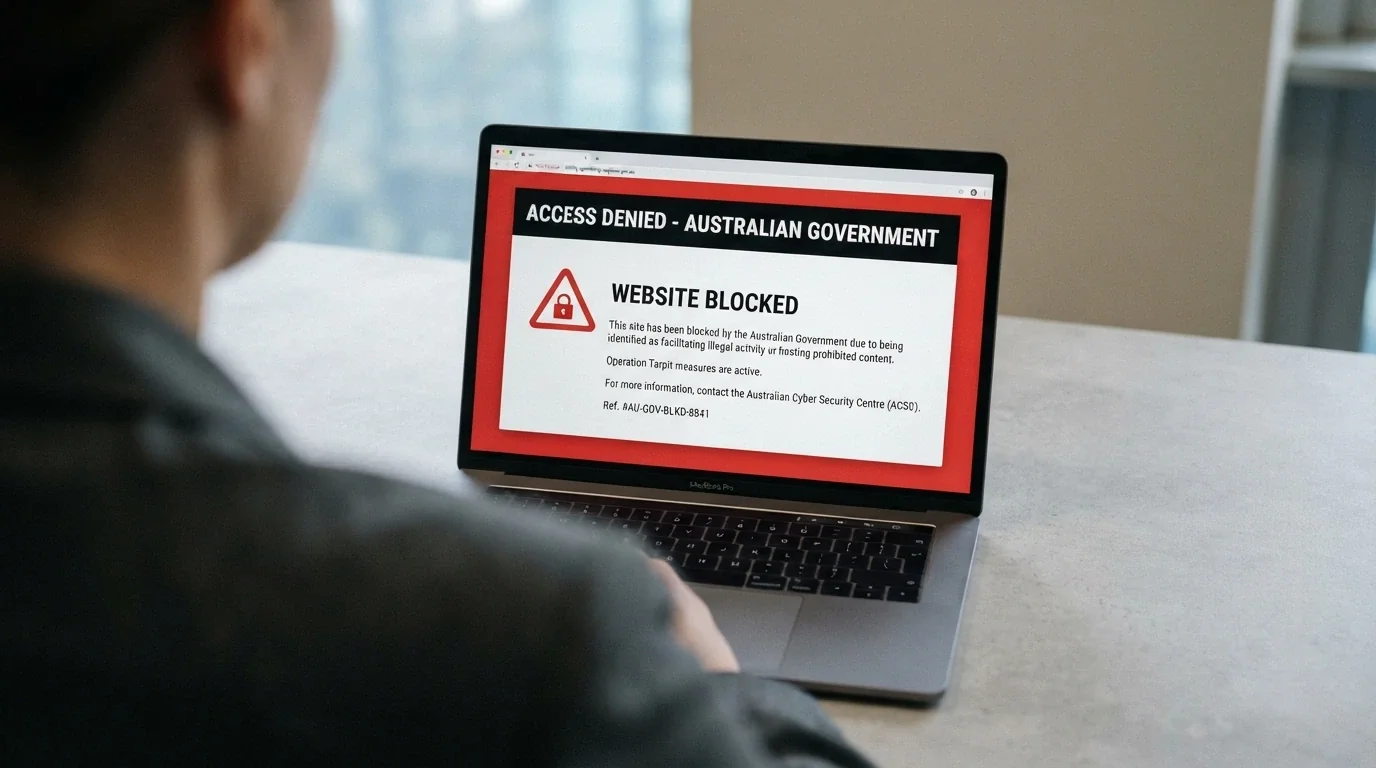
That means an Australian player can encounter an offshore site without converting it into a licensed product. A casino can accept an AUD display, advertise in Australian-facing language or process a BTC transfer while still being outside the Australian regime. Reachability is not permission. A site that asks for crypto deposits is operating outside the payment rules for licensed Australian wagering, even when it markets itself to people in Australia.
The law targets the provider, not the individual player. The individual is not criminalised for using an offshore crypto casino; the Interactive Gambling Act 2001 prohibits operators from providing prohibited interactive gambling services to people in Australia. That distinction is important, but it is not an endorsement of the product. It means the practical decision is not “am I committing a crime?” It is “what protection am I giving up and how much money am I prepared to lose?”
The Interactive Gambling Act 2001 and Who It Actually Targets
The Interactive Gambling Act 2001 is the federal starting point. It prohibits providing interactive gambling services to people in Australia, including online casino games and online pokies. Section 8AA is the provider-facing provision highlighted in the surrounding explanation of the player position. The law is not written around the idea that a person who opens an offshore account becomes a criminal simply by spinning a reel.
The 2017 amendment strengthened the regime. It closed offshore loopholes and gave the Australian Communications and Media Authority, or ACMA, stronger blocking and enforcement tools. ACMA is the federal regulator that investigates complaints and can direct internet service providers to act against illegal services. It is not the operator’s commercial partner and not a complaints handler standing behind an offshore account.
The 2026 reform changes the payment horizon. The Interactive Gambling Amendment (Gambling Reform) Bill 2026 passed Parliament on 19 August 2026. Its measures commence on 1 January 2027. From that date, banks and payment providers gain express authority to block transactions to illegal gambling operators. That does not mean every transaction will be blocked on the same day. It means the legal pressure on payment routes is moving closer to the offshore operator’s point of access.
The current position is therefore two-layered. The product is already prohibited, while the payment system is being given a more direct role in enforcement. A BTC route that works today is not a permanent exemption. The change from a card or bank transfer to crypto does not alter the prohibited service at the centre of the transaction.
The practical answer for an Australian player is not to search for a loophole. It is to recognise that “offshore” describes the operator’s legal relationship, not a special quality mark. The IGA does not make the player a criminal, but it also does not create a licence, a consumer guarantee or a self-exclusion right for an offshore account. Those protections have to come from somewhere else, and at an offshore crypto casino they generally do not come from Australia.
How the ACMA Enforces the Ban: Site Blocking and Operator Withdrawals
ACMA can direct internet service providers to block illegal online gambling services under section 313 of the Telecommunications Act 1997. Since its first blocking request in November 2019, ACMA had requested the blocking of 1,564 illegal gambling and affiliate websites in its March 2026 update. More than 225 illegal services have withdrawn from the Australian market since ACMA began enforcing the strengthened rules in 2017.
The number is not a count of every site an Australian player might encounter. It is the accumulated record of enforcement requests and market exits. That distinction matters because a comparison of ten brands can feel comprehensive while the wider online market is much larger. ACMA’s list includes names such as Frumzi, Great Win, MyStake, RetroBet and Viperwin in the March 2026 update. The presence of other names does not make any one of them an Australian licensed casino, and it does not change the status of the brands reviewed here.
The fourth quarter of 2025 gives the picture a sharper edge. ACMA’s action report for October to December 2025 records 133 websites blocked and 10 formal warnings issued to providers of prohibited or unlicensed gambling services. FairGO domains were among the sites named in that report. A blocking action is not a finding that every player loses money, but it is a concrete reason to treat an offshore brand’s continued access as uncertain.
Site blocking is a blunt instrument. It can make a domain unavailable while a player still has a balance, pending withdrawal or unresolved identity check. ACMA’s action is aimed at the illegal service, not at a promise to recover each individual account. A player who needs a predictable route to funds is therefore exposed to a risk that a domestic regulated operator does not face in the same form.
The enforcement trend should be read in one direction. ACMA is not stepping back from the offshore market. The authority to block transactions from 1 January 2027 adds another lever. The more tempting the crypto rail sounds, the less sensible it is to confuse a fast payment with a stable legal position.
What Australian Players Give Up When They Play Offshore
The first thing lost is BetStop. BetStop reaches Australian-licensed online and phone wagering services, but an offshore casino is not connected to the register. A person who has self-excluded can still reopen an offshore account and deposit. The site does not inherit the exclusion merely because the player used an Australian-facing website or saw an AUD balance.
The second loss is an Australian complaints route. An offshore operator may have a support team, an internal dispute process or a licence in another country. None of those automatically gives the player a remedy under the Australian consumer-protection framework. The fact that ACMA investigates complaints about illegal services is not the same as ACMA acting as a customer-service department for an offshore casino.
The third loss is payment security at the point of play. Licensed Australian wagering cannot use credit cards, credit-related products or digital currency as funding methods; those restrictions commenced on 11 June 2024. A crypto casino asking for a BTC deposit is outside those rules. That does not make a BTC transfer inherently fraudulent, but it places the transaction outside the payment protections and identity controls that apply in the licensed setting.
The fourth loss is continuity. ACMA can direct ISPs to block an illegal service. A site can disappear from Australian reach while a balance remains in the account, or a previously working address can stop resolving. The player cannot assume that a support page, a wallet address or a withdrawal form will remain available after a blocking action.
These are not arguments for pretending that offshore play is risk-free. They are reasons to price the missing safety net. A faster cashier can be attractive when the withdrawal is routine. It is less attractive when the operator is unreachable, the bonus terms are disputed or the payment route is under new pressure.
Licensed Wagering vs Offshore Crypto Casino: The Protections Compared
The useful comparison is not a moral scale. It is a list of protections that are present in the Australian licensed environment and absent, or materially less accessible, offshore.
| Protection | Licensed AU Wagering | Offshore Crypto Casino |
|---|---|---|
| Regulatory oversight | ACMA enforces federal online-gambling rules; state and territory licensing includes arrangements such as Licensing NT and the NTRWC | No AU online casino licence; offshore status and ACMA blocking action mean ACMA is not a consumer-protection backstop |
| Self-exclusion register | BetStop excludes a person from all Australian-licensed online and phone wagering services in one step | Not connected to BetStop; an offshore casino can continue accepting a self-excluded person |
| Deposit-method restrictions | Credit cards, credit-related products and digital currency are banned for licensed Australian online wagering from 11 June 2024 | Crypto deposits are a defining route and place the casino outside those licensed wagering rules |
| Formal complaints process | Australian regulatory and consumer-protection channels apply within the licensed wagering framework | No Australian complaints route identified for the offshore operator |
| Site-blocking risk | Not the offshore site-blocking scenario described here | ACMA can direct ISPs to block the illegal service under Telecommunications Act section 313, including while an account balance remains |
| Consumer-protection law | Australian consumer-protection framework applies to the licensed environment | No Australian consumer-protection or complaints safety net identified for the offshore service |
The table is intentionally asymmetrical. “Licensed” does not mean that every dispute becomes easy, and “offshore” does not prove that every payout fails. It means the player cannot transfer the expectations of one system into the other. The Australian framework tells the player where to turn. The offshore framework leaves more of the burden with the individual.
Responsible Gambling When the Safety Net Was Built for Someone Else
Responsible gambling is not a decorative box to place beneath a bonus table. The Australian system contains real tools, and the offshore gap is not a minor technicality. BetStop and Gambling Help Online belong to the Australian environment. They cannot be imported into a site that is not connected to the register and has no Australian licence.
The problem is not that offshore sites make every player vulnerable in the same way. It is that the player bears more of the safety work. A self-exclusion request can be a firm boundary in one environment and a message that an offshore operator has no obligation to honour. A deposit limit set at a licensed operator can be enforced centrally; a limit at an offshore crypto casino has to be remembered and maintained by the player.
The prevalence figures make the distinction more than theoretical. As of March 2026, Roy Morgan estimated that 13.0% of the Australian population, about 2,857,000 people, were experiencing some form of gambling harm from their own gambling. Another estimate put harm from other people’s gambling at 5.4%, or about 1,177,000 people. In total, 15.1% of Australian adults, about 3,320,000 people, were experiencing some level of harm from their own or someone else’s gambling.
Those figures do not describe every reader of a bitcoin-pokies page. They describe why a responsible-gambling section belongs in one. A player can understand a bonus and still be unable to stop. The more frictionless the payment rail feels, the more important it is to set boundaries before the first transfer.
The Tools Australian-Licensed Operators Must Provide
BetStop is the National Self-Exclusion Register. It launched on 21 August 2023 and lets a person exclude themselves from all Australian-licensed online and phone wagering services in one step. A registration can last from three months to a lifetime. That range is a boundary, not a suggestion.
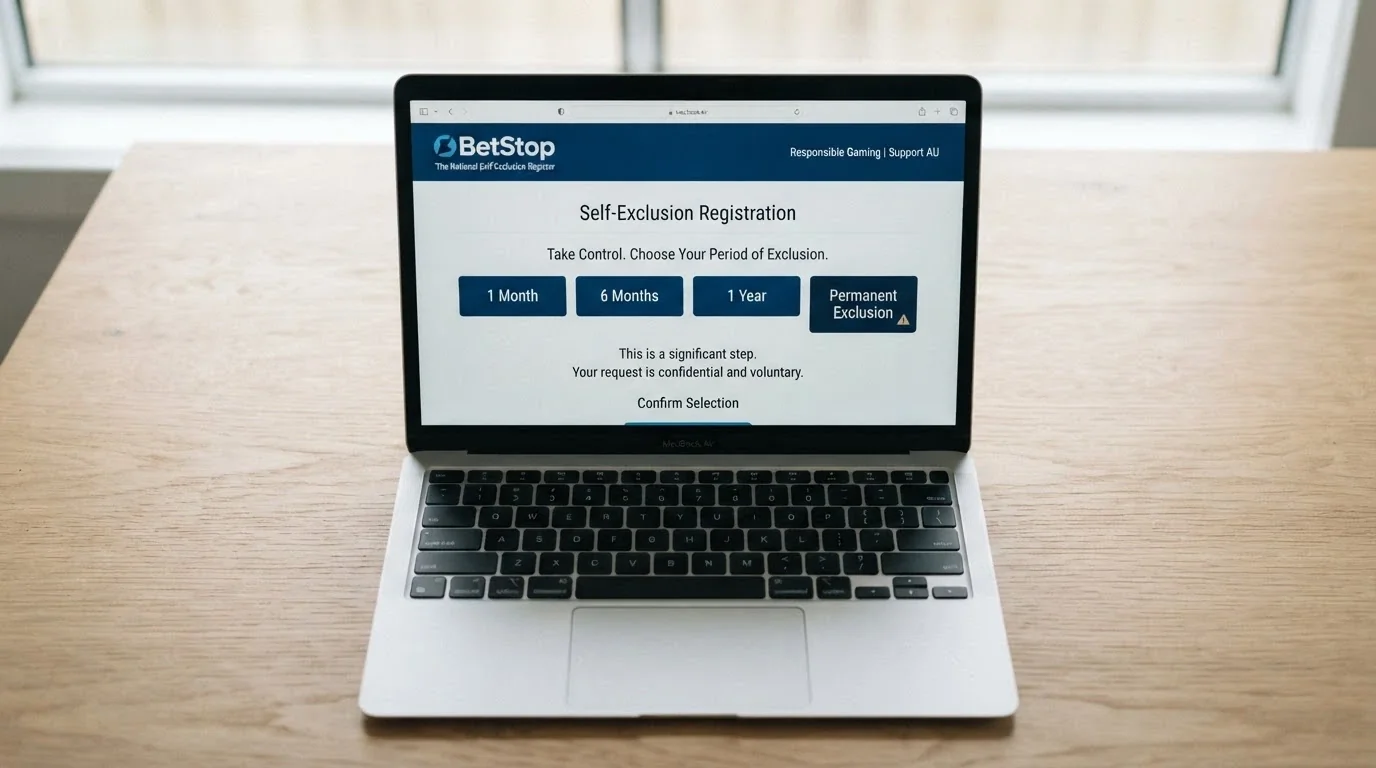
As at 31 July 2026, ACMA reported 67,480 BetStop registrations. Of those, 41,290 exclusions were still active, 78% of registrants were under 40, and 38% had chosen lifetime exclusion. The figures show that self-exclusion is used across different age groups and durations. They do not turn a three-month exclusion into a guarantee that a person will be ready to return at the end of it.
The licensed-operator framework also centres on deposit limits, activity statements and take-a-break tools. Those controls give a player ways to inspect and interrupt play before a loss becomes a crisis. They are part of the Australian safety net described alongside BetStop, not optional decorations that a player can assume exist at every offshore site.
Support remains available. The National Gambling Helpline can be reached on 1800 858 858, free and confidential, with staff available 24 hours a day. Gambling Help Online also provides free 24/7 access through online chat and counselling. The practical message is simple: self-exclusion and support do not have to wait until the player has worked out every bonus term.
For an offshore player, those tools do not cover the site they are using. BetStop’s reach is expressly limited to Australian-licensed online and phone wagering services. A person who has registered and then encounters a crypto casino is still exposed unless the person creates a separate boundary and follows it without relying on the casino to remember.
The Crypto-Anonymity Trap and Why Self-Exclusion Does Not Carry Over
Crypto’s privacy pitch can be useful in one narrow sense and dangerous in another. A BTC transfer can keep a casino name off a bank statement in the way a card deposit normally does. That may reduce the immediate embarrassment or friction of a gambling transaction appearing on a statement. It can also remove the natural pause created by a card decline or a visible bank balance.
The trade-off is that privacy from a bank statement is not privacy from the people who handle the money. An Australian exchange will normally require identity verification to open and use an account, and the exchange’s records link the purchase to the player. An offshore casino can request identity documents at the withdrawal stage. The reviewed material does not provide a complete per-operator KYC audit, but the exchange step and withdrawal checks are part of the route the product depends on.
That creates a trap for a self-excluded player. BetStop does not bind an offshore casino. The player can return to the site, create another account and deposit again. The absence of an Australian register connection means the operator has no reason to consult the exclusion record. The person who thought crypto would make the boundary invisible is left with the same behaviour and fewer external prompts to stop.
The 2026 reform tightens the Australian side. From 1 January 2027, direct marketing of inducements is prohibited for three months after a person deregisters from BetStop. The restriction applies to the regulated environment; it does not reach an offshore operator that has never joined BetStop. A player should not read a new advertising rule as a new offshore self-exclusion rule.
The practical safeguard has to be personal and enforceable. A player can decide not to keep a casino-funded wallet, can set a hard deposit ceiling before the first spin and can use a time limit that ends the session independently of the casino. A private payment rail cannot be allowed to become a private promise to continue. The fewer reminders stand between an impulse and a transfer, the more important the written boundary becomes.
How Big the Problem Is: Gambling Harm in Australia by the Numbers
The figures are not there to sensationalise play. They are there to give the safety question scale. Roy Morgan’s March 2026 estimate put gambling harm from a person’s own gambling at 13.0% of the Australian population, or about 2.857 million people. Harm from another person’s gambling affected an estimated 5.4%, or about 1.177 million. The combined estimate was 15.1% of Australian adults, about 3.32 million people.
The wider participation data points in the same general direction. Gambling participation declined to 58.8% in 2025, but risky gambling increased from 13.7% in 2024 to 19.4% in 2025. Among people who gambled, more than half, 56.1%, had mainly participated online in the previous 12 months. Online access is not the sole cause of harm, but it is a setting in which a fast deposit and a short decision loop can matter.
The numbers create a useful order of operations. First, a player should decide whether the product is acceptable at all. Second, if the player nevertheless proceeds, the player should set a firm monetary and time boundary. Third, the player should recognise that offshore self-exclusion may not work. Help should be sought before a boundary fails, not after a large balance is already under dispute.
Gambling Help Online is available through 24/7 online chat, and the National Gambling Helpline is 1800 858 858. BetStop can cover Australian-licensed wagering services. Neither of those facts makes offshore access safe. They give the reader a route to help when the product’s own controls cannot be trusted.
From AUD to BTC: How Deposits and Withdrawals Actually Work
The payment rail is the reason bitcoin pokies exist as a distinct marketing category for Australian searchers. AUD is the familiar funding currency. BTC is the asset that moves through the exchange and blockchain. The pokie is still paid for with money, and the player is still hoping for a return. The difference is the route between the bank account and the casino account.
That route has three distinct stages. The player buys BTC through an Australian exchange. The player moves BTC into a wallet and then to the casino’s address or QR code. The casino credits the deposit after network confirmation. A withdrawal reverses the direction only partly: the casino first has to approve the payout, and the blockchain then has to record the transfer.
Each stage can introduce a delay or a condition. The exchange may apply identity checks. The blockchain may charge a network fee. The casino may impose a minimum, a maximum stake or a bonus wagering condition. A fast token transfer does not remove the need to read the casino’s terms.
Funding a Crypto Pokies Account: Exchanges, Wallets and the AUD-to-BTC Route
The cleanest path begins with an Australian exchange. The player deposits AUD through the exchange’s own permitted route, completes the exchange’s identity checks and buys BTC. An independent exchange such as CoinSpot can perform that on-ramp role, although the exchange is not the casino and should not be mistaken for a gambling operator. Its job is to provide access to the asset; the casino controls the gambling account.
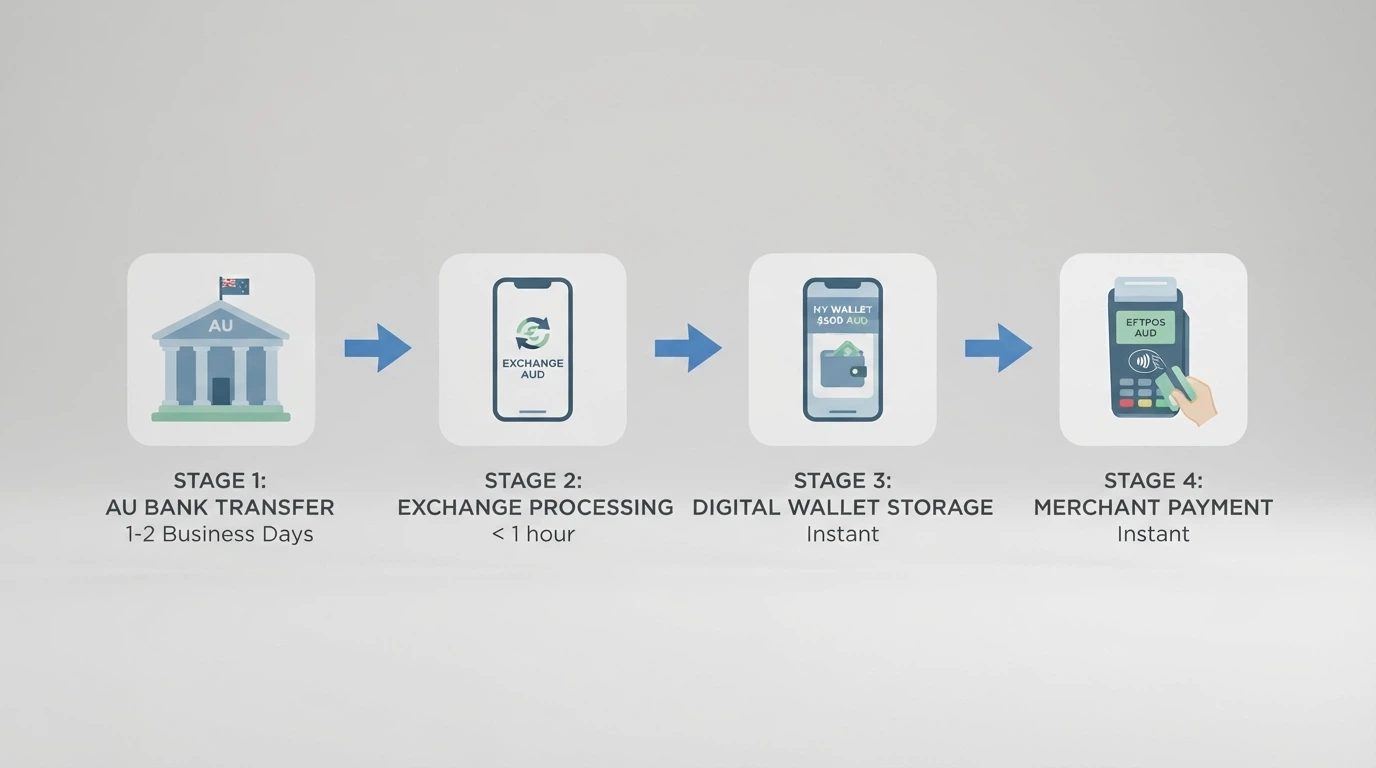
The next step is the wallet. The player sends BTC to a personal wallet, checks the address and then transfers the amount required by the casino cashier. Some cashiers display a QR code, which can be scanned rather than manually copied. The player should still confirm that the selected asset is BTC and that the destination is the intended wallet or casino address. A correct symbol does not compensate for a wrong destination.
The casino credits the deposit after network confirmation. Bitcoin casino deposits typically credit after 10 to 30 minutes. A confirmation is not the same thing as the transfer appearing in the player’s personal wallet. The wallet may show an unconfirmed transaction while the casino is still waiting, and the casino may require a confirmation before it exposes the balance for play.
Network fees often range around A$1 to A$5 per transaction, varying with congestion. A player who sends a small deposit can therefore pay a meaningful share of the amount in fees. The cost is part of the route, even when the casino’s promotion describes a deposit of a different size. The exchange’s spread and the BTC price movement can matter as well, although they are separate from the casino’s own terms.
The Australian banking context is changing. From 1 January 2027, payment providers gain express authority to block these transactions, as detailed in “The Interactive Gambling Act 2001 and Who It Actually Targets”. That makes a crypto route less settled than a permanent workaround. A transfer that works through an exchange today may face new pressure after the reform measures commence.
This is also where the legal distinction becomes practical. A crypto transfer is not a domestic wagering deposit. It is a payment to an offshore service that operates outside the payment rules for licensed Australian online wagering. The player should assume that the exchange, the blockchain and the casino each keep their own records. The route is not a blank cheque.
How Fast Bitcoin Deposits and Withdrawals Really Are
Deposit speed is usually described by the network confirmation window. Bitcoin deposits typically credit after 10 to 30 minutes. That is a more honest description than promising instant play. The clock starts before the casino’s balance updates, and congestion can stretch it.
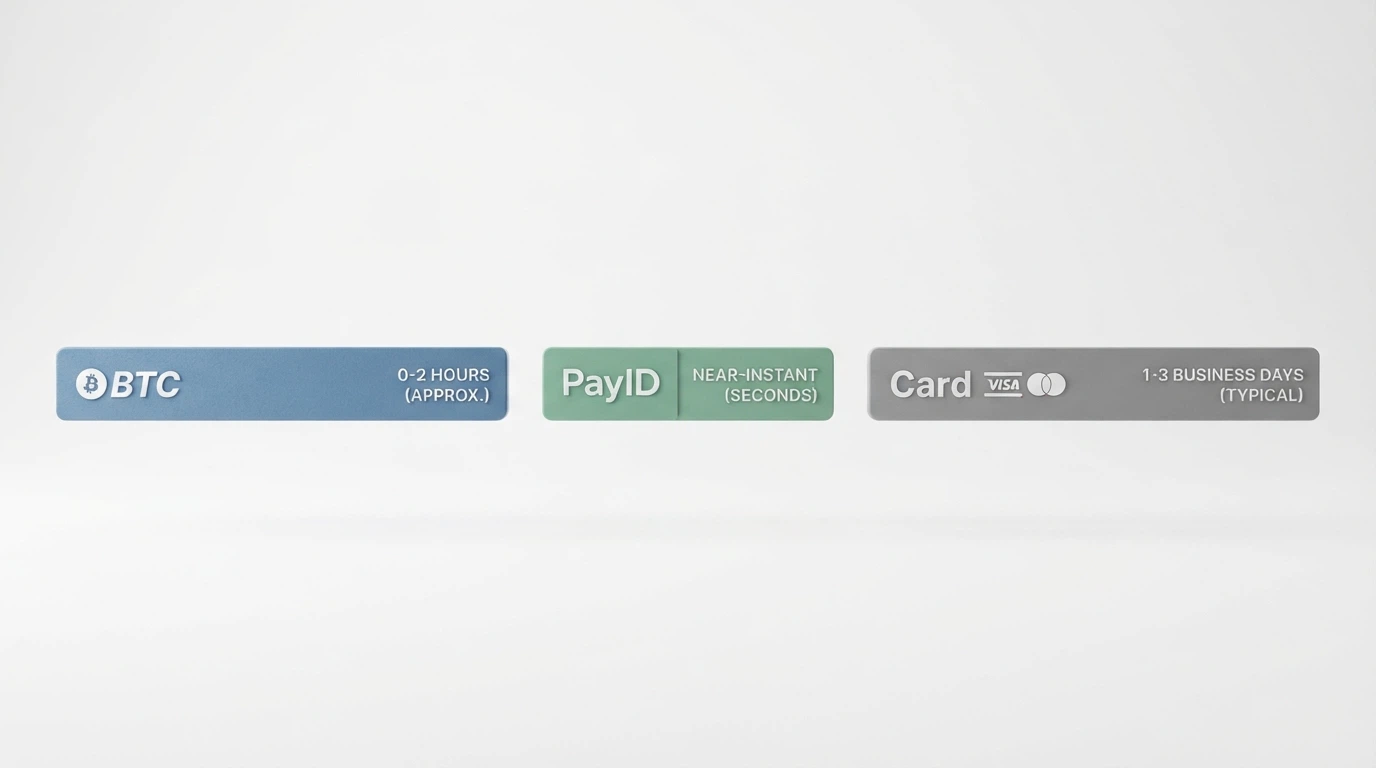
Withdrawal speed has another stage. Bitcoin withdrawals are commonly processed in zero to two hours, and approved payouts often leave inside an hour. The qualifier “approved” is essential. A request can be submitted quickly and still wait for review, a bonus check or identity documentation. The blockchain movement is only the final part.
Rainbet gives the fastest published figure in the set: its crypto cashout description says the route can move from review to a wallet in instant handling to roughly 10 minutes. That is a meaningful operational claim, but it is still a published description rather than a promise for every account. It should be compared with the more general zero-to-two-hour picture, not added to it as though they were two separate transactions.
PayID/Osko is the domestic comparison. It is near-instant for licensed wagering and sits within the Australian payment framework, but it is unavailable at the offshore crypto casinos reviewed here. Card payments are also a poor comparison because credit cards are banned for licensed Australian online wagering, and crypto is outside the permitted licensed methods. The domestic option is not simply slower or faster. It is a different regulatory environment.
A player who cares about speed should ask what is being timed. Is it the network confirmation, the casino’s review or the final wallet credit? The answers can be ten minutes, two hours or something longer. A site that names its stage honestly is more useful than one that advertises speed without conditions.
Bitcoin vs Card: What the Anonymity Angle Actually Delivers
The privacy pitch begins with a real difference. A BTC deposit can keep a casino name off a bank statement in the way a card deposit normally does. The player does not hand over a card number to the casino, and the transaction description may show a wallet or exchange rather than a familiar gambling merchant. That can be a practical reason to prefer the rail.
The privacy stops there. To buy BTC through an Australian exchange, the player normally completes identity verification. The exchange links the account to the person, and the purchase leaves a financial trail. Sending BTC to a casino does not erase that record. At withdrawal, the casino may ask for identity documents to confirm the account holder. The reviewed material does not provide a per-operator KYC audit, but the withdrawal stage can require verification.
The result is a narrower promise than “anonymous gambling”. The payment rail can separate a casino charge from a card statement. It cannot make the player anonymous to the exchange, the operator or the people who maintain the relevant records. The player is choosing payment friction, not invisibility.
The distinction matters because a card transaction can also act as an accidental stop. A visible bank balance or a declined card may interrupt an impulse. Crypto can remove that friction. That is convenient for a deliberate transfer, but it can be dangerous for someone trying to impose a boundary. Privacy is a product feature, not a responsible-gambling tool.
Credit cards and digital currency are banned for licensed Australian online wagering from 11 June 2024. A card deposit to a casino and a crypto deposit to a casino therefore both take the player outside that licensed payment framework. The fact that a crypto transaction is harder to identify on a bank statement does not make the casino lawful or the payment risk-free. The clean privacy gain is the rail; the missing piece is the operator’s accountability.
The AUSTRAC Threshold and What It Means for Larger Crypto Transactions
AUSTRAC’s reporting threshold is AU$10,000. It can trigger extra checks for related transactions, and the relevant test is cumulative activity rather than only one isolated transfer. That matters when a player moves significant amounts through an exchange, wallet and offshore casino instead of sending one small deposit.
The threshold should not be inflated into a claim that every large casino transaction is automatically unlawful or automatically taxed. The sourced point is narrower: related transactions can attract extra checks. The practical implication is that larger or repeated flows deserve more scrutiny than a casual assumption that separate transfers are invisible to reporting systems.
The exchange is the point where a player should expect identity and transaction records to exist. A casino may have its own withdrawal conditions as well. A player who is considering an amount near the threshold should not rely on splitting transfers as a way around reporting obligations. The relevant question is whether the activity is related and whether the player understands the records created along the route.
For an ordinary player with a small bankroll, the threshold may seem remote. For a player treating an offshore casino like a high-volume account, it is a reminder that “private” and “unreported” are not the same thing. The payment route can be technically separate from a bank statement while still leaving a trace through the exchange and the operator.
How We Selected and Ranked These Bitcoin Pokies Sites
The comparison uses ten brands that appeared in Australian-facing search results and operator or review material covering bonus terms, payment options and licence status. The licence question was considered against the Australian Communications and Media Authority’s published blocking and enforcement information and the Interactive Gambling Act 2001. Because Australian law does not issue licences for online casinos or online pokies, none of the ten can be placed in an Australian licensed-casino category.
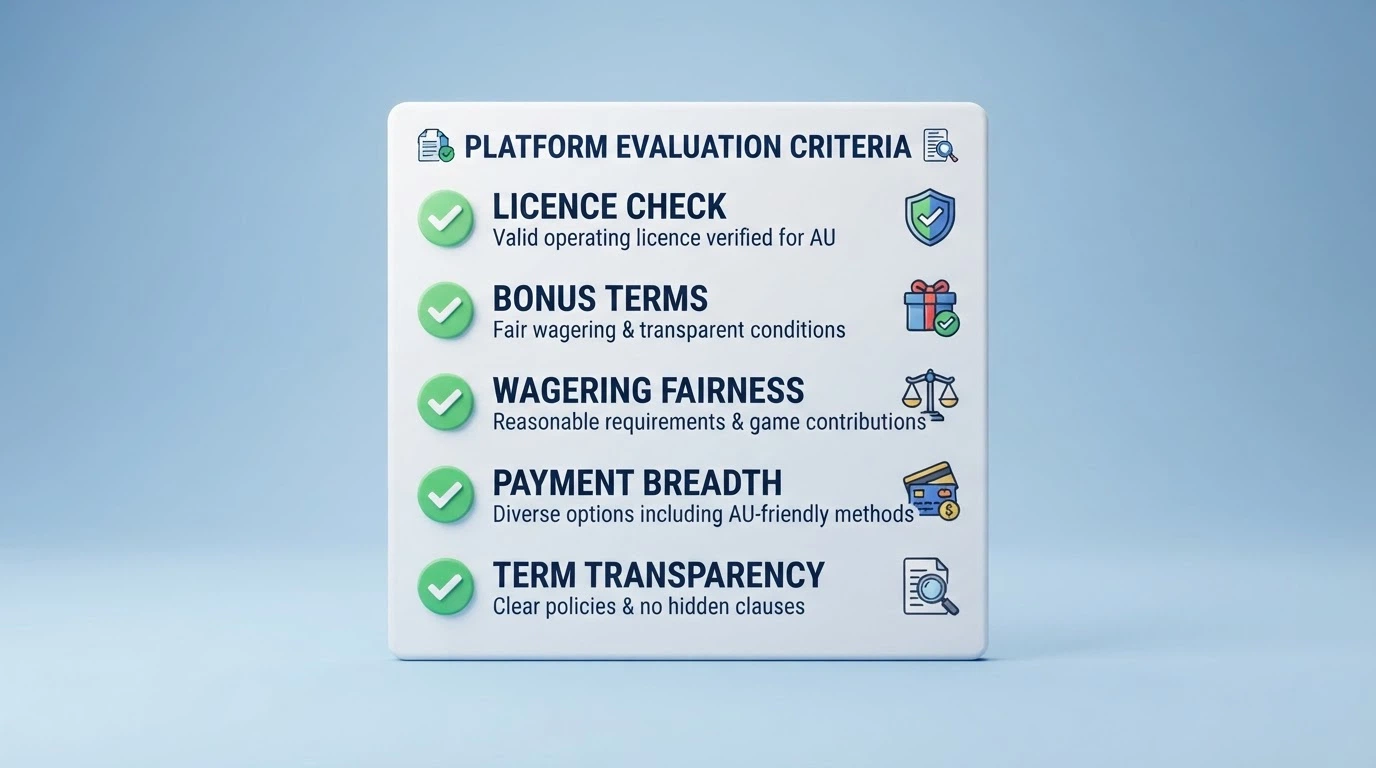
The ranking gives weight to four practical things: bonus value, wagering fairness, term transparency and payment breadth. A brand with a smaller headline but a clearly specified wagering requirement can therefore sit above a brand with a much larger headline and an opaque condition. RocketPlay earns a place near the top because its payment band and withdrawal caps are visible, not because it is legal in Australia. Royal Reels stands out because its 35x bonus-only requirement is the lowest sourced figure. Rainbet is differentiated by 25 supported tokens, about A$23 minimums and a stated cashout window.
The ranking is not a payment for placement. No operator is given a better position because of an affiliate relationship, and no affiliate weighting is applied. The order is a reading of the published comparison, not a promise that one casino will pay faster or return more to a player. Offshore status is a shared disqualifying context, not a competitive advantage.
Where no quantitative term was supported, the table uses an em dash. That is especially important for Stake, WinSpirit and Scream Casino. A blank is not a zero bonus, a zero wagering requirement or proof that a withdrawal is unavailable. It means the available record did not establish the number. FairGO’s commonly described 30x figure is labelled as review-copy information because the exact published terms were not fully confirmed.
The same discipline applies to game details. No RTP, volatility or bonus-slot title is assigned to a title unless the relevant figure was sourced. A casino may market thousands of games while a specific offer names no game. The comparison does not fill the gap with a generic percentage. Players should treat a missing game specification as a reason to inspect the offer before depositing.
The method also leaves some potentially useful columns out. Offer-level maximum cashout, validity, free-spin value, bonus-game RTP and volatility are not consistently available across the set. Including them only for a few rows would make the table look more exact than it is. The operator notes place those facts beside the brands where they matter, while the table keeps the comparison honest.
The final criterion is protection. All ten are offshore and not connected to BetStop. A favourable bonus or a fast published cashout cannot change that. The ranking is useful for comparing what the brands state, not for turning an offshore service into an Australian licensed option.
What Australian Players Should Actually Do About Bitcoin Pokies in 2026
The conclusion is not that a clever route makes bitcoin pokies legal. Online casinos and online pokies are prohibited under the Interactive Gambling Act 2001, and the player is not criminalised for using an offshore service because the law targets the provider. Those two statements can sit together. They should not be confused with permission, safety or a guarantee of a payout.
The practical cost begins before the first spin. BetStop does not cover an offshore casino, ACMA does not provide an Australian consumer-protection backstop, and an illegal site can be blocked while a balance remains. Crypto can keep a casino charge away from a bank statement, but the Australian exchange and the casino can still hold identity records. Privacy is narrower than the marketing line.
The bonus comparison should end the bonus hunt, not start it. Royal Reels’ 35x requirement on the first A$500 tier is the clearest figure in the set. At the A$5 maximum stake it requires A$17,500 of turnover and an estimated 4.86 hours at five seconds per spin, assuming only the bonus amount is wagered. That is a statistical estimate, not a promise. SkyCrown, RocketPlay, Bizzo Casino and Rainbet use 40x conditions in the terms that were surfaced. The larger the headline, the more important the qualifier beside it becomes.
If an Australian player nevertheless chooses to access an offshore site, the choice should be made from published terms, not from a brand name. A withdrawal ceiling, a maximum stake, a validity period and a precise wagering condition are worth more than a decorative “provably fair” badge. Royal Reels has the clearest wagering edge, Rainbet the broadest stated crypto support, RocketPlay the clearest withdrawal caps and SkyCrown the largest headline. That is a comparison of disclosure, not an endorsement of any casino as a place to play.
Set the boundary before sending BTC. Write down the maximum amount that can be deposited and the maximum amount that can be lost. Set a time limit for the session and stop when either limit is reached. Do not let a lower withdrawal fee or a faster blockchain confirmation turn a loss into a reason to send more. The casino will not provide the Australian safety net that BetStop and the licensed framework provide.
The payment horizon is moving. Banks and payment providers gain express authority to block transactions to illegal gambling operators from 1 January 2027. A route that works now may face new pressure later. The BTC rail is not a permanent loophole, and an AUD display is not a domestic licence. The player should assume that access can change, because ACMA’s enforcement record shows that illegal sites are blocked and services withdraw from the Australian market.
The right decision is therefore a deliberate one, not a promotion-led one. Do not play if the missing protection is part of the reason the offer feels attractive. If play continues, use only money that can be lost, set personal limits, inspect the live terms and seek help early. Gambling Help Online offers 24/7 chat, and the National Gambling Helpline is 1800 858 858. The bitcoin is the least interesting part of that decision. The loss of protection is the part that matters.
Frequently Asked Questions
Are bitcoin pokies legal in Australia if the site accepts Australian players?
No. Accepting Australian traffic does not make an online casino or online pokie an Australian licensed service. The Interactive Gambling Act 2001 prohibits those products, and the player is not criminalised because the law targets the provider. Offshore access is reachable in some cases, but it is not a domestic licence, an endorsement or a substitute for Australian consumer protection.
Do Australian banks block deposits to crypto casinos and what is the cleanest route from AUD to BTC?
Licensed Australian wagering cannot accept credit cards, credit-related products or digital currency. Banks and payment providers will gain express authority to block transactions to illegal gambling operators from 1 January 2027. The cleanest route is to buy BTC through an Australian exchange, complete its identity checks, transfer to a wallet and then send the coins to the casino, allowing for network fees and confirmation time.
What bonus terms matter most on bitcoin pokies sites, such as wagering, max bet and cashout caps?
Read the wagering multiplier first, including whether it applies to the bonus or the deposit. Check the maximum stake, validity period, qualifying deposit and any cap on free-spin winnings. A published withdrawal ceiling is also important. A large headline means little if the turnover target, expiry rule or cashout restriction makes the bonus impractical to clear.
What do I lose by playing at an offshore crypto casino instead of a licensed Australian wagering operator?
An offshore casino is not connected to BetStop and does not provide the Australian self-exclusion and consumer-protection framework. ACMA can direct internet service providers to block it, potentially while a balance remains. You also give up the payment and complaints environment attached to licensed wagering, while accepting that offshore licensing and support do not create an Australian remedy.
Is my money safe if an illegal offshore site is blocked while I still have a balance?
Blocking does not make a balance disappear safely or create an automatic Australian refund route. ACMA can direct internet service providers to block an illegal service, but that action is aimed at the service rather than guaranteeing recovery of every account. Treat any balance at an offshore casino as exposed to continuity, identity and dispute risk from the moment it is deposited.
Prepared by the No Deposit Bonus Casino AU editorial staff.