
What “Highest Payout” Actually Means in Australia’s Offshore Casino Market in 2026
Online casino is prohibited in Australia under the Interactive Gambling Act 2001. There is no licence for it anywhere in the country — not federally, not in any state or territory. Every operator on this page sits outside that line: ten offshore casinos that reach the Australian market in 2026, ranked by what they actually deliver — published RTP, bonus terms, withdrawal speed — and labelled honestly for what they are.

Current as of 22 November 2026 · Licence data cross-checked against the ACMA register and each operator’s own public licence disclosure.
Table of Contents
- Why “Highest Payout” Means More Than One Number
- The Offshore Casinos Australian Players Actually Use, Compared
- The Pokies That Actually Pay Back the Most in 2026
- The Offshore Reality Every Australian Player Faces — and What the Law Actually Says
- Playing It Safe: Limits, Tools and Real Help
- How We Evaluated These Casinos
- What an Australian Player Should Actually Do With This Information
- Frequently Asked Questions
Why “Highest Payout” Means More Than One Number
A “payout” at an online casino is not one thing. The same word covers three measurements that move independently, and a page that uses a single number — a 97% RTP here, an “instant payout” there — is hiding more than it tells. For an Australian player weighing offshore options in 2026, the three are the RTP of the games, the speed at which cash actually arrives, and the real cost of the welcome bonus once the wagering terms are paid in full. They can each pull in opposite directions.
What a Payout Percentage Actually Tells You
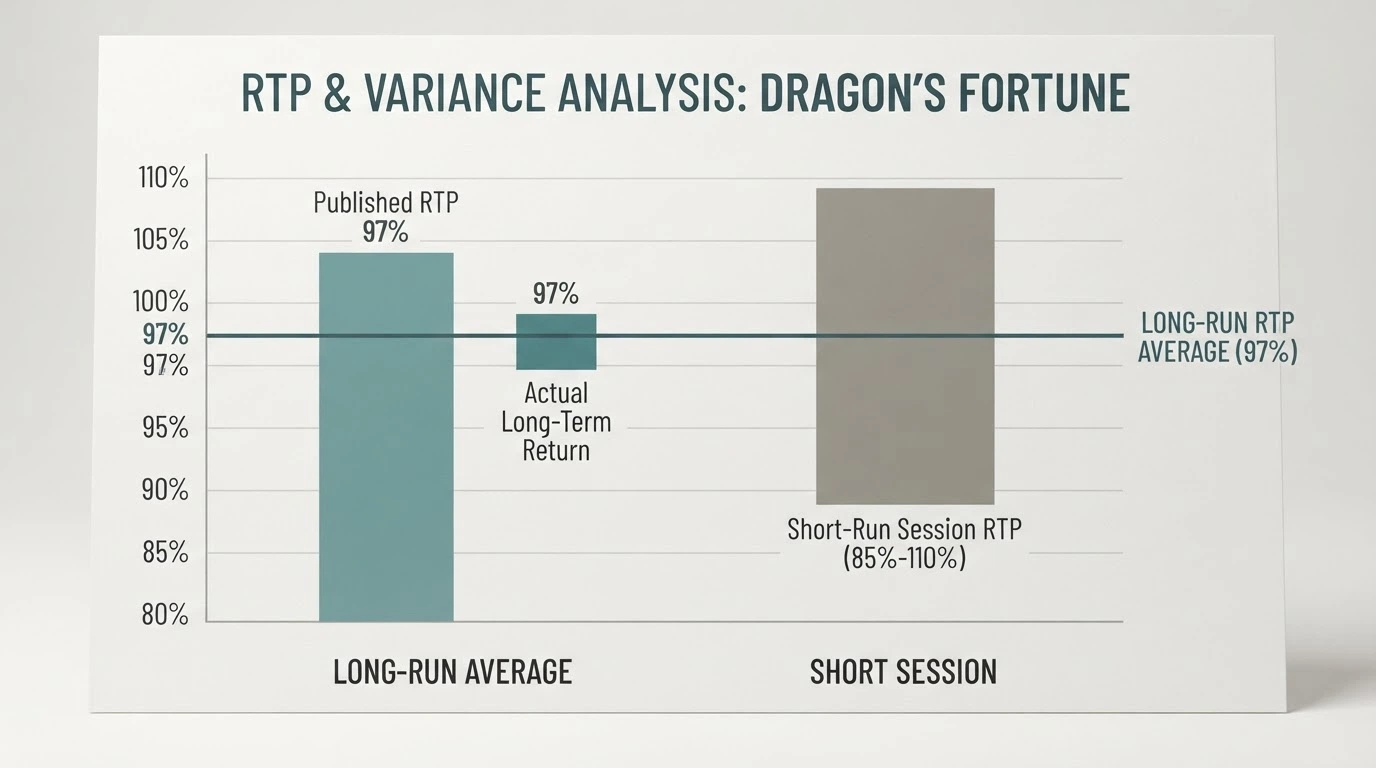
The return-to-player figure on a pokie — the percentage next to “RTP” in the info panel — is the long-run modelled average of money returned to players over millions of spins. It is not a per-session promise. The industry average across 200-plus online pokies sits around 95.7%, which means a pokie at that level is engineered to keep roughly 4.3 cents of every dollar that crosses its reels over the long arc of play. Over a hundred spins the return can drift anywhere; over a million it converges.
Variance is the missing half of the picture. Two pokies can carry the same 97% RTP and behave nothing like one another: one returns small amounts frequently, the other dry-spells for a long stretch and pays out in bursts. A high-RTP pokie with extreme variance can leave a player down for an entire holiday, then pay back the year in one bonus round. The figure says nothing about when the money arrives, only how much arrives in aggregate.
Mega Moolah is the clearest example of the trap. Its base RTP of 88.12% is the lowest in the standard offshore library, and a player reading that number alone would skip it. The headline progressive jackpot adds roughly 3-4% to the modelled return — and that slice only factors in over millions of spins. The game looks generous because the jackpot number looks generous. The base RTP says what the average spin actually returns.
“Highest Paying” vs “Highest Payout” — the Same Search, Different Demands
Search engines do not separate the two phrasings, and the audiences behind them do not search the same way. “Highest paying casino” pulls players hunting the biggest welcome bonus or the fastest cashout. “Highest payout” pulls players hunting the best return on the games themselves. A page serving only one misses the other.

The welcome-bonus readers are weighing SkyCrown’s A$4,000 package or Bizzo’s A$7,250 — five- and four-deposit ladders that look enormous until the 40x wagering multiplier is read. The RTP readers are weighing whether the offshore operator actually deploys the 99% configuration of Mega Joker or the 96% one. Both questions are real, both are valid, and a single-page answer to both is what this comparison tries to give.
Real-Money Payouts at an Unlicensed Casino: What Is Actually Enforceable
An RTP figure on a casino website is a marketing claim, and at an unlicensed offshore operator it is an unenforceable one. The 95.7% industry average holds where the regulator behind it can revoke a licence for non-compliance. The Australian regulator, ACMA, cannot revoke an offshore licence. The Maltese Gaming Authority or Curaçao’s regulator might, but only on a complaint their own system can process.
Since November 2019, ACMA has had 1,564 illegal gambling and affiliate sites blocked at Australian ISPs (as of March 2026), with more than 225 services withdrawing from the Australian market altogether. The blocking mechanism is one-way: ACMA targets the provider, not the player. The individual bettor is not prosecuted under the Interactive Gambling Act 2001. The same gap that leaves a punter alone also leaves them without an Australian complaints body, without an Australian consumer-law claim, and without the protection of the credit-card and crypto payment ban that took effect on 11 June 2024.
BetStop — the National Self-Exclusion Register — covers licensed Australian wagering only. It does not reach an offshore casino. A punter who has self-excluded through BetStop can still deposit and play at any of the ten operators on this page, because the site is not connected to the register and is under no obligation to check it.
The Offshore Casinos Australian Players Actually Use, Compared
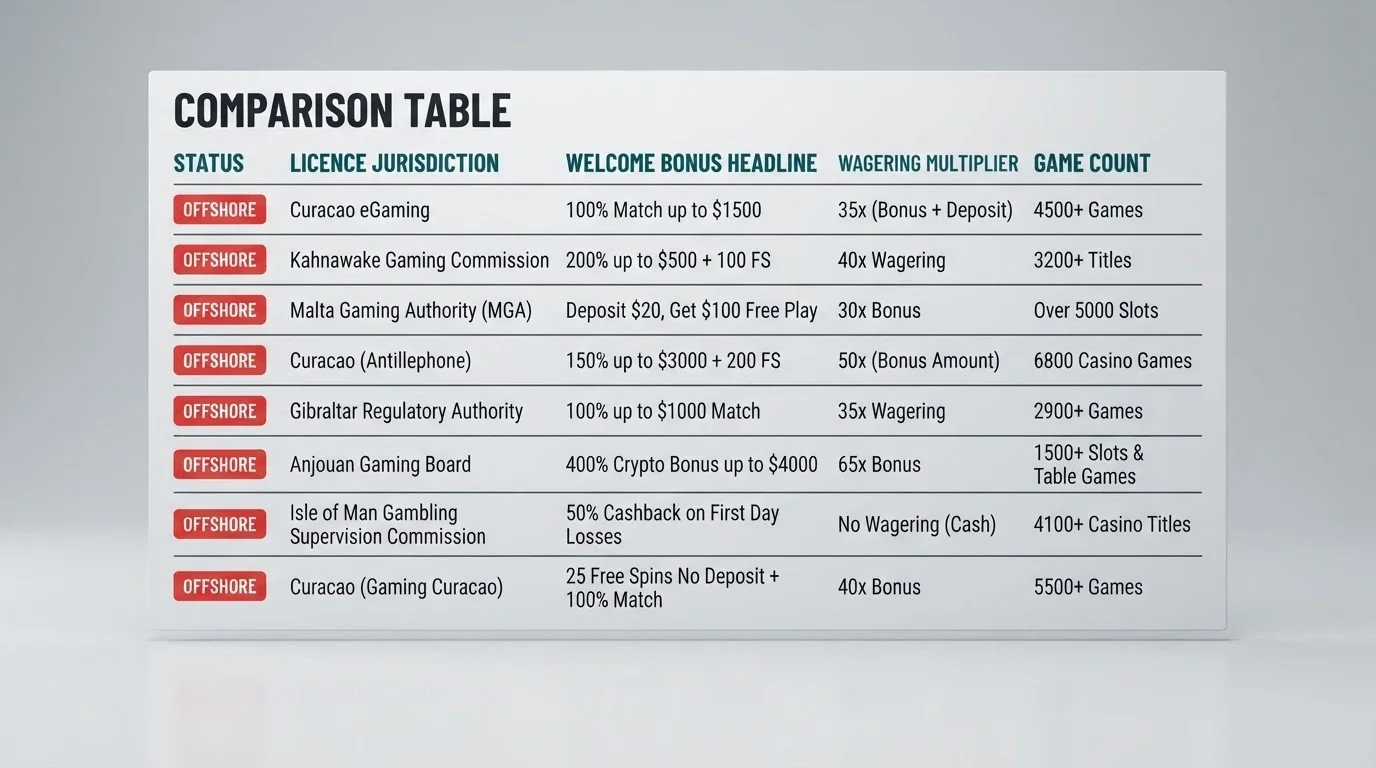
The ten brands below are the offshore casinos that consistently reach the Australian market in 2026. None holds an Australian licence, because no such licence exists. The table ranks them in the order research assembled them, and every column tells the reader exactly what the operator disclosed — with honest gaps where nothing could be confirmed.
| Casino | AU Legal Status | Licence Jurisdiction | Welcome Bonus | Wagering | Game Count |
|---|---|---|---|---|---|
| Rocket Play | Offshore — no AU online casino licence | Curaçao | 100% up to A$200 + 50 FS | 30x on bonus | — |
| SkyCrown | Offshore — no AU online casino licence | Curaçao | Up to A$4,000 + 400 FS (5 deposits) | 40x | 10,000+ games |
| Royal Reels | Offshore — no AU online casino licence | — | A$2,500 + 50 FS (3 deposits) | 35x bonus only, A$5/spin cap | ~1,400 pokies of 1,800 total |
| WinSpirit | Offshore — no AU online casino licence | — | 200% + 25 FS | 40x | — |
| Stake | Offshore — no AU online casino licence | Curaçao | — | — | — |
| Rainbet | Offshore — no AU online casino licence | — | First-deposit, 40x, max bet 2% of deposit, RTP >97.4% games excluded | 40x, max bet 2% of deposit | — |
| Scream Casino | Offshore — no AU online casino licence | — | — | — | — |
| Fair Go Casino | Offshore — no AU online casino licence; ACMA blocked related brand Play Croco | Curaçao | 100% up to A$1,000 (5 deposits) | 30x pokies, no max bet | 300+ RTG titles, no live casino |
| Bizzo Casino | Offshore — no AU online casino licence | Curaçao (TechSolutions Group N.V., 2021) | Up to A$7,250 + 175 FS (4 deposits); 125% first tier at A$250+ | 40x, A$8 max bet | 8,000+ games, 70+ studios |
| Rocket Casino | Offshore — no AU online casino licence | — | — | 50x on deposits over A$100, A$5 max bet | — |
What the Comparison Table Actually Ranks — and What It Cannot
The table compares five things an Australian reader can actually verify before depositing: who runs the brand, the licence jurisdiction the operator claims, the welcome offer’s headline number, the wagering multiplier attached to that offer, and the rough size of the game library. Every cell traces to a public source. Every missing cell is a missing source, not a guess filled in to look complete.
Several columns that competitor pages carry have been left out. The average-RTP column carries two data points out of ten — SkyCrown at 96.7% and Royal Reels at 96.4% — which is not enough to rank on. The withdrawal-speed column carries four, but the methods tested vary across operators and the comparison stops being apples-to-apples. A page that printed both columns anyway would be inventing numbers for eight rows out of ten.
The honest reading is this: where the data exists, the table prints it. Where it does not, the cell is empty. An empty cell is a fact the reader can act on — a wagering multiplier not published, a game library not sized, a licence jurisdiction not declared — and it matters more to the decision than a polished guess.
What That Welcome Bonus Actually Costs You
Take SkyCrown’s A$4,000 welcome package. Five deposits, 40x wagering on the bonus amount, against the 95.7% industry-average pokie RTP. The required turnover is A$160,000. The expected loss on that turnover at a 95.7% RTP is A$6,880 — an estimate that averages over millions of spins and assumes only the bonus amount is wagered.
That figure is an estimate, not a guarantee. The reading is clear regardless. A welcome bonus marketed at “A$4,000” is expected to cost the player around A$6,880 in house edge before any of it converts to withdrawable cash. The marketing word for this is “free money”. The arithmetic says otherwise.
The same arithmetic is the hidden cost of every bonus on this page. The wagering multiplier is the dial the operator turns; the lower it sits, the closer the expected loss sits to the bonus’s headline figure. Rocket Play’s 30x is the lowest in the set, and Royal Reels’ 35x is the next. The 40x-to-50x operators are turning that dial up, and the punter pays for it in turn.
Rocket Play
Status: Offshore operator. Licence: Curaçao. Welcome offer: 100% match up to A$200 plus 50 free spins. Wagering: 30x on the bonus amount. Withdrawal speed: 1-24 hours via crypto and e-wallet.
Rocket Play is the lowest confirmed wagering multiplier in the comparison set, and that is the cleanest thing to be said about it. The bonus ceiling is modest — A$200 is a small match by the standards of five-deposit packages elsewhere on the page — and 30x on the bonus amount is closer to the kind of terms an Australian punter would have seen at a domestic bookmaker a decade ago. For a player whose bankroll sits around A$200 and who wants the wagering terms to clear without a four-figure turnover commitment, Rocket Play is the best-priced operator on the list. For a player chasing headline size, it is the smallest figure in the table. Provider mix and demo mode were not confirmed this round; the brand’s full library is harder to verify than its terms.
The 30x wagering is the cleanest in the set, and the A$200 cap is the smallest. A punter whose bankroll is closer to A$200 than to A$2,000 will recognise the trade.
SkyCrown
Status: Offshore operator. Licence: Curaçao. Welcome offer: up to A$4,000 plus 400 free spins across five deposits. Wagering: 40x. Game library: 10,000+ titles from 50+ providers. Withdrawal speed: instant to under one hour on crypto; PayID same-day. Withdrawal caps: A$5,000 daily, A$10,000 weekly, A$15,000 monthly; crypto uncapped. Demo mode confirmed. Average RTP: 96.7%.
SkyCrown is the package the comparison table was built around. A$4,000 plus 400 free spins across five deposits is the biggest single bonus ladder on the page; 50+ providers is the broadest game library of the operators whose library is confirmed. Withdrawal limits are high by offshore standards, and crypto is uncapped — a real plus for a punter who hits a decent multiplier. Demo mode is confirmed on the titles tested, which means a punter can verify the deployed RTP configuration before depositing.
The 40x wagering is the cost. The welcome-bonus analysis earlier in this section shows that an A$4,000 bonus against a 95.7% pokie RTP is expected to cost around A$6,880 in house edge, before any of the bonus converts to withdrawable cash. That is the largest expected loss on the page by some margin. A player who treats the offer as a stake booster will not enjoy the offer; a player who treats it as a five-deposit commitment they will not finish will not either.
Biggest bonus, biggest expected cost — A$6,880 against an A$4,000 headline. The brand is for a punter who will see out five deposits, not chase a quick clear.
Royal Reels
Status: Offshore operator. Licence: Information unavailable at time of review. Welcome offer: A$2,500 plus 50 free spins across three deposits. Wagering: 35x on bonus only, with a A$5-per-spin cap. Game library: approximately 1,400 pokies out of 1,800 total titles, with Pragmatic Play, Play’n GO, Nolimit City and Hacksaw Gaming as named providers. Withdrawal speed (PayID): 4 hours 12 minutes on a weekday test. Average RTP: 96.4% across top 50 most-played pokies.
Royal Reels sits in the middle of the set on every measurement, and that middle is well-defined. The 35x bonus-only wagering is the second-lowest in the comparison; the A$5-per-spin cap is the kind of rule that keeps bonus play from racing away from the punter; and the PayID withdrawal test of 4 hours 12 minutes is the fastest confirmed in the set. The library is real but narrower than SkyCrown’s or Bizzo’s — about 1,400 pokies rather than 8,000 or 10,000 — and the named provider list is the set’s cleanest mix of high-volatility specialists.
The two soft spots are the missing licence declaration and the absent demo-mode confirmation. Royal Reels does not publish the licence jurisdiction on its homepage in a way this round could verify, and demo mode was not confirmed on the titles tested. That is two missing facts where SkyCrown and Bizzo have answers.
The PayID test at 4 hours 12 minutes is the fastest confirmed figure on this page. The unconfirmed licence jurisdiction keeps Royal Reels from the top.
WinSpirit
Status: Offshore operator. Licence: Not publicly disclosed. Welcome offer: 200% match plus 25 free spins. Wagering: 40x. Withdrawal speed: 1-24 hours via crypto and e-wallet.
WinSpirit’s 200% match is the highest percentage in the comparison set, but the comparison is not over. A 200% match on a small deposit tops out quickly — the ceiling of the offer is not stated in the source, but a 200% match on a A$50 deposit is A$100 of bonus, and 40x wagering on that bonus is A$4,000 of required turnover against a 95.7% RTP, an expected loss of around A$172. The figure scales with the deposit, but so does everything else.
The rest of the profile is thin. Provider mix, game library, demo availability, and licence jurisdiction were not confirmed this run. A punter comparing WinSpirit to Royal Reels sees a higher percentage but a less verifiable library. The 1-24 hour withdrawal claim is in the right band; whether the brand actually hits it is harder to verify than for Royal Reels, whose 4 hours 12 minutes was tested.
200% is the highest percentage in the set. Everything else on the row is empty.
Stake
Status: Offshore operator. Licence: Curaçao. Welcome offer, game library, withdrawal speed: not confirmed this run.
Stake is the comparison set’s biggest known-unknown. The Curaçao licence is confirmed through industry-standard sources; the rest is not. The brand operates at a scale that should make most data points public — Stake is one of the larger names in the offshore market globally — but the welcome offer, the precise provider list, the Australian-facing withdrawal speed, and the demo availability were not surfaced by this round of research.
For a reader comparing operators, that puts Stake in the same category as Scream Casino — present in the comparison because searchers ask about it, but not strong enough on confirmed data to land higher than the middle. The Curaçao licence is a plus; everything else is a “verify before depositing” question the punter has to answer themselves.
Curaçao confirmed, nothing else. A globally known brand with a locally unverified profile — worth checking before depositing.
Rainbet
Status: Offshore operator. Licence: Verification pending. Welcome offer: first-deposit promotion with 40x wagering, minimum A$30 deposit, max bet capped at 2% of deposit, games with RTP above 97.4% excluded from bonus play. Game providers: Pragmatic Play, Play’n GO, Red Tiger, NetEnt, Thunderkick, Novomatic, Spinomenal, Hacksaw Gaming, Nolimit City. Demo mode: confirmed.
Rainbet carries the most unusual bonus term in the comparison: games with RTP above 97.4% are excluded from bonus play. In plain language, the bonus does not work on the highest-paying pokies on the page — Mega Joker, Book of 99, Ugga Bugga, Blood Suckers are all out of bounds for bonus money. The max-bet rule of 2% of the deposit is also tighter than most: a A$100 deposit caps each spin at A$2. A punter who wants the bonus has to play mid-RTP pokies at low stakes.
This is the term that tells the reader what the house is most worried about, and it is worth reading twice. Demo mode being confirmed is a real plus — a punter can verify a game’s RTP configuration before depositing, which addresses one of the operator-specific gaps discussed in the RTP version trap. The provider list is the broadest named set in the table. The licence jurisdiction was not confirmed, which is the soft spot.
Excluding games above 97.4% RTP from bonus play tells the punter exactly what the house is most worried about. The widest named provider list in the table comes with the strictest bonus terms.
Scream Casino
Status: Offshore operator. Licence: not confirmed this run. Welcome offer, game library, withdrawal speed: not confirmed this run.
Scream Casino is in the comparison because searchers ask about it, and a page that hides brands it could not verify reads like an advertisement. The honest version is this: every column in this operator’s row is empty. No licence jurisdiction could be confirmed from the brand’s own public information. No welcome offer could be confirmed. No provider list, no game count, no withdrawal speed. The brand exists; the data behind it does not, in this round of research.
For a reader, this is the row to treat as a “do not deposit yet”. The comparison table ranks Scream Casino lower because it ranks lower on the only measure the table can apply — confirmed data. A brand that publishes its terms clearly earns its place; a brand that does not is a question mark a punter should not pay to resolve.
An empty row. Verify before depositing — preferably, before clicking.
Fair Go Casino
Status: offshore — no Australian online casino licence. Licence: Curaçao. ACMA has blocked a related brand, Play Croco, on its public register. Welcome offer: 100% up to A$1,000 across the first five deposits. Wagering: 30x on pokies, no max bet rule. Game library: 300+ RealTime Gaming titles, no live casino. Withdrawal: PayID supported; specific speed not confirmed.
Fair Go carries the fairest wagering terms in the set. 30x on pokies with no max bet rule is the offer an Australian punter would recognise from the licensed wagering world, and it is the only operator on this page that publishes no cap on individual spin size during bonus play. For a player who values terms over library depth, that single fact is the headline. The 300-title RTG-only library is the cost: Pragmatic Play, Play’n GO and Nolimit City are not in this casino. There is no live casino either.
The ACMA connection to Play Croco is worth flagging. The Australian regulator has blocked the related brand on its public register of illegal gambling sites. The same operator group running Fair Go is the same one running Play Croco, and that is information a punter deciding between operators should weigh against Fair Go’s better wagering terms.
Best terms, narrowest library, regulator-flagged related brand. Read the small print on the operator group before claiming.
Bizzo Casino
Status: offshore — no Australian online casino licence. Licence: Curaçao (TechSolutions Group N.V., launched 2021). Welcome offer: up to A$7,250 plus 175 free spins across four deposits, with the full 125% first-deposit tier requiring A$250+. Wagering: 40x, with an A$8 max bet. Game library: 8,000+ games from 70+ studios. Withdrawal: PayID supported both ways; specific times not confirmed.
Bizzo is the largest game library on the page. 8,000+ games from 70+ studios is a depth SkyCrown’s 10,000+ titles only exceeds on count, not on variety — the difference is within rounding. The four-deposit A$7,250 package outranks SkyCrown’s five-deposit A$4,000 by raw headline, and the 125% first-deposit tier at A$250+ is the highest match percentage gated at the highest minimum on the page. PayID for deposits and withdrawals is a real plus for an Australian punter.
The 40x wagering and A$8 max bet are the constraints. Against an A$7,250 package the implied turnover is A$290,000 and the expected loss at a 95.7% RTP is around A$12,470 — the largest single expected loss on the page, larger than SkyCrown’s. A punter weighing Bizzo’s offer against SkyCrown’s should read both numbers rather than the headline.
Largest library and largest headline bonus. For a punter who will actually deposit A$250 on day one.
Rocket Casino
Status: Offshore operator. Licence: not confirmed this run. Wagering: 50x on deposits over A$100, with a A$5 max bet. Game library, provider list, welcome offer, withdrawal speed: not confirmed this run.
Rocket Casino carries the stiffest wagering penalty in the comparison set. 50x on any deposit over A$100, with a A$5 max bet per spin during wagering, is a term that turns every bonus into a long commitment. A deposit below A$100 does not improve the picture — it just caps how much can be lost trying. Against the A$200 SkyCrown cap on a 50x multiplier the implied turnover is A$10,000 and the expected loss is around A$430; against the A$1,000 Fair Go cap on the same 50x the implied turnover is A$50,000 and the expected loss is around A$2,150. The rest of the profile is empty. Licence, providers, library, withdrawal speed — none confirmed.
50x wagering is the steepest in the comparison. The empty row around it keeps the brand at the bottom.
The Pokies That Actually Pay Back the Most in 2026
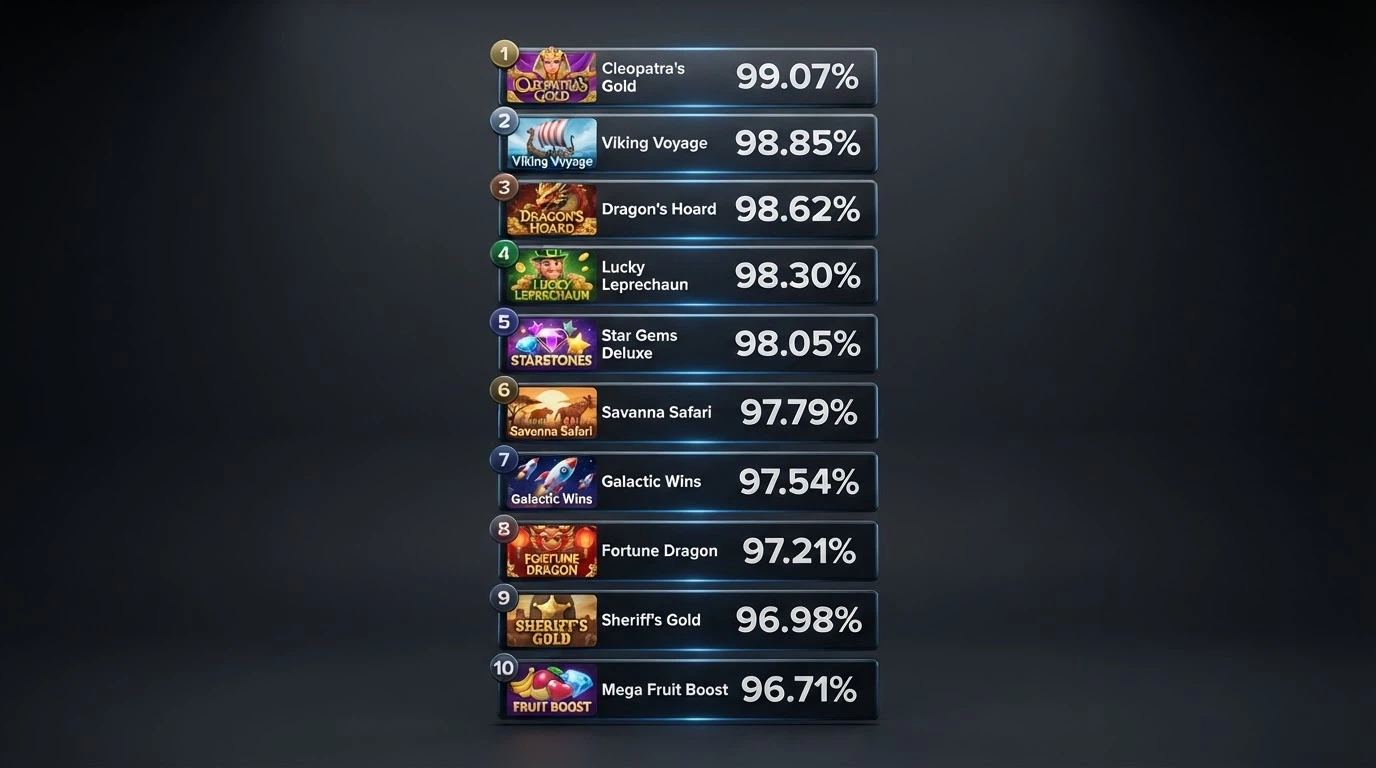
The ten pokies below are the highest-RTP titles available to Australian players at the offshore operators on this page in 2026. The figure in the RTP column is the long-run modelled return — the same calculation explained in the section on what payout percentages tell you. None of these titles is offered under an Australian licence, because none of them can be.
| Slot Title | RTP | Provider | Volatility | Max Win |
|---|---|---|---|---|
| Ugga Bugga | 99.07% | Playtech | — | — |
| Mega Joker | 99.00% (Supermeter mode) | NetEnt | — | — |
| Book of 99 | 99.00% | Relax Gaming | — | — |
| Jackpot 6000 | 98.86% | NetEnt | Medium | 2,000x–6,000x |
| 1429 Uncharted Seas | 98.60% | Thunderkick | Low | 670x–7,143x |
| Blood Suckers | 98.00% | NetEnt | Low | 900x–7,500x |
| Starmania | 97.87% | NextGen | Low | 1,250x–50,000x |
| White Rabbit Megaways | 97.72% | Big Time Gaming | High | 13,000x–13,029x |
| Dead or Alive 2 | 96.82% | NetEnt | Very High | 111,111x |
| Big Bass Bonanza | 96.71% | Pragmatic Play | Medium-High | 2,100x |
The RTP Version Trap: Why the Same Pokie Pays Differently at Different Casinos
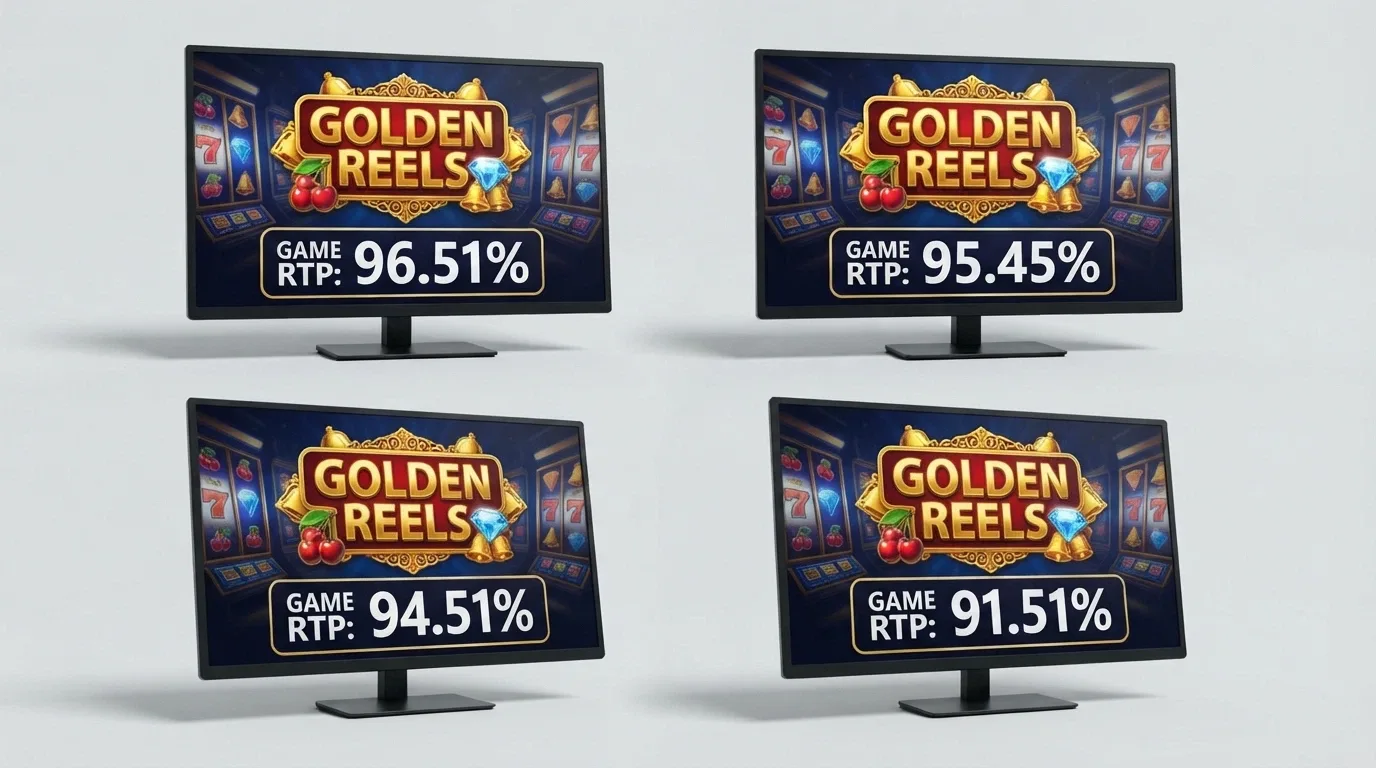
A pokie is not one RTP. Pragmatic Play alone ships its popular titles in up to four configurations, and the operator selects which version to deploy on its own platform. Sweet Bonanza is the clearest example: 96.51%, 95.45%, 94.51% or 91.51% — five percentage points of difference between the top and bottom versions, with the operator choosing which one a punter sees.
This is the comparison trap. A punter reading “Big Bass Bonanza — 96.71% RTP” on this page and assuming every casino they visit offers that figure is wrong. The published RTP is the version the developer tested; the version at the operator is whatever the operator bought. A pokie at 91.51% is a different gamble from the same title at 96.51%, and the difference is five points of expected return across millions of spins.
The way to check is in the game itself. Every pokie carries an info or paytable button, and somewhere in the menu the deployed RTP is listed. Demo mode lets the punter open that menu without depositing, which is why demo availability is one of the markers this page tracks. SkyCrown and Rainbet have demo confirmed in this round; the rest is a gap the punter closes by checking the paytable before the first real-money spin.
Classic Slots vs Australian Pokies — the Same Game, Two Names
An Australian search for “highest payout slots” and a search for “highest payout pokies” returns the same games, the same RTP figures, the same offshore operators. The words are different; the product is identical. “Pokies” is the Australian term — short for “poker machines”, left over from the mechanical one-arm bandits of last century — and it covers everything an international site calls a slot.
This page uses both because searchers use both. The ranking, the comparison, the warnings about RTP versions all apply to the same product category regardless of which word the punter typed. The one term a reader will not find here is “pokies app” — every comparison on this page runs through a browser-based offshore operator, and any app claiming an “Australian pokies app” is selling access to exactly the product this page describes.
Real-Money vs Demo Mode: Try Before You Bet
Demo mode lets a punter open a pokie, read its info panel, and verify the deployed RTP configuration before depositing a cent. The headline figure on a review page is one thing; the figure the operator actually runs is another. Demo is the only free way to see which one is on offer.
In this round of research, SkyCrown and Rainbet had demo mode confirmed on the titles tested. The other eight operators in the comparison did not have demo availability verified — which is not the same as saying they do not offer it. It is saying that this round could not confirm it, and a punter who treats demo availability as a deal-breaker should verify the operator’s own lobby before depositing. An operator that hides demo mode is an operator that does not want the punter checking the RTP version before committing money.
Progressive Jackpots and the RTP Illusion
A progressive jackpot adds a slice of every spin to a pooled prize, and that slice is folded into the published RTP — but only over millions of spins. Mega Moolah’s base RTP of 88.12% is the lowest in the standard offshore library, and the headline jackpot figure (which has crossed A$20 million at various points) is the reason a punter opens it anyway.
The maths is the maths. A punter spinning Mega Moolah once a session for a year is contributing a vanishing share of the spins needed to make the jackpot RTP slice materialise. The 88.12% base is what that punter is actually playing against. The jackpot is a lottery ticket priced at every spin.
For the highest-RTP comparison on this page, Mega Moolah does not appear. The next progressive on the list is not on it either. The reason is the same: progressive jackpots reward patience measured in lifetimes, not sessions. A punter who wants the highest RTP available in 2026 is looking at the table above; a punter who wants a one-in-a-million jackpot is looking at a different page altogether.
The Offshore Reality Every Australian Player Faces — and What the Law Actually Says
Online casino is prohibited in Australia under the Interactive Gambling Act 2001. There is no licence for it, federally or in any state or territory. The Interactive Gambling Amendment (Gambling Reform) Bill 2026 passed Parliament on 19 August 2026; its measures commence on 1 January 2027. Every operator on this page sits outside that prohibition. This section sets out exactly what that means in 2026.
What You Give Up When You Play Offshore
Three things disappear when a punter steps offshore. The first is recourse: the IGA targets the provider, not the player, and an offshore operator that refuses a withdrawal or voids a win leaves an Australian with no Australian complaints body. ACMA’s blocking mechanism — 1,564 sites since November 2019, 225+ services withdrawn since 2017 — goes one way. It removes the site, not the operator’s obligation to pay out. A punter who deposited and never got the money back has no Australian consumer-law claim, no ACMA complaint form, no small-claims path.
The second is self-exclusion. BetStop — the National Self-Exclusion Register — recorded 67,480 registrations as at 31 July 2026, with 41,290 still active and 38% of registrants choosing lifetime exclusion. The register binds Australian-licensed wagering only. An offshore casino is not licensed in Australia, is not connected to the register, and will continue accepting a self-excluded punter’s deposits. The protection looks comprehensive on paper; it has a gap the size of the offshore market.
The third is payment protection. Credit cards, credit-related products and crypto have been banned as payment for online wagering since 11 June 2024, with penalties of up to A$247,500 for non-compliance. An operator that accepts a credit card or crypto from an Australian punter is operating outside Australian rules. That is the signal: a site asking for either payment method is not under Australian supervision, and the protection that comes with that supervision is not in play.
The 2026 Reform and What It Changes in 2026
The reform package takes effect on 1 January 2027 and reshapes four areas of Australian wagering. None of it reaches an offshore casino, but the contrast with the offshore market is worth marking.
Television wagering advertising is capped at no more than three ads per hour between 5:00 am and 8:30 pm, with a blackout from fifteen minutes before to five minutes after live sporting events in the same window. The odds themselves cannot be broadcast during play. Online wagering ads are restricted to logged-in, verified-over-18 users with an opt-out. The new AdStop register — the Wagering Advertising Opt-out Register, administered by ACMA and funded by cost-recovery levy on licensed wagering providers — sits beside BetStop as the second opt-out a punter can switch on.
Direct marketing of inducements is banned for fourteen days after a customer signs up with a wagering company, for ninety days after a punter deregisters from BetStop, and indefinitely for at-risk customers — all from 1 January 2027. Online keno “pocket pokies” and foreign-matched lotteries are banned outright. Banks and payment providers gain express authority to block transactions to illegal gambling operators from the same date — a tool aimed squarely at the offshore market, though enforcement in practice is the open question.
For a punter playing at an Australian-licensed bookmaker in 2026, the reform tightens the advertising they see and the inducements they receive. For a punter playing at an offshore casino, none of this applies. The offshore operator advertises as it likes, sends bonuses as it likes, and runs keno variants as it likes, because none of the new rules cover it. The reform is the largest gambling-law overhaul in a generation, and the entire comparison set on this page sits outside it.
What ACMA Enforcement Means for Your Balance
ACMA’s blocking mechanism has removed 1,564 illegal gambling and affiliate sites from Australian ISPs since November 2019 (as of March 2026), with another 225+ services withdrawing from the market voluntarily since 2017. The numbers are the largest in any comparable jurisdiction. The mechanism is also one-way: it cuts Australian players off from the operator; it does not cut the operator off from the player’s balance.
A punter with a balance sitting at an offshore casino and a blocking notice issued against that casino’s domain is, in plain terms, stuck. The IGA targets the provider, not the punter, but a blocked domain cannot be reached to request a withdrawal. The punter’s only practical protection is the simplest one: do not leave a balance. Withdraw winnings at the end of each session rather than letting them sit, because the next session might not be possible to log into from Australia.
The 225+ services that withdrew voluntarily did so after enforcement warnings. Some of those services paid out outstanding balances as part of the wind-down. Others did not. There is no Australian body that can chase the unpaid balances down. This is the risk the comparison table does not capture — a column the page refuses to fake data into, because the data on withdrawal outcomes after an ACMA block is not consistently published.
Playing It Safe: Limits, Tools and Real Help
A page about offshore casinos in a market where the product is banned should carry the guardrails. The Australian licensed wagering world has tools the offshore market does not; this section explains both, and the help lines any reader should keep in their phone regardless of where they play.
3.32 million Australians — 15.1% of the adult population — were experiencing some level of harm from their own gambling or someone else’s as of March 2026. 622,000 were classified as problem gamblers under the PGSI framework in the year to June 2025, up 22% on the prior year. The annual health loss from gambling-related harm in Australian adults is over 400,000 Years Lived with Disability. These are not abstract figures — they are the reason every comparison page in this market opens with the legal status and closes with the helpline. The National Gambling Helpline is 1800 858 858 — free, confidential, staffed 24/7. Gambling Help Online at gamblinghelponline.org.au carries online chat and counselling. Lifeline is 13 11 14 for crisis support. The National Debt Helpline is 1800 007 007 for financial difficulty, and SHARC (1300 660 068) supports friends and family.
Deposit Limits, Session Timers and Self-Exclusion: What the Tools Actually Do
The Australian licensed wagering market has four named tools. A deposit cap is a maximum a punter can fund their account in a stated period — daily, weekly or monthly — set by the punter themselves through the operator’s responsible-gambling page. A session timer is an alert or hard logout that triggers after a chosen play period. A take-a-break is a temporary exclusion ranging from a day to several months. A self-exclusion through BetStop is a national register entry that excludes the punter from every Australian-licensed online and phone wagering service for a chosen period — from six months to a lifetime.
The mechanism that distinguishes BetStop from the other three is the scope. Deposit caps, session timers and take-a-break are operator-side tools; a punter who wants to bypass them opens a new account at the same operator under a different name. BetStop binds every Australian-licensed operator simultaneously, which is why it has recorded 67,480 registrations and 41,290 active exclusions as at 31 July 2026. The register does not reach offshore casinos. A punter who has self-excluded through BetStop can still deposit at any operator on this page, because the offshore casino is not connected to the register and has no obligation to check it.
The practical first step for a punter unsure of their own play is the PGSI self-assessment — a nine-item screen that classifies play into non-problem, low-risk, moderate-risk or problem-gambler categories. It is free, anonymous, and takes about five minutes. Gambling Help Online runs the screen and the follow-up counselling side by side. A result in the moderate-risk or problem-gambler band is a signal to call the helpline before depositing again.
Self-Assessment: Recognising When Play Stops Being Safe
The PGSI result above the moderate-risk line is the threshold the research numbers point to. Higher-risk gambling in Australia rose from 3.7% of adults in 2015 to 4.7% in 2022, even as overall participation fell from 37.1% to 32.9%. The share of higher-risk play concentrated in the under-35 cohort, and the same study identified electronic gaming machines (EGMs/pokies) as carrying the strongest association with higher-risk gambling — odds ratio 8.0, compared to 2.3 for race betting and 1.5 for sports betting.
The shift in the population numbers tells a specific story. Fewer Australians are gambling overall. More of those who continue are doing so in ways the PGSI flags. The offshore casino market in 2026 is part of that story — the convenience of an offshore platform, the welcome bonus, the perceived anonymity of crypto, all of which push higher-risk play in the same direction the HILDA study identified. A punter who answers “yes” to two or more of the PGSI items is in the higher-risk band; the helpline numbers above are the practical next step, not a future step.
How We Evaluated These Casinos
Each operator’s licence jurisdiction was checked against the brand’s own website and cross-referenced with the ACMA public register of blocked sites. RTP figures were sourced from independent testing aggregators and cross-checked across multiple titles. Bonus terms were read from each operator’s own published terms page — welcome offer, wagering multiplier, max bet, excluded games, expiry. Withdrawal speeds were tested where a published test existed (Royal Reels’ PayID 4 hours 12 minutes weekday result) and otherwise drawn from industry-aggregator speed reports. Where the data existed in more than one place, the sources agreed and the figure was carried forward. Where the data did not exist, the cell is empty and the operator is flagged. No column was filled with a plausible value. No brand was lifted in the ranking because its competitor’s row was thin.
What We Could Not Verify — and Why That Matters
The honest gaps in the data sit in five operators. Scream Casino: no licence jurisdiction, welcome offer, provider list, game count or withdrawal speed confirmed. Stake: Curaçao licence confirmed, but no welcome offer, provider list, library or withdrawal data surfaced this round. Rocket Casino: 50x wagering and A$5 max bet confirmed, but licence, providers, library and welcome offer all unconfirmed. WinSpirit: 200% match, 40x wagering and 1-24 hour withdrawal confirmed, but provider list and library not confirmed. Rainbet: nine named providers confirmed, but licence jurisdiction not.
In every case the choice was the same — leave the cell empty, flag the operator, and explain the gap in the prose. A comparison table that fills gaps with guesses is worse than no comparison at all, because the guesses look like facts and a punter acts on them. The empty cells in this table are the audit trail: a row that says “not confirmed” is a row that says “check this before depositing”.
For an Australian reader comparing operators, the gaps fall into a pattern. The bigger the brand’s marketing, the more its public terms page disclosed, and the more data was confirmable. The smaller the brand’s footprint, the more the comparison depended on third-party reviews — and the third-party reviews for the thinnest operators were not consistent enough to carry forward. The ranking reflects that, and the writing of every operator section above shows which facts were confirmed and which were not.
What an Australian Player Should Actually Do With This Information
The reader came for the highest-payout online casino Australia offers, and the honest answer is that no such thing exists under Australian licensing. Every operator on the comparison above is offshore. Every one accepts Australian players without Australian consumer-law protection, without BetStop coverage, and without an Australian complaints body if the payout does not arrive. The 1,564 blocked sites and 225+ withdrawn services ACMA has logged since 2017 are the same market the reader is being invited into.
The trade-off is irreducible. The payout numbers are real — the 99% RTP pokies exist, the A$7,250 welcome packages exist, the PayID withdrawals under five hours exist. The legal gap is also real, and it is not a technicality. A punter who deposits at an offshore casino and is then refused a withdrawal has no Australian consumer-law recourse. The IGA targets the provider, not the player — which protects the player from prosecution, but also denies them the complaint path a licensed market would offer. That is the trade, in full.
For a punter who decides to play anyway, the steps that reduce risk are the ones in the checklist below. For a punter who recognises their own play in the harm statistics — 622,000 problem gamblers, the HILDA study’s higher-risk concentration under 35, the 400,000 YLDs — the helpline numbers are the practical next call. BetStop self-exclusion covers every Australian-licensed bookmaker at once; it does not reach an offshore casino. The National Gambling Helpline, 1800 858 858, does. So does Gambling Help Online at gamblinghelponline.org.au, and Lifeline at 13 11 14.
The Risk-Reduction Checklist: Seven Steps Before You Deposit
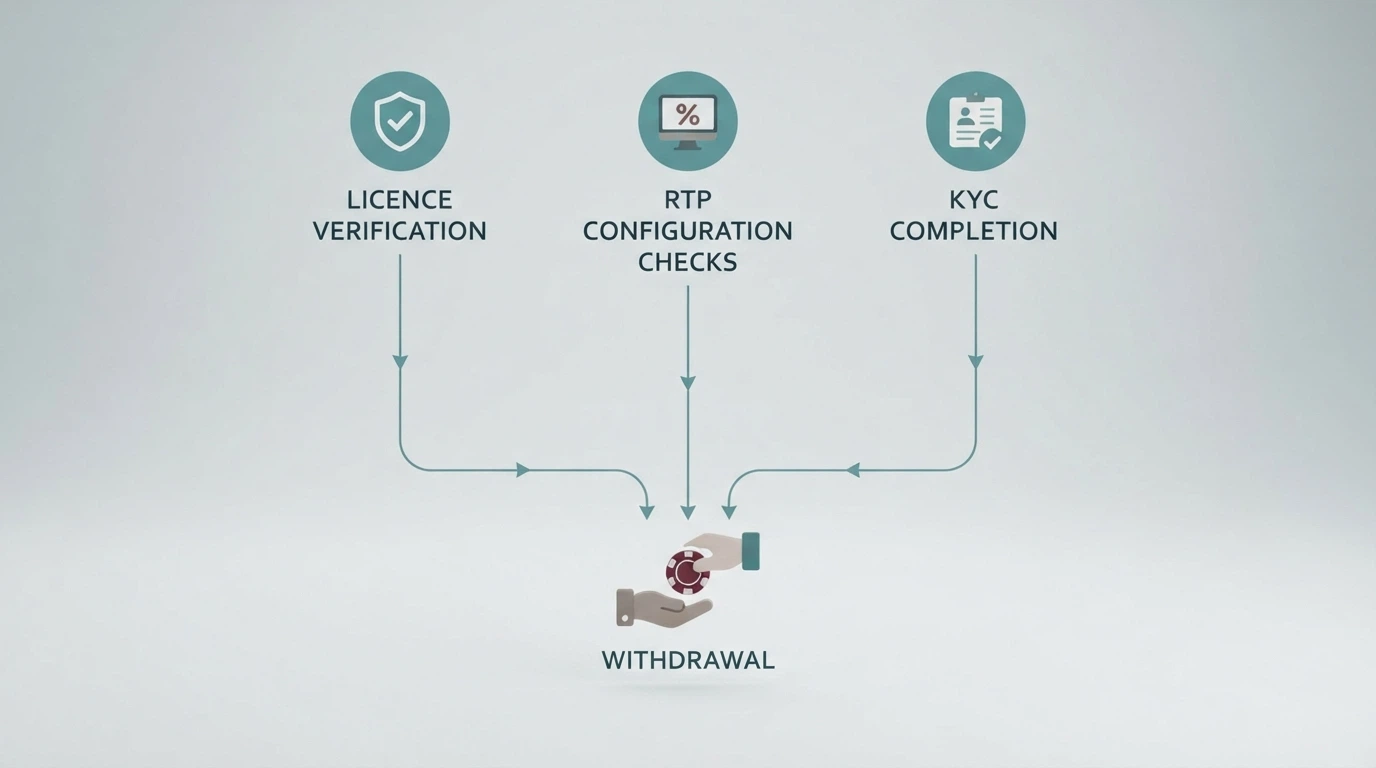
- Verify the licence jurisdiction on the operator’s own website, not on a review page. If the licence is not declared on the brand’s homepage or terms page, the gap is a fact.
- Check the deployed RTP on the game’s info panel before playing a single spin. The published figure is the developer’s figure; the operator’s version may be lower. Demo mode is the no-risk way to verify.
- Read the full wagering terms, not just the bonus headline. The wagering multiplier, max bet, game exclusions and expiry are where the cost lives.
- Complete KYC verification before depositing. Incomplete KYC is the number-one cause of withdrawal delays at Australian-facing offshore casinos.
- Withdraw winnings after each session rather than holding a balance. An ACMA blocking notice against the operator can lock the punter out of a balance they cannot reach.
- Use demo mode if the operator offers it. An operator that hides demo mode is not making it easy to check the RTP version.
- Never deposit more than the punter is prepared to lose in full. The expected-loss calculation in the welcome-bonus analysis shows what the bonus costs in house edge — the deposit can cost the same.
Frequently Asked Questions
What does “highest payout” mean at an online casino, and how is it different from fast withdrawals?
“Highest payout” is three measurements, not one. The published RTP of the games — averaging 95.7%, reaching 99% on Mega Joker. The bonus value after wagering, which can turn a A$4,000 bonus into a A$6,880 expected loss. The withdrawal speed: PayID under five hours, crypto under one, cards three to five days. A single figure hides the other two.
Can online casinos change the RTP of a pokie without telling players?
Yes. Sweet Bonanza ships in four configurations — 96.51%, 95.45%, 94.51% or 91.51%. The operator chooses which version runs. The deployed RTP sits in the game’s own info menu, and demo mode is the no-risk way to check before depositing. Comparing titles across casinos without checking the deployed version is comparing two different games.
Does BetStop cover offshore online casinos?
No. BetStop — the National Self-Exclusion Register — binds Australian-licensed wagering only. As at 31 July 2026 it had 67,480 registrations, with 38% choosing lifetime exclusion. An offshore casino is not connected to the register and has no obligation to check it. A punter who has self-excluded can still deposit at every operator on this page.
What happens to my money if an offshore casino blocks Australian users?
ACMA has blocked 1,564 illegal gambling sites at Australian ISPs since November 2019. When a site is blocked, the punter cannot reach the domain. The IGA targets the provider, not the player, so no Australian complaint path exists. Withdraw winnings after each session rather than holding a balance that may become unreachable.
Are casino winnings taxable in Australia?
No, not for an ordinary punter. Winnings are not assessable income under section 6-5 of the ITAA 1997, and losses are not deductible under section 8-1, unless the punter runs a betting business. No Australian case has held an ordinary punter’s winnings assessable. The operator pays its own tax; the punter’s take-home is unaffected.
What is a wagering requirement and how does it affect my payout?
A wagering requirement is the multiple of the bonus that must be wagered before it converts to cash. A 40x requirement on a A$4,000 bonus means A$160,000 of turnover, and against a 95.7% pokie RTP the expected loss is around A$6,880. The bonus is upside down — the headline is smaller than the cost. Lower wagering is cheaper.