
Fast Withdrawal Casinos in Australia: What the Speed Costs You
Payout data current as of 22 November 2026. Licence claims verified against the ACMA register (acma.gov.au).
A fast withdrawal at an Australian online casino is one of those marketing terms that sounds simple until you ask the obvious follow-up: fast by whose clock, and protected by whose rules. The answer reshapes the whole conversation. Australia has never licensed an online casino — not a single one — which means every brand promising fast payouts to Australians does so without an Australian licence, without BetStop coverage, and without any consumer protection an Australian regulator can enforce.

That is the structural reality before any payout speed comparison begins. Once it is on the table, the speed question itself becomes more interesting, because the fastest cash-out in the featured set arrives in seconds, on a blockchain rail, from an operator the ACMA can block tomorrow morning.
This page is a working guide to that reality: how the speed tiers actually behave, which payment method moves a withdrawal in under fifteen minutes and which takes a full working week, what the wagering terms on a welcome bonus do to your cash-out timeline, and what the offshore status means for a player who registers with BetStop expecting the system to hold.
Table of Contents
- What a Fast-Withdrawal Casino Actually Means for Australian Players
- Why One Withdrawal Method Lands Your Cash Days Faster Than Another
- The Fastest-Paying Online Casinos Available to Australians in the Current Year
- The Pokies and Live Tables Where Your Winnings Clear Fastest
- Digital-Currency Cash-Outs — Minutes, Not Days, With a Trade-Off
- Bonus Offers That Promise a Fast Payout — and the Terms That Slow It Down
- The Legal Reality — No Australian Casino Licence Exists for What You’re Playing
- Staying in Control While Chasing a Fast Cash-Out
- How We Selected and Ranked These Fast-Withdrawal Casinos
- What Australia’s Fastest Payouts Actually Cost — Our Final Word
- Frequently Asked Questions
What a Fast-Withdrawal Casino Actually Means for Australian Players
Every brand reviewed here meets a working definition of fast: its tested or published withdrawal time is shorter than the three-to-five business day card-and-bank-transfer baseline that still describes most online gambling sites elsewhere. The definition is honest, and it is also unfinished. Fast is a feature of how the cashier works. It says nothing about the licence, the regulator, or the consumer protection behind the cashier.
That gap is the whole subject of this page, because the international market for fast-withdrawal online casinos and the Australian market for licensed online casinos are not the same market. They cannot be reconciled. A fast, licensed, Australian online casino does not exist.
The Offshore-Only Reality
The Interactive Gambling Act 2001 makes it an offence to provide online casino games, online pokies or in-play sports betting to a person physically in Australia. No state or territory issues a licence for the product. No federal regulator oversees it. There is no application form and no waiting period, because the category itself is prohibited.
The ACMA, the federal regulator that enforces the prohibition, has had 1,788 illegal gambling and affiliate websites blocked by Australian ISPs since November 2019. Over 230 illegal gambling services have withdrawn from the Australian market entirely since 2017, once the ACMA’s new enforcement tools began biting. Those are real numbers, and they describe the same market every fast-withdrawal brand here is operating in.
The ACMA’s own framing is worth reading twice. “Even if a service looks legitimate,” the regulator warns, “it’s unlikely to have important customer protections. This means Australians who use illegal gambling services risk losing their money.” The regulator is not making a hypothetical point. It is describing the structural condition of the market. Speed is one thing the offshore operator can offer, because speed is a software and banking question it controls end-to-end. Consumer protection is something else entirely, and it travels with the licence the operator cannot hold.
For an Australian player, the practical implication is direct. Walk into any of the operators reviewed in this guide and you are playing at an unlicensed site using payment methods that are themselves banned for licensed Australian wagering. There is no Australian ombudsman for the cashier decision. There is no Australian regulator to complain to if the operator refuses a withdrawal. The site can be blocked at any time, with a balance technically still on it.
What “Fast” Actually Means in Real Terms
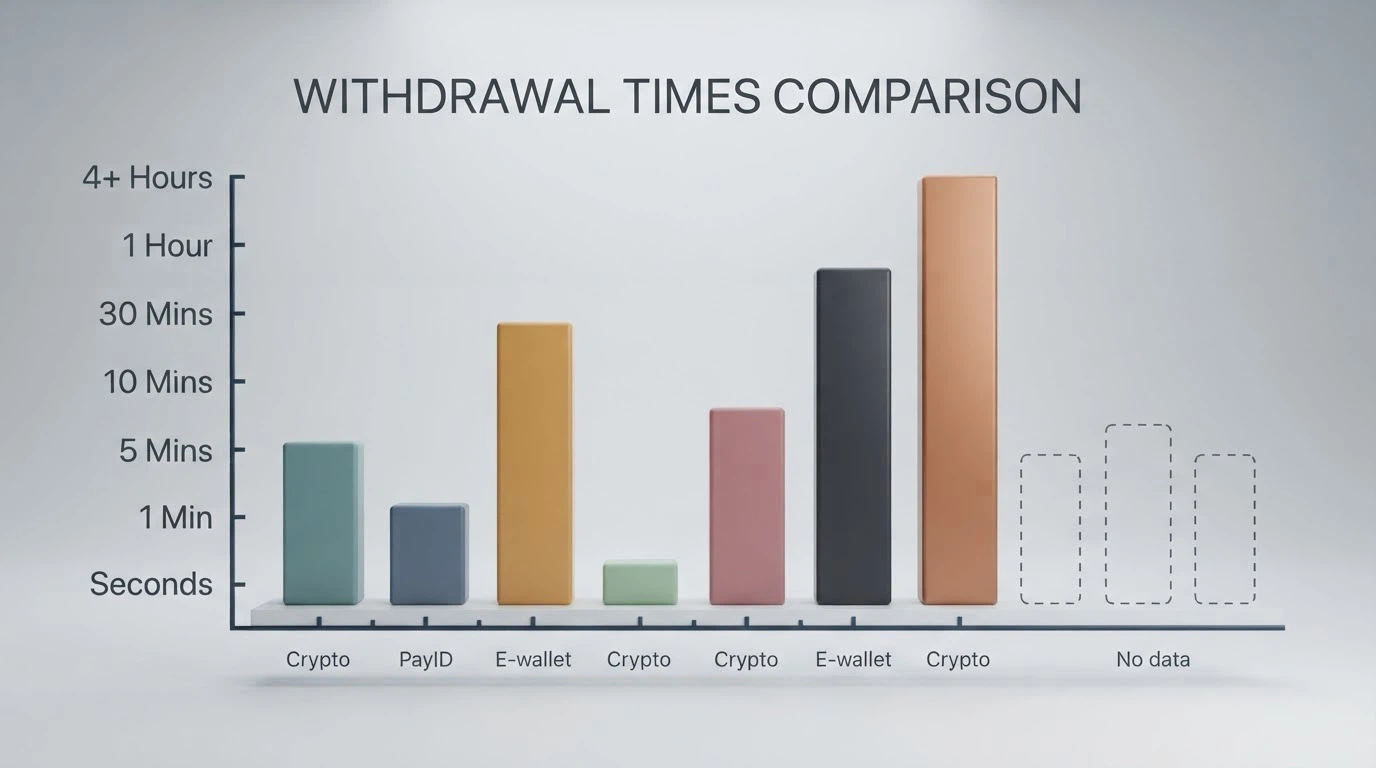
The speed spectrum is wider than the marketing copy suggests. At one end, a TRX, XRP or SOL withdrawal at Stake settles in seconds to minutes — the time it takes for blockchain confirmations to clear. At the other end, a Visa or bank-transfer withdrawal at any of the featured operators takes three to seven business days, because that is how those rails work regardless of which casino is sending the money.
Tested and published times across the featured set look like this:
- SkyCrown crypto cashouts: under 15 minutes in independent testing, with an advertised average around 10 minutes
- Royal Reels PayID withdrawal: 4 hours and 12 minutes during weekday testing once KYC was complete
- FairGo crypto withdrawal: 15 to 45 minutes during business hours, extending to 2 to 4 hours on weekends
- Rocket Play crypto withdrawal: under 1 hour, with e-wallets at 24 to 48 hours and cards at 3 to 5 business days
- WinSpirit e-wallet withdrawal: 0 to 1 hour once processed, but the internal processing window runs up to 48 business hours
- Rainbet published withdrawal time: 5 to 15 minutes
- Stake TRX, XRP and SOL withdrawals: seconds to minutes
The advertised headline of “instant” deserves an asterisk. Every real-world cash-out passes through three stages: a pending review on the operator side, a processor approval window, and the payment rail’s own transit time. Only the third is determined by the method you choose. The first two are determined by the operator, and the second is often the longest.
Why One Withdrawal Method Lands Your Cash Days Faster Than Another
The payment rail sets the floor on how quickly money can move. A casino with a 24-hour processing window and a card payout is still waiting three to five business days for the card network. A casino with a 48-hour processing window and a TRX rail is still waiting seconds to minutes once the operator releases the funds. The rail is the multiplier; the operator is the gate.
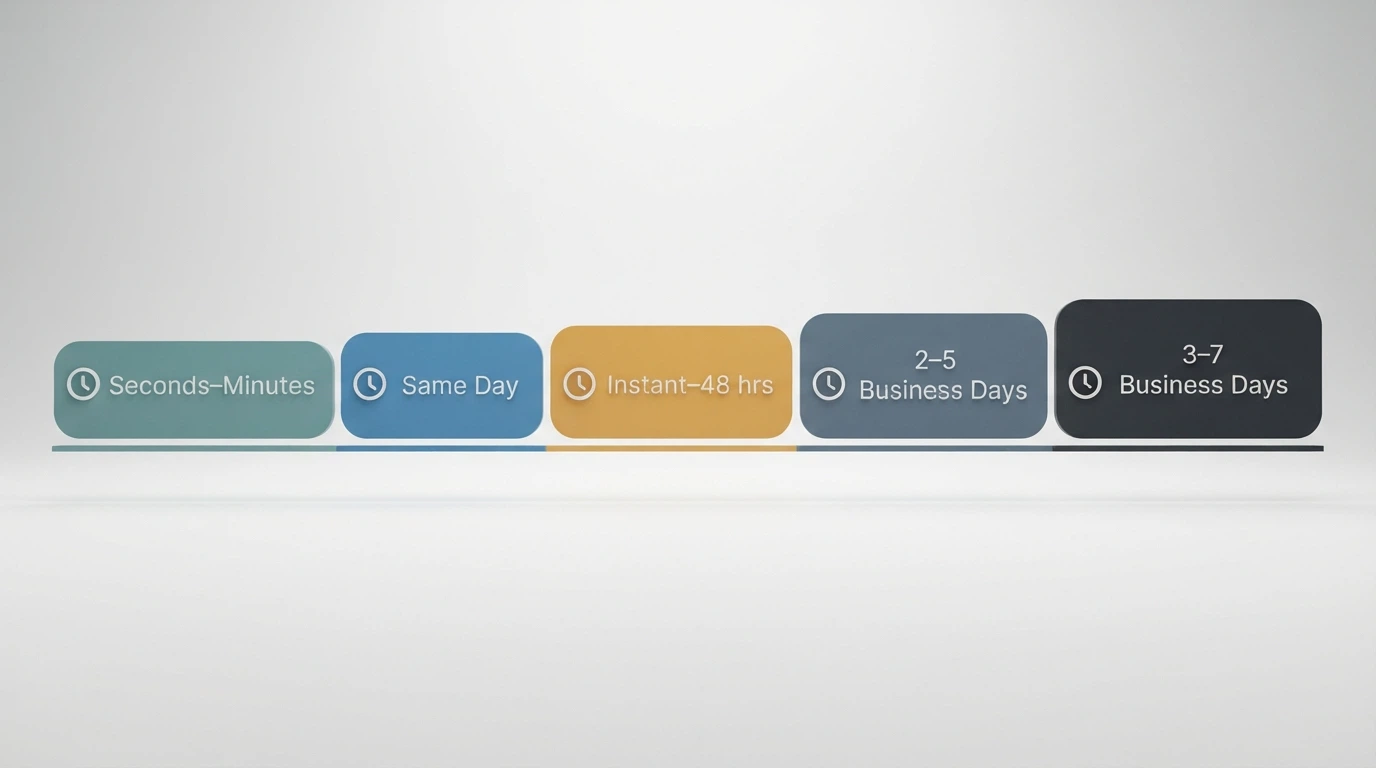
| Method | Typical payout speed | Featured casinos offering it (of 10) | Key detail |
|---|---|---|---|
| Crypto (TRX/XRP/SOL) | Seconds to minutes | 6 | Fastest option across the featured set; no BetStop coverage on the receiving end either |
| Crypto (BTC/ETH/USDT) | 15 minutes to 1 hour | 6 | Speed depends on chain congestion; large flagged withdrawals take 2–4 business days at some brands |
| PayID / Osko | Same day; 4 hours 12 minutes tested at Royal Reels | 3 (Rocket Play, SkyCrown, Royal Reels) | Closest non-crypto route to instant for Australians; requires domestic bank account |
| E-wallet (MiFinity, eZeeWallet) | Instant to 48 hours | 3 (Rocket Play, WinSpirit, SkyCrown) | Speed capped by operator’s processing window, not by the rail |
| Visa / Mastercard | 2 to 5 business days | 4 | Built for purchases, not payouts; card-issuer holds add friction |
| Bank transfer | 3 to 7 business days | 3 | Slowest rail in the set; useful only when no faster option exists |
The takeaway from the spread: the rail you choose can save you days, but only if the operator’s internal gate does not eat the head start.
The Life of a Cash-Out Request
Every withdrawal goes through three stages, and the time spent in each is set by different actors.
Stage one is the pending review, which happens entirely on the operator’s side. The transaction sits in the cashier while the operator’s system checks for irregular play, bonus abuse, account verification status and anti-money-laundering flags. FairGo publishes a pending review window of up to 48 hours. WinSpirit’s standard internal processing runs up to 48 business hours — the widest in the featured set. Some operators complete this stage in minutes; the published range across the set is zero to 48 hours.
Stage two is processor approval. Rocket Play describes a 0 to 24 hour approval window, after which the transaction is released to the payment method. WinSpirit’s same 48-hour ceiling applies here as well. The cashier then hands the funds to the payment rail.
Stage three is the rail itself. From the moment the rail accepts the transaction, crypto networks settle in seconds to minutes, PayID/Osko settles in real time on Australian banking infrastructure, e-wallets credit within hours, and cards or bank transfers enter the multi-day settlement window that the card networks were built around.
The method matters mostly at stage three. If stage one takes 48 hours and the rail takes seconds, the player still waits 48 hours. If stage one takes minutes and the rail takes five business days, the player waits five business days. The fastest real-world result comes when both stages are short, which is why the tested four-hour and twelve-minute cash-outs in the featured set happened at operators with relatively tight pending windows.
PayID Withdrawals
PayID/Osko is the standout non-crypto rail for Australians because it settles in real time on domestic banking infrastructure — no card network, no correspondent bank, no SWIFT queue. A PayID withdrawal at Royal Reels cleared in 4 hours and 12 minutes during weekday testing once KYC was complete. That time is composed of the operator’s processing window plus the PayID rail’s near-instant settlement. The rail contributes almost nothing to the wait.
Three of the ten featured operators list PayID as a withdrawal method: Rocket Play, SkyCrown and Royal Reels. The standard withdrawal caps at those operators still apply on top — Royal Reels publishes a weekly cap of A$10,000 at the standard tier, scaling to A$50,000 per week for VIP players. The intersection of PayID’s speed and Royal Reels’ VIP limit is the closest thing to a same-day, large-amount, Australian-banked cash-out the featured set offers.
PayID also has structural limits that cap its usefulness for very large withdrawals. The per-transaction cap sits at A$10,000 under the standard Osko settlement window, which is why several large-amount withdrawals at PayID-enabled operators get split across multiple transactions rather than landing in one piece. For mid-sized winnings, that fragmentation is invisible. Once a win crosses the A$10,000-per-day line, the rail’s own design starts to matter.
Visa, Mastercard and Bank Transfers
The card networks were built to move money at the point of sale, not to send payouts back to the consumer. That structural legacy is the reason card withdrawals at the featured operators still take two to five business days even at the brands that publish the fastest other times. The card issuer receives the credit, applies its own hold, and credits the customer’s account on a settlement cycle. The casino cannot accelerate that step no matter how much it streamlines its own processing.
Bank transfers are slower still, at three to seven business days across the featured set. WinSpirit publishes bank transfer and card times of 3 to 7 business days. Rocket Play publishes card times of 3 to 5 business days, and SkyCrown publishes the same. Royal Reels publishes 2 to 5 business days for cards. The exact day count varies; what does not vary is that these rails all sit at the slow end, regardless of which operator is sending the money.
The credit-card element deserves its own note. Since 11 June 2024, credit cards have been banned as a payment method for online wagering in Australia under the Interactive Gambling Amendment (Credit and Other Measures) Act 2023. The ban covers credit and credit-related products, with a maximum civil penalty of A$234,750 for an operator accepting them. The ban applies to Australian-licensed wagering. Offshore casinos accepting credit cards is the regulator’s own example of what “outside Australian rules” looks like in practice. When a casino offers you a credit-card deposit, the payment screen is telling you which side of the prohibition you are on.
How Much You Can Actually Pull Out
The published withdrawal caps across the featured set:
| Operator | Standard visible cap | VIP / top tier |
|---|---|---|
| Royal Reels | A$9,000/day, A$10,000/week | A$50,000/week |
| SkyCrown | A$5,000/day, A$10,000/week, A$15,000/month | Not confirmed |
| Rocket Play | A$5,000–A$15,000/week by VIP tier | A$15,000/week |
| WinSpirit | A$14,000/week | Not confirmed |
| Stake | No hard floor on deposits; withdrawal to same currency deposited | n/a |
| Rainbet | A$15 minimum; no published maximum | n/a |
| FairGo | A$100 minimum; weekly cap not confirmed | n/a |
A weekly cap interacts with a daily cap in ways that surprise players. A A$10,000 weekly cap means a single weekly cash-out of A$10,000 closes the cap for seven days. A daily cap of A$9,000 layered on top means the weekly number is the binding constraint only if the player is withdrawing once a week; players withdrawing daily hit the daily ceiling first. For VIP tiers at Royal Reels, the A$50,000 weekly cap removes the constraint for almost any single win a real-money player would land, but reaching the VIP tier typically requires the volume of play that produces those caps as a meaningful guardrail.
The minimum is the other side of the same problem. Rainbet’s A$15 minimum is permissive — most small wins are withdrawable. FairGo’s A$100 minimum is restrictive at the small-win end and irrelevant for anyone playing at the stakes that matter.
The Fastest-Paying Online Casinos Available to Australians in the Current Year
The ranked set appears in two forms here: a comparison table that ranks every operator on the same dimensions, and a per-operator write-up that puts each brand’s speed, limits, licence and payment-method profile into a paragraph of context. Three operators in the set — Bizzo, Scream and Rocket Casino — have no independently verified withdrawal data for this review cycle, and the table leaves the cells blank where research carries nothing.
| Casino | Licence | Fastest payout method & tested time | Withdrawal limits | Payment methods |
|---|---|---|---|---|
| Stake | Curaçao | TRX/XRP/SOL — seconds to minutes | No hard floor; same-currency withdrawal | 22+ cryptocurrencies; Visa, Mastercard, Apple Pay, Google Pay via MoonPay |
| SkyCrown | Curaçao | Crypto — under 15 minutes (tested) | A$5,000/day, A$10,000/week, A$15,000/month | Visa, Mastercard, Neosurf, MiFinity, PayID, BTC, ETH, USDT, LTC, ADA, TRX |
| Rocket Play | Curaçao (Dama N.V.) | Crypto — under 1 hour | A$5,000–A$15,000/week by VIP | PayID, Visa, Mastercard, BTC, ETH, USDT, MiFinity |
| Royal Reels | Curaçao (suggested) | PayID — 4 hours 12 minutes (tested) | A$10,000/week standard; A$50,000/week VIP | PayID, Visa, Mastercard, Neosurf, BTC, ETH, USDT, USDC, bank transfer |
| Rainbet | Curaçao | Crypto — 5–15 minutes (published) | A$15 minimum; no published maximum | 20+ cryptocurrencies; gift cards via Kinguin (A$10–A$5,000) |
| WinSpirit | Curaçao | E-wallet — 0–1 hour (once processed) | A$14,000/week | Visa, Mastercard, MiFinity, eZeeWallet, prepaid vouchers, BTC, ETH |
| FairGo | Curaçao (suggested) | Crypto — 15–45 minutes (business hours) | A$100 minimum; weekly cap not confirmed | BTC, LTC, ETH, bank transfer |
| Bizzo Casino | Curaçao | — | — | — |
| Scream Casino | Curaçao (suggested) | — | — | — |
| Rocket Casino | Curaçao (Dama N.V.) | — | — | — |
A single note belongs in front of whichever operator a reader lands on: every row of this table is an offshore operator, none holds an Australian licence, and the ACMA can direct Australian ISPs to block any of them. The fastest payout you see above is real. The licence behind it is not.
Rocket Play
Rocket Play runs on a Curaçao licence under the Dama N.V. group, and its fastest tested cash-out is crypto under one hour. E-wallet withdrawals sit at 24 to 48 hours, while card withdrawals take 3 to 5 business days. The withdrawal cap is tiered by VIP status — A$5,000 to A$15,000 per week — and PayID is listed alongside Visa, Mastercard, BTC, ETH, USDT and MiFinity. The game library runs above 3,000 titles.
The standout for Australians is the PayID listing. Three of the ten featured operators name PayID as a withdrawal method, and Rocket Play is one of them, which means a domestic bank account holder can move money in and out without touching the card networks at all. The VIP-tier escalation is the structural advantage for larger players — climbing the tier ladder lifts the weekly cap from A$5,000 to A$15,000, which is the difference between a forced stagger across multiple weeks and a single weekly cash-out for most realistic wins. There is no separate fast-payout marketing here; the speed comes from the rail you choose and the tier you hold.
SkyCrown
SkyCrown holds a Curaçao licence and runs the fastest independently tested crypto withdrawal in the featured set — under 15 minutes, with an advertised average around 10 minutes. PayID is available and settles same-day. MiFinity sits at 24 to 48 hours, and Visa and Mastercard take 3 to 5 business days. The withdrawal caps are clean and explicit: A$5,000 daily, A$10,000 weekly, A$15,000 monthly. The welcome package is A$4,000 plus 400 free spins, with the wagering multiplier not confirmed for this run. Ten-plus cryptocurrencies are supported, the widest stablecoin selection in the featured set along with the deepest altcoin coverage.
SkyCrown offers a transparent and consistent experience for players whose bankroll and win sizes fall within the monthly A$15,000 cap, as the explicit limits allow for predictable planning. However, for those aiming for individual wins surpassing A$15,000, the monthly limit becomes a rigid barrier that forces payouts into a staggered, multi-month schedule.
Royal Reels
Royal Reels is the only operator with a publicly tested PayID withdrawal time: 4 hours and 12 minutes during weekday testing, with KYC already complete. Crypto withdrawals run under one hour, and cards take 2 to 5 business days. Standard-tier limits sit at A$9,000 per day and A$10,000 per week, with VIP tiers scaling to A$50,000 per week — the highest published VIP cap in the featured set. Push Gaming is confirmed as an exclusive provider. The 50% deposit bonus carries 30x wagering on the bonus amount only, which is a structurally lighter wagering load than the bonus-plus-deposit structures common elsewhere.
The wagering structure matters more than the headline percentage. “30x on bonus only” means a A$100 bonus requires A$3,000 of qualifying turnover — meaningful, but materially smaller than the A$6,000 to A$8,000 a bonus-plus-deposit structure on the same bonus would demand. The Push Gaming exclusivity is the second structural advantage: a small set of confirmed provider relationships is a thinner library than SkyCrown’s, but the named exclusive gives a player a concrete reason to choose Royal Reels over a wider, uncurated alternative. The PayID test is the third. A reader who specifically wants PayID and wants to see a tested time has exactly one operator to look at.
Stake
Stake runs a Curaçao licence and positions itself as a crypto-native operator: 22+ cryptocurrencies accepted, with TRX, XRP and SOL withdrawals settling in seconds to minutes, USDT, USDC and BNB within 30 minutes for verified accounts, and BTC and ETH withdrawals taking between instant and one hour. There is no hard floor on deposits, and withdrawals are processed back to the same currency deposited. Visa, Mastercard, Apple Pay and Google Pay are accepted as fiat on-ramps through MoonPay. PayID is not offered.
Stake positions itself as a crypto-native platform, prioritising speed via blockchain confirmations rather than traditional banking rails. While this approach offers superior altcoin support and rapid settlement times, it inherently removes the Australian banking infrastructure from the process, requiring users to handle the conversion of fiat into crypto to participate. For players already comfortable with digital assets, this setup provides a seamless experience; for others, the additional friction may outweigh the speed benefits.
WinSpirit
WinSpirit’s e-wallet payouts run from 0 to 1 hour once processed, but the standard internal processing window stretches up to 48 business hours, the widest published in the featured set. Crypto withdrawals take minutes to 24 hours. Bank transfers and cards sit at 2 to 7 business days. The weekly cap is A$14,000. Payment methods include Visa, Mastercard, MiFinity, eZeeWallet, prepaid vouchers, Bitcoin, Ethereum and other cryptocurrencies. The Curaçao licence applies.
The honest read of WinSpirit is two numbers colliding. Once the cashier releases the funds, the rail is fast. Until the cashier releases the funds, the funds sit for up to two working days. A player who requests an e-wallet cash-out on a Friday afternoon can effectively wait until Tuesday for the cashier to act, and then watch the e-wallet credit immediately. For a player whose priority is the speed profile once approved, WinSpirit is competitive. For a player whose priority is the total time from request to funds, the two-day ceiling is a real cost.
Rainbet
Rainbet runs a Curaçao licence and publishes a withdrawal-processing window of 5 to 15 minutes — the lowest in the featured set among operators with a stated published time. The minimum withdrawal is A$15. There is no published maximum. Twenty-plus cryptocurrencies are supported (BTC, ETH, LTC, SOL, TRX, TON, LINK, XLM, ZEC, DOGE, ADA, BNB, MATIC, HBAR, XRP, WETH, SHIB, WBTC, WBNB, CBBTC and ARB). Gift cards via Kinguin cover the A$10 to A$5,000 range and function as a non-bank withdrawal route. The deposit wager lock is 1x — a player wagers the deposit once before withdrawing, which is effectively no playthrough friction.
The combined profile — published 5–15 minute processing, low minimum, no published maximum, a 1x deposit lock — is unusually permissive for a fast-payout offshore brand. The thing to note is that “published” is not the same as “tested”. No independent test in this review cycle confirms the 5–15 minute figure against an actual cash-out; it sits at the speed the operator advertises on its own homepage. That distinction matters because every other operator in this section has either an independent test (Royal Reels, SkyCrown, FairGo) or a published average from an independent reviewer (Stake, Rocket Play) backing the speed claim. The recommended read on Rainbet: take the speed promise seriously, but verify the current processing window with a small withdrawal before any larger one.
FairGo
FairGo runs a Curaçao licence (suggested by industry context), and crypto withdrawals take 15 to 45 minutes during business hours, extending to 2 to 4 hours on weekends. The pending review period runs up to 48 hours before approval. The minimum withdrawal is A$100 — the highest in the featured set. Bitcoin, Litecoin and Ethereum are confirmed as payment chains, plus bank transfer.
The pending-review window is the binding constraint. FairGo’s crypto speed is competitive in absolute terms, but the 48-hour ceiling before the operator’s review finishes means a player who requests a withdrawal at 9pm Friday is unlikely to see the fund release until Tuesday at the earliest — by which point the weekend window has already eaten into the speed advantage. FairGo suits an Australian player who plans withdrawals deliberately, in business hours, with patience for the pending window. It does not suit a player who needs a Sunday-night cash-out to settle before Monday.
Bizzo Casino
Bizzo Casino appears in this set because it has measurable Australian market share at 0.57%, sourced from operators-skill market data. It runs a Curaçao licence. No independently verified withdrawal speed, limit, payment method or bonus detail is available this review cycle.
Treat Bizzo as unvetted at the specifics. A player curious about the brand should check the current terms directly on Bizzo’s site before depositing, and verify that the ACMA has not added the brand to its block list since this review. The licence, the licence holder, and the operating group are not, on their own, indicators of payout speed — they need to be confirmed against the live cashier terms.
Scream Casino
Scream Casino holds a Curaçao licence (suggested) and 0.99% Australian market share — the highest of the three unverified brands. No independently verified withdrawal speed, limit, payment method or bonus detail is available this review cycle.
The same caveat applies as for Bizzo: the operating profile on the page is the market presence data, not the cashier data. A player considering Scream should treat this as a starting point for verification, not a basis for action.
Rocket Casino
Rocket Casino is operated under the same Dama N.V. Curaçao licence group as Rocket Play, with 0.57% Australian market share in the operators-skill dataset. No independently verified withdrawal speed, limit, payment method or bonus detail is available this review cycle.
The corporate link to Rocket Play is real but does not translate into a verified payout profile. Dama N.V. operates a portfolio of brands; each runs its own cashier terms, its own bonuses and its own withdrawal procedures. A reader who likes what Rocket Play publishes should not assume Rocket Casino runs the same way, and a reader who finds Rocket Casino first should not assume the parent-group licence transfers any of Rocket Play’s tested speed across the portfolio.
The Pokies and Live Tables Where Your Winnings Clear Fastest
The pokie title does not set the withdrawal speed, but the game and the provider shape three things that do: how fast a jackpot-style win verifies, how quickly wagering-clearing turnover generates, and what the bonus terms let the player count.

Pokies That Support Fast Cash-Outs
Every pokie feed at a real-money casino enters the same withdrawal pipeline as the cashier’s deposit method, so the structural speed of a pokie cash-out equals the structural speed of the brand’s chosen rail. There is no pokie that withdraws faster than PayID and no pokie that withdraws slower than a bank transfer; the rail, not the reel, sets the floor.
What the provider ecosystem does control is the friction inside the cashier’s pending review. A win at a jackpot-mechanic pokie can trigger additional verification, which is internal to the operator and unrelated to the rail. Push Gaming’s confirmed exclusive presence at Royal Reels is the only provider relationship this review can verify at the per-title level — it does not translate into a faster cash-out, but it does translate into a known, named provider behind the games. For a player who values provider transparency, that is information the wider market of uncurated libraries does not supply.
Wagering contribution is the second structural factor. Games contribute to playthrough at different rates, and a pokie that contributes 100% of stake toward wagering clears bonus turnover faster than a table game contributing 10% or 20%. The bonus terms are where the speed difference actually shows up — the rail still wins the race, but the game weighting determines how long the bonus ties the balance down before the rail gets to run.
Real-Money Pokies vs Demo Mode
Demo mode is a practice mode with zero payout. Real-money play is the only route to a withdrawal, and the distinction is worth keeping when a casino promotes its game library. A demo spin at Royal Reels, SkyCrown or any featured operator never turns into a withdrawal. It is a trial, a learning tool, and a responsible-gambling feature for a player who wants to test a pokie before staking money on it. The payback rate on a demo spin is mathematically meaningless for the real-money withdrawal question.
For a player testing a new pokie, the responsible pattern is the same at every brand: play demo first to learn the mechanics, then move to real money only when the bankroll can absorb the loss, and never assume a winning demo session predicts anything about real-money play.
Live Casino Tables
Live-dealer rounds run at the dealer’s pace, which is slower than a pokie reel per individual round. The win enters the same withdrawal pipeline once the session ends, with no special fast-payout or slow-payout treatment at the cashier. The contribution rate to wagering requirements is the key structural difference — table games typically contribute less per dollar staked than pokies, sometimes as low as 5% to 20%, which materially slows bonus clearing for any player trying to unlock a bonus-linked balance through live play.
For a player not playing through a bonus, the choice between pokies and live tables does not change the cash-out speed. For a player working through a wagering requirement, the choice can mean the difference between clearing the bonus this week and clearing it next month.
Digital-Currency Cash-Outs — Minutes, Not Days, With a Trade-Off
Crypto delivers the fastest withdrawals in the featured set, but the speed is conditional and the trade-off is structural. The speed comes from blockchain rails that operate 24/7 and settle in seconds to minutes — they do not depend on banking hours, correspondent-bank queues or card-network settlement cycles. The trade-off is that those same rails operate outside the Australian consumer-protection regime that a licensed wagering customer’s deposit and credit-card protections would otherwise provide.

Since 11 June 2024, digital currency has been banned as a payment for online wagering in Australia under the same Act that banned credit cards. The ban, with its A$234,750 maximum civil penalty, applies to licensed Australian wagering operators only — offshore casinos are not within reach of the penalty and continue accepting crypto. The payment screen is therefore the same tell as the credit-card screen: a casino asking for crypto is signalling that it sits outside Australian rules. Speed is the explanation; lack of protection is the corollary.
Bitcoin, USDT and Altcoin Withdrawals
The crypto withdrawal picture across the featured set runs from SkyCrown’s under-15-minute Bitcoin and altcoin speeds to Stake’s seconds-to-minutes TRX, XRP and SOL settlements. FairGo’s 15 to 45 minute Bitcoin window sits comfortably in the middle. Rainbet publishes a 5 to 15 minute processing figure across twenty-plus supported chains. The slowest chains — Bitcoin under congestion, large ETH amounts — can stretch to hours; the fastest — TRX, XRP, SOL — clear faster than the cashier’s own pending review.
The structural advantage of crypto is that the rail and the operator’s release step run in parallel time: the operator releases the funds, the chain confirms, and the wallet balances, all in the same hourly window. With a bank transfer or card, the operator releases the funds, the rail settles on a three-to-five-day cycle, and the player waits. Crypto’s edge is not that it is faster in absolute terms; it is that the rail itself does the work, leaving almost no settlement lag once the operator has acted.
No-Verification Casinos
A no-verification or KYC-light casino promises the fastest possible cash-out by removing one of the longest delays in the withdrawal pipeline: the document review that confirms the player’s identity against the deposited funds. Removing the review saves hours. It also removes the player’s only audit trail and the operator’s only accountability if a dispute arises.
The ACMA framing is the relevant one here. The regulator’s position on anonymous gambling is consistent with its position on illegal offshore services more broadly: customers of operators outside the Australian rules lack the protections that come with the licence the operator does not hold. No identity trail means no recourse at the cashier, no regulator to complain to, and no Australian dispute resolution body to escalate to if the operator refuses a withdrawal, holds a balance, or changes its terms after a win.
A reader weighing a no-KYC brand against a verified one is choosing between faster cash-outs and a documented relationship. That trade-off belongs in the decision, not at the bottom of the fine print.
Bonus Offers That Promise a Fast Payout — and the Terms That Slow It Down
A welcome bonus is not free money, and the wagering requirement is where the marketing promise meets the cashier reality. A 30x wagering multiplier turns a A$50 bonus into A$1,500 of required turnover. A 40x multiplier turns a A$100 bonus into A$4,000 of required turnover. The turnover is what the player must stake before the bonus-linked balance is withdrawable. The rail is irrelevant until the turnover is complete.

No-Deposit Bonuses on Fast-Payout Sites
No-deposit bonuses are sometimes promoted on fast-payout brands as a “try before you deposit” offer. The structural reality is that a no-deposit bonus is the most heavily restricted bonus format: maximum cashout caps, game restrictions, wagering multipliers, and bonus-validity windows that bound the clock in ways a deposit bonus does not. No featured operator in this review cycle has a verified no-deposit bonus with independently confirmed payout terms. A reader who sees one advertised should read the terms carefully — the maximum-cashout cap is the real number, not the headline bonus amount.
The gap between “no deposit” and “fast withdrawal” is wide. A no-deposit bonus that requires 50x wagering on a A$10 bonus means A$500 of qualifying turnover, which is hours of play even at a generous spin rate. The fast payout is genuine on the rail the operator offers; the time to reach the rail is set by the bonus terms.
Wagering Requirements
The wagering multiplier is the single most important number on a bonus terms page, and it varies widely across the featured set:
- Royal Reels applies 30x wagering on the bonus amount only — a lighter-than-average structure, and the only featured operator with an explicit “bonus only” wording
- Rainbet applies a 1x wager lock on deposits — effectively no playthrough friction on the deposit itself
- Rocket Play reports x40 wagering in some sources
- SkyCrown and the remaining featured operators do not have wagering conditions confirmed this run
The “bonus only” wording at Royal Reels is not a marketing nuance. On a A$100 bonus, the structure means A$3,000 of bonus-only turnover before withdrawal — versus A$8,000 of bonus-plus-deposit turnover at the same multiplier. At typical A$0.20 to A$1.00 pokie stakes, the bonus-only structure saves a player several hours of qualifying play.
The Rainbet 1x deposit lock is a different kind of advantage. It removes the playthrough friction on the deposit itself, leaving the player free to focus on game selection and session length rather than turnover management. It also reduces the bonus value to a marketing device — there is no large bonus balance to chase at Rainbet, but that means no large bonus balance tying the cash out either.
The Legal Reality — No Australian Casino Licence Exists for What You’re Playing
The Interactive Gambling Act 2001 is the legal frame around every brand reviewed on this page. The Act, strengthened by the Interactive Gambling Amendment Act 2017, gives the ACMA its enforcement and blocking powers. The 2026 reform, which passed Parliament on 19 August 2026 and commences on 1 January 2027, extends that enforcement frame further.

The Interactive Gambling Act 2001
The IGA makes it an offence to provide online casino, online pokies or in-play sports betting to a person physically in Australia. What it permits is narrower than what it prohibits: pre-event wagering (sports and racing), lotteries and keno, all operated by state and territory licensed operators. The minimum age for any of these products is 18.
The product the IGA prohibits is the product every featured operator on this page offers. There is no Australian licence to apply for, no regulator to approach, no pathway by which a Curaçao-licensed casino can become a licensed Australian casino for online gaming. The Northern Territory Racing and Wagering Commission, which licenses some of Australia’s largest sports wagering brands, has no jurisdiction to license an online casino. The ACMA, which enforces the prohibition, has no enforcement power over the offshore operator’s cashier. The structural separation between “licensed wagering” and “online casino” is complete.
There is no federal deposit, loss or stake ceiling for online gambling in Australia, and the absence is not a regulatory gap. The product those ceilings would govern is banned outright, and the ceilings are a tool of a regulatory regime that does not apply to casinos.
ACMA Enforcement
The ACMA’s enforcement record is concrete. 1,788 illegal gambling and affiliate websites have been blocked by Australian ISPs since the first blocking request in November 2019. Over 230 illegal gambling services have withdrawn from the Australian market since 2017. The numbers are not theoretical — they describe actual sites Australians could previously reach.
The blocking request operates under section 313 of the Telecommunications Act 1997, which gives the ACMA the authority to direct ISPs to block identified services. The block list is updated regularly; the 1,788 figure is current to August 2026. New offshore casinos continue to appear — a brand not on today’s list can be added tomorrow. The regulator has also moved against promotion of illegal operators: in 2026 the ACMA warned MMA fighter Jamie Mullarkey for promoting an illegal gambling operator on Instagram, and the regulator ruled against SBS for breaching gambling advertising restrictions during its Tour de France broadcast.
For a player with a balance at a site the ACMA has just blocked, the consequences are immediate. The site becomes unreachable from Australia. The funds remain on the operator’s books. The operator has no obligation to refund Australian customers — and is, by the same logic that defines the prohibition, outside the regulatory frame that would compel a refund.
The Payment-Method Ban
The Interactive Gambling Amendment (Credit and Other Measures) Act 2023, which commenced on 11 June 2024, banned credit cards, credit-related products and digital currency as payment for online wagering in Australia. The maximum civil penalty is A$234,750 (750 penalty units) per breach. The ACMA’s parliamentary submission on the bill framed the ban with a sentence that doubles as a regulatory tell: “Illegal offshore gambling services often allow consumers to use Australian-prohibited payment methods like credit cards and cryptocurrency, which licensed operators cannot accept.”
For an Australian player, the framing makes the payment screen diagnostic. A casino that offers credit-card deposits or cryptocurrency deposits is, by the payment methods it accepts, identifying itself as an offshore operator outside Australian rules. That identification is faster to read than any “about us” page.
The Current-Year Gambling Reform
The Interactive Gambling Amendment (Gambling Reform) Bill 2026 passed Parliament on 19 August 2026, and its measures commence on 1 January 2027. The reform introduces express authority for banks and payment providers to block transactions to illegal gambling operators — meaning an Australian whose bank chooses to act on the new authority can find deposits to offshore casinos declined at the banking layer, without an ACMA direction to the ISP. That represents a meaningful tightening of the practical access to offshore sites.
The reform also caps wagering advertising: no more than three wagering ads per hour between 6:00 am and 8:30 pm; no wagering advertising from 15 minutes before a live sporting event until five minutes after it ends; athletes, celebrities and influencers barred from promoting wagering products. The inducement ban that runs alongside the reform prohibits direct marketing of inducements for 14 days after a customer signs up and for three months after a person deregisters from BetStop.
None of the reform measures legalise the offshore online casino product for Australian players. They tighten the frame around it, not the product itself.
Staying in Control While Chasing a Fast Cash-Out
Speed and safety are not the same question. A fast payout at an offshore casino means a fast transaction through a payment rail, not a fast resolution if the operator behaves badly. The Australian help infrastructure exists to support players who decide the offshore route has cost them more than money.
BetStop
BetStop — the National Self-Exclusion Register — launched on 21 August 2023. A single registration through BetStop blocks a person from every Australian-licensed online and phone wagering service in one step. The register’s limits are wide enough to matter: 67,480 registrations by 31 July 2026, with 41,290 exclusions still active. Of those registrants, 25,155 chose a lifetime exclusion. 78% of registrants were under 40, and 38% chose lifetime exclusion.
The structural limit of BetStop is its scope. The register binds Australian-licensed wagering services only. An offshore casino is not licensed in Australia, is not connected to the register, and will keep taking a self-excluded person’s money. The gap is not a feature of BetStop’s design — it is a property of the regulatory perimeter the register operates inside. A player who registers with BetStop and continues to play at any of the operators in this review is not protected by the exclusion at those operators.
The 2026 reform tightens the inducement side of the regime. From 1 January 2027, a person who deregisters from BetStop is shielded from direct-marketing inducements for three months — designed to prevent a freshly re-registered player from being immediately captured by welcome offers. That protection also runs through licensed wagering only.
Gambling Harm in Australia
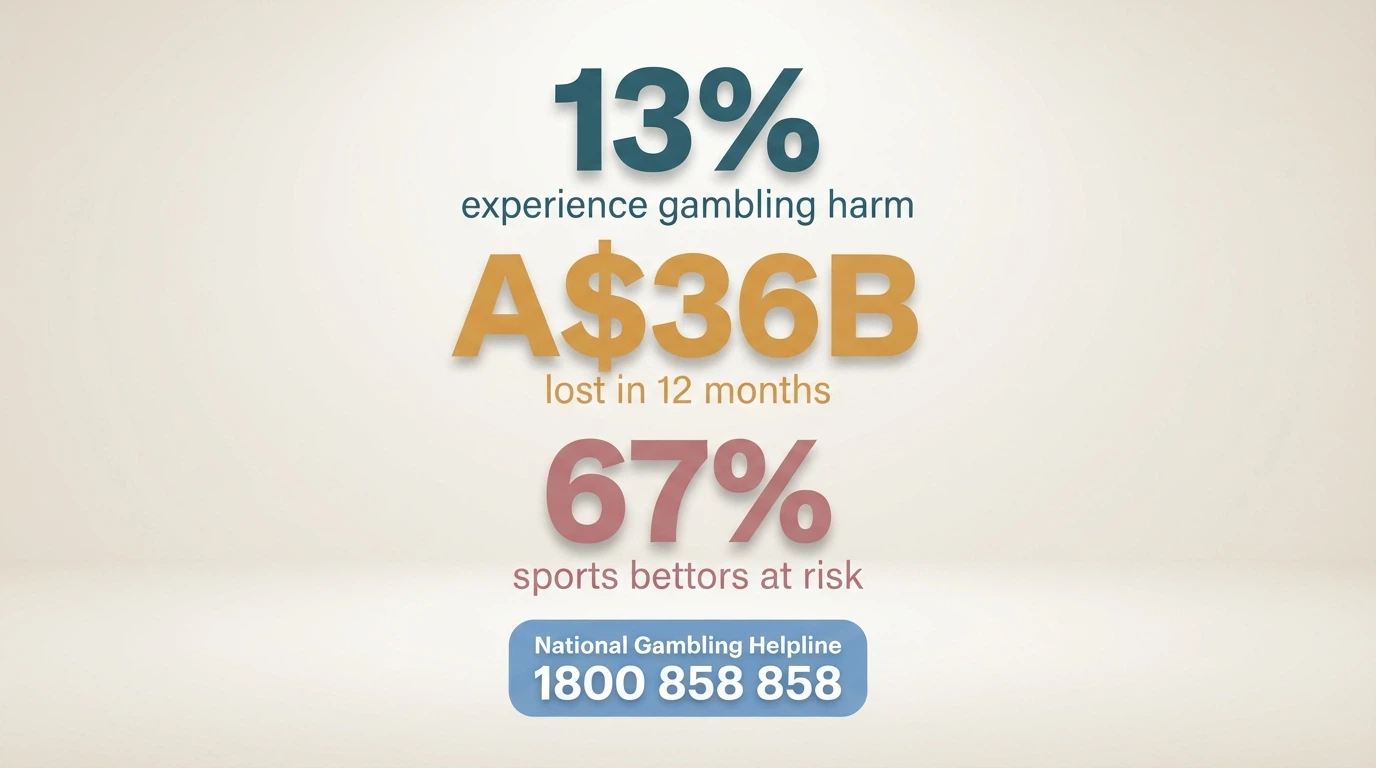
The speed of a withdrawal does not change the arithmetic of the game. In the twelve months to March 2026, Australians lost A$36.0 billion to gambling — an increase of A$1.3 billion on the previous year, and a 75% (A$15.3 billion) rise since 2020. 13.0% of Australians — an estimated 2,857,000 people — were experiencing some form of gambling harm from their own gambling behaviours. Including harm from others’ gambling, the figure rises to 15.1% (3,320,000 people). Almost half of the people who gamble are classified at some risk of gambling harm, rising to 67% among sports and race bettors. Online gambling accounts for 45 to 50% of calls to counselling and support services.
The numbers are a different kind of velocity — the speed at which losses compound across a population, measured in harm prevalence and dollar totals rather than payout minutes. The faster the cash-out rail, the faster the cycle of deposit, loss and re-deposit can run for a player who is losing. That is the case for treating speed and safety as one conversation.
Where to Get Help
The National Gambling Helpline (1800 858 858) offers free, confidential support 24 hours a day, 7 days a week. You can also access Gambling Help Online at gamblinghelponline.org.au for online chat and counselling. Additional resources include SHARC (1300 660 068), the National Debt Helpline (1800 007 007), and Medicare Mental Health (1800 595 212). BetStop, the National Self-Exclusion Register, provides a single registration to block access to all licensed Australian online and phone wagering services, though it does not cover offshore casinos.
How We Selected and Ranked These Fast-Withdrawal Casinos
The ranking combines four inputs: the ACMA register and enforcement record, operator terms pages, independent testing accounts where available, and the operators-skill AU market-share data. The evaluation criteria, in order of weight, are: tested or independently sourced withdrawal speed, payment-method breadth, licence-jurisdiction transparency, and withdrawal-limit clarity.
The rankings are not weighted scores. They are an ordered shortlist in which operators with multiple independent test points sit higher than operators with a single published number, and operators with verified tests sit higher than operators without any verification this cycle. The three unverified brands — Bizzo, Scream and Rocket Casino — are listed at the bottom of the set because market presence is the only dimension on which this review can rank them; the table leaves other cells blank rather than substitute marketing claims.
No weighting, formula or threshold is invented for this methodology. The limitations are stated plainly: no Australian licence exists for any operator reviewed, and the verified-vs-unverified status is the practical ceiling on how confident any review can be about an offshore brand’s actual payout behaviour. Where this review ranks, it ranks. Where it does not, it does not pretend.
What Australia’s Fastest Payouts Actually Cost — Our Final Word
The fastest withdrawal in the featured set clears in seconds. The operator sending it is licensed in Curaçao. The same operator is reachable in Australia because the ACMA has not blocked it yet. The same operator is not connected to BetStop. The same operator can change its terms tomorrow morning, and an Australian player with a balance will have no Australian regulator to appeal to. That is the full geometry of a fast payout in this market.

The speed is not illusory — Royal Reels’ 4-hour-12-minute PayID withdrawal, SkyCrown’s under-15-minute crypto cashout, Stake’s seconds-to-minutes TRX settlement: those are real. The structural absence of Australian protection is also real, and it travels with the licence the operator cannot hold. A player who chooses one of these operators is choosing both facts at once.
Three concrete checks before depositing. Confirm the operator is not currently on an ACMA block list. Read the withdrawal terms for this account, this method and this bonus. Set the deposit at an amount that can be lost without harm. None of those steps change the cashier speed. They make the speed safer to use.
The decision belongs to the reader armed with the facts this page has laid out. A fast payout at an offshore casino is fast because it operates outside Australian rules. The protection an Australian licence provides is one of the things the offshore casino does not provide. Both belong in the decision, and neither cancels the other.
Frequently Asked Questions
How does KYC verification affect withdrawal speed at online casinos?
KYC — “know your customer” — is the identity-verification step that casinos use to confirm a player’s identity against the deposited funds. Until KYC clears, withdrawals sit in pending review or are refused. Once KYC is complete, the rail the player chooses sets the cash-out speed. The operators reviewed here complete KYC during or shortly after registration, but the verification timeline varies by operator and by document complexity. A player who completes KYC promptly sees faster cash-outs than a player who delays document submission.
What happens if an offshore casino refuses my withdrawal in Australia?
The Australian regulator — the ACMA — has jurisdiction to take action against the operator for offering an unlicensed product to Australians, but it has no authority to compel an offshore operator to release a player’s funds. The player’s options are limited: dispute the transaction with the payment method (which works for credit cards and some e-wallets, and does not work for crypto once the transaction is confirmed), complain to the Curaçao licensing authority that oversees the operator (slow and not Australian-led), or walk away. There is no Australian ombudsman for the cashier decision.
What is the typical withdrawal limit at Australian online casinos?
There is no Australian-licensed online casino to anchor a “typical” to. At the offshore operators in this review, weekly caps range from A$10,000 (Royal Reels standard tier) to A$14,000 (WinSpirit) and upward to A$50,000 for VIP tiers at Royal Reels. Daily caps are typically A$5,000 to A$9,000. Monthly caps at SkyCrown cap at A$15,000. Minimums range from A$15 at Rainbet to A$100 at FairGo. A player who lands a single win larger than the relevant cap will see the win split into multiple cash-out periods.
Are crypto withdrawals faster than PayID at Australian online casinos?
Generally yes, on the rail itself. PayID/Osko settles in real time on Australian banking infrastructure, but it operates inside the operator’s processing window and inside the A$10,000 single-transaction cap that the rail applies. Crypto on TRX, XRP or SOL settles in seconds to minutes once the operator releases the funds, with no rail-side cap. The single-cash-out advantage belongs to crypto. The deposit friction is the other side: a PayID deposit is funded from an Australian bank account; a crypto deposit requires converting Australian dollars to crypto on the way in.
Can I use a credit card to deposit at a fast withdrawal casino in Australia?
Not at an Australian-licensed wagering operator — credit cards, credit-related products and digital currency have been banned as payment for online wagering in Australia since 11 June 2024 under the Interactive Gambling Amendment (Credit and Other Measures) Act 2023. Offshore casinos accepting credit cards remain outside the reach of the ban and continue offering the deposit method. The credit-card acceptance itself is the signal that the operator sits outside Australian rules. The maximum civil penalty for an operator accepting the banned payment method is A$234,750.