The 7-Reel Pokies Guide for Australian Players in 2026
 Available in AU
The seven-by-seven grid has gone from a curiosity to the format that defines modern online pokies. Play’n GO’s Reactoonz and Pragmatic Play’s Sugar Rush 1000 sit at the centre of a category that pays in clusters instead of paylines, cascades wins instead of stopping at one, and pushes volatility high enough that a single spin can swing a session. None of it is legal to provide to Australians — every site in this comparison is offshore — and that single fact changes what every other paragraph on this page is worth.
Data current as of 18 October 2026. Licence and regulatory claims checked against the Australian Communications and Media Authority register, the Interactive Gambling Act 2001, and the Australian Gambling Research Centre’s 2025 statistics.
Table of Contents
- Why 7-Reel Grid Slots Are Reshaping Online Pokies in 2026
- How to Test Every 7-Reel Slot Before You Stake a Dollar
- Why Your 2026 7-Reel Slot Bonus Is Smaller Than the Headline Number
- Where Australians Play 7-Reel Slots for Real Money: 2026 Operator Comparison
- What Australian Law Actually Says About Online Pokies in 2026
- Playing 7-Reel Slots Without Letting the Reels Play You
- How We Evaluated Every 7-Reel Slot Site on This Page
- Your 7-Reel Slots Game Plan for 2026
- Frequently Asked Questions
Why 7-Reel Grid Slots Are Reshaping Online Pokies in 2026
The shift happened quietly. A format that once lived as a novelty in a single Play’n GO release now accounts for the most-played digital pokies in catalogues across providers. The format’s defining numbers — RTP between roughly 94 and 97 per cent, and a volatility profile that sits mostly medium to high — give it the personality that has pulled players away from the five-reel machines their parents played.
What a 7-Reel Slot Actually Is — and How It Differs from Standard Pokies
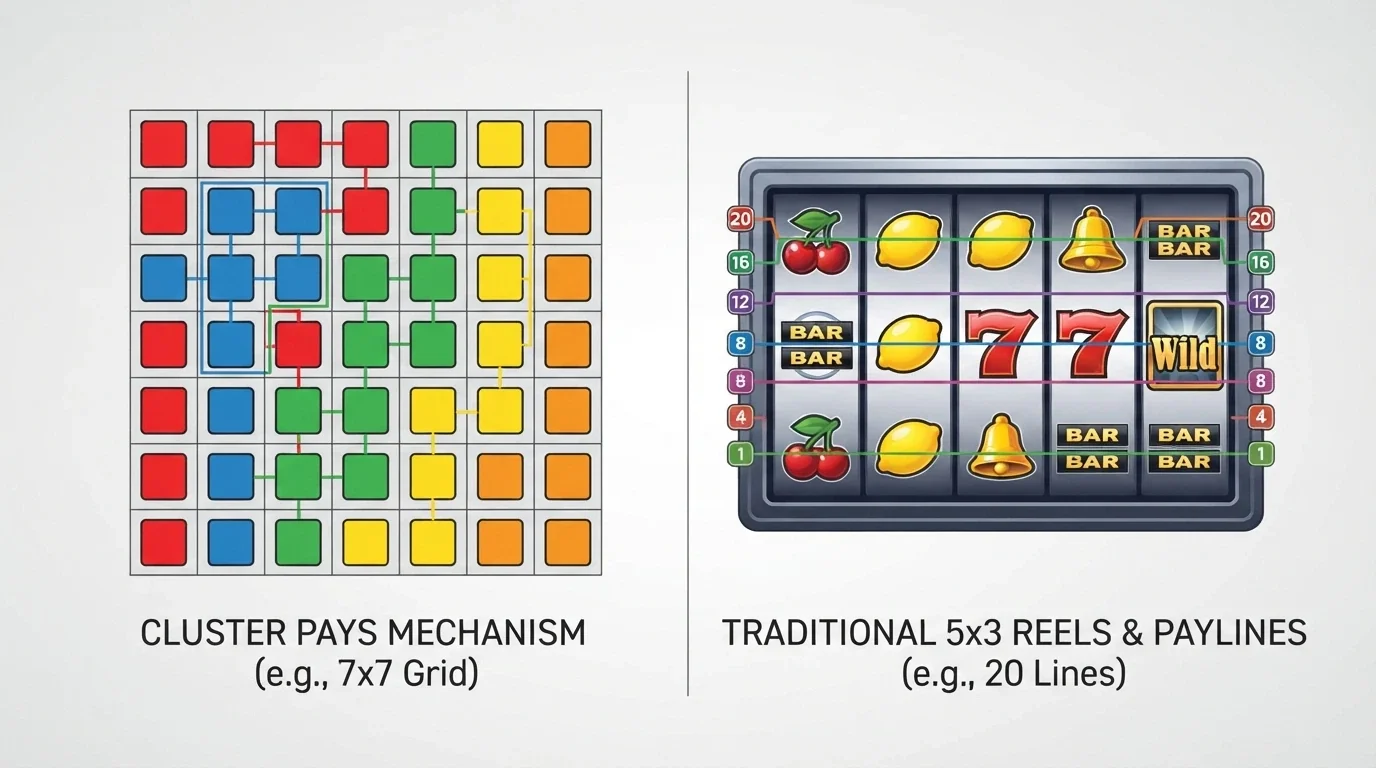
A 7-reel slot replaces fixed paylines with symbol clusters. Where a traditional five-reel pokie pays only when matching symbols line up on a chosen payline, a 7×7 grid slot pays whenever a cluster of five or more identical symbols touches horizontally or vertically anywhere on the board. Most of these titles add a tumble or avalanche feature: winning clusters disappear, the symbols above fall into the empty spaces, and a new cluster can form on the same spin. A single bet can chain four or five cascades in a row, and the math — and the suspense — runs on every one of them.
The numbers below come from per-game specifications the research verified. They are the base configuration most operators publish; a few titles offer a higher-RTP operator setting that the player usually has to opt into, but those are not the running default.
| Slot Title | Provider | RTP | Volatility | Max Win |
|---|---|---|---|---|
| Sugar Rush 1000 | Pragmatic Play | 96.53% | High | 25,000x |
| Fiesta Clusters | BGaming | 97.00% | High | 5,000x |
| Gemix | Play’n GO | 96.83% | Medium | 4,500x |
| Daruma Impact | — | 96.77% | High | 10,000x |
| Atomic Kittens | — | 96.75% | Low | 17,040x |
| Rave Party Fever | — | 96.73% | Medium | 5,000x |
| Wild Clusters | — | 96.71% | High | 5,000x |
| Seven 7’s | — | 96.60% | High | 25,000x |
| Mining Rush | — | 96.56% | High | 10,000x |
| Reactoonz | Play’n GO | 96.51% | High | 4,750x |
| Wild Frames | Play’n GO | 96.50% | High | 7,000x |
| Honey Rush | Play’n GO | 96.50% | High | 9,000x |
Two patterns jump out. The RTPs sit in a tight half-point band from 96.50 to 97.00 per cent, which is unusually compressed by slot-category standards and tells the player that any of these titles is a mathematically sensible starting point. The volatility, though, splits. High is the dominant classification, with two mediums and a single low — Atomic Kittens. A 7-reel session on a high-volatility title is a session that can go ten minutes between meaningful wins and then pay five hundred times the stake in a single cascade chain.
Reactoonz is the test case for the format. Its charge metre fills as winning clusters form and triggers one of four feature states — Implosion, Alteration, Demolition, or Giantoonz — each modifying the grid before the next cascade. Every feature is fully playable in demo mode, and every one of them costs nothing to learn except time.
Sugar Rush 1000 operates differently. The grid does not transform between cascades; instead, every winning position stamps a multiplier that compounds for subsequent tumbles in the same spin. Pragmatic Play publishes a 96.53 per cent default RTP with a 97.5 per cent top configuration available to operators that opt in, and the max win of 25,000x is one of the largest in the category. The bet range runs from A$0.20 to A$240 per spin, which puts a real-money session on the title within reach of casual bankrolls and well clear of high-roller ceilings.
Real-Money vs Free-Play 7-Reel Slots: What Changes When You Stake Cash
The maths does not move when real money enters the picture. A 96.5 per cent RTP demo plays at 96.5 per cent for real; the algorithm has no mode. What changes is everything else.
A free-play session has no stake behind the cascade. A real-money spin carries it — and a high-volatility 7-reel title is engineered around the gap between routine losses and the rare, large cluster. The minimum-stake range across the category runs from roughly A$0.20 on Sugar Rush 1000 up to A$240 on the same title at the upper end. A player on A$0.20 can run thousands of spins on a casual session budget; a player on A$5 will feel a high-volatility 7-reel grid as a sequence of small bets that vanish between occasional standout cascades.
The legal backdrop reframes the question. Online casino games are prohibited under the Interactive Gambling Act 2001 — no Australian licence exists for them, anywhere in the country. Every real-money 7-reel session an Australian player has happens on a site that the law says should not be offering the product. That does not put the player at risk of prosecution; the Act targets the provider. It does mean there is no Australian regulator to complain to, no BetStop coverage to lean on, and no automatic guarantee that a withdrawal will be processed. Free-play demo mode on a provider’s own site carries none of those risks, and that is the strongest argument for spending time in it before any deposit is made.
Why Australians Call Them Pokies — and What That Means for Your Search
The Australian word for slot machines is pokies, and the distinction is more than colloquial. Punter, bookie, multi, TAB, odds, welcome offer, turnover requirement, deposit limit, take-a-break, activity statement — the gambling vocabulary an Australian reader expects on a trustworthy page runs in a particular register. Search engines read that vocabulary back. A query for “best 7-reel pokies Australia” surfaces Australian-facing casino reviews and AU-licensed content; the same query rendered as “best 7-reel slots Australia” pulls in a different mix, with more offshore brand mentions and less local regulatory framing.
For payment, Australian players expect to see PayID, Osko and BPAY listed for licensed wagering. For a pokie’s structure, the in-game terms an Australian review uses are cluster pays, grid slot, and the tumble or avalanche feature. None of these terms is exotic; they are simply the native vocabulary of the market, and using them is the cheapest signal that the writer has actually engaged with the AU context.
Classic Cabinets vs 7-Reel Grid Slots: Why the Format Changes Everything
The jump from a mechanical three-reel cabinet to a 7×7 digital grid is not two extra reels. The cluster-pays structure, the cascading tumble feature, the multiplier stamps, the charge metres — these are not bolt-on extras to a payline engine. They are the engine.
A classic three-reel machine pays on a single line, takes a couple of seconds per spin, and rewards patience with frequent small wins. A 7-reel grid slot is designed for continuous play. The cluster pays anywhere, the cascades chain, and the player can sit through twenty or thirty rounds of nothing before a feature triggers and the board lights up. The Megaways alternative — a six-reel slot with a variable number of symbols per reel — sits between the two formats and shares the high-volatility profile but pays on lines rather than clusters. Gates of Olympus 1000, with its 6×5 pay-anywhere grid and 15,000x max win, is the closest neighbour outside the 7×7 cluster format. Play’n GO is the studio that has done the most to define the 7-reel cluster-pays category, with Reactoonz, Gemix, Wild Frames and Honey Rush all running on the same core mechanic.
How to Test Every 7-Reel Slot Before You Stake a Dollar
The format is built for exploration, and free-play mode exists for exactly that. It is important to remember that playing in demo mode is the only way to explore without financial exposure; no offshore operator offers a deposit or payout guarantee. While some offshore licences provide supervision, they do not offer the protections of an Australian-licensed service, such as a local legal venue for disputes or connection to the BetStop National Self-Exclusion Register. Always verify an operator’s terms and licence details before any real-money commitment.
Free 7-Reel Slots Online: Where to Play Without Spending a Cent
Two routes. A provider’s own site usually carries a “play demo” button beside every release, and that demo is the cleanest version of the title — no casino branding, no bonus hook on top, just the game. The other route is the practice mode inside a casino lobby, which may or may not require an account and which usually carries the casino’s own framing around the title. Pragmatic Play and Play’n GO both publish demo versions of their major releases, including Sugar Rush 1000 and the Reactoonz series. Demo access varies by operator — some embed the full game, some restrict features — and that variation is itself useful information before any real-money commitment.
The demo balance is not real money. It will refill if it runs out, usually with a button click, and the experience is mathematically identical to real-money play. The only thing the demo cannot simulate is what a session feels like when the balance is the player’s own bankroll.
No-Download, No Sign-Up: Instant-Play 7-Reel Demo Slots Explained
The instant-play model replaced the downloadable casino client a decade ago, and HTML5 is the standard. On desktop the game opens in a browser tab; on mobile it loads in the device’s browser or inside a casino app shell. The technical baseline is the same on both — the same title runs the same engine. Where they differ is in how a casino gates the lobby. A provider demo on the studio’s own page does not require an account; a casino-lobby practice mode often does, with the implicit invitation that the same player is about to deposit.

For a player evaluating a 7-reel slot, the no-sign-up provider demo is the better tool. Nothing in the session is engineered to convert the player into a depositor. The game’s volatility, the feature frequency, the cascade length — all of it shows up unadorned.
Demo Slots With Bonus Features: What You Can (and Cannot) Test for Free
Bonus features fire at the same mathematical rate in demo and real-money mode. The charge metre on Reactoonz fills on the same triggers; the multiplier stamps on Sugar Rush 1000 accumulate on the same cascades. A player can sit in demo mode for an hour and watch three or four feature cycles complete, which is enough to understand how the bonus round actually behaves — when it tends to fire, how long it usually runs, and what it tends to pay.
What demo mode cannot replicate is the emotional response to having a stake behind each spin. A free-play session treats a cascade chain as a visual sequence; a real-money session treats it as a stake recovering itself. The demo is the right place to learn the rules. It is the wrong place to learn whether the format suits the player’s bankroll.
Why Your 2026 7-Reel Slot Bonus Is Smaller Than the Headline Number
A welcome offer’s sticker figure shrinks the moment the player reads the wagering multiple. A A$8,000 headline figure from SkyCrown is the largest in the comparison, and the 40x wagering that sits beneath it is the same story at every offshore operator on this page. The arithmetic is the same; only the headline figure varies.

Bonus-Tagged 7-Reel Slot Variants: What the Label Actually Delivers
“Bonus” in a 7-reel slot title usually refers to a bonus-buy mechanic — a button that lets the player buy directly into the feature round for a fixed multiple of the stake, usually between 50x and 100x. The mechanic is in-game, not casino-driven, and it shortens the wait for a feature trigger at the cost of paying for it up front.
Bonus-buy availability varies by jurisdiction, and Australian players should check the game rules in their session to confirm the feature is enabled. Some operators disable bonus-buy on slots they offer to certain markets; others enable it for everyone. When it is enabled, the cost is published in the game’s paytable and the math is straightforward — the player is paying the slot’s full price for a feature that would otherwise come at random.
No-Deposit Bonus Offers for 7-Reel Slot Players: What Is Actually on the Table
A no-deposit bonus is the smallest offer with the tightest strings. The free-chip structure — A$25 credited on registration with no deposit required — looks generous until the cashout cap is read: A$100 is the common ceiling, and the expiry window runs 3 to 7 days from activation. Wagering on the winnings can be as low as 5x on some offers and as high as 40x on others.
The headline figure is the trap. A A$25 no-deposit chip with a A$100 cashout cap and a 5x wagering requirement is a real offer — a player can win up to A$100 from a chip that cost them nothing and clear the wagering in a short session. The same chip with a 40x wagering requirement is much harder to clear and pays out the same A$100 ceiling if it does. The offer’s worth is in the cashout cap and the wagering multiple, not in the A$25 chip itself. A no-deposit bonus is also distinct from a free-chip offer in some casinos’ books — the terminology varies, but the cashout cap and the expiry window are the constant.
Free Spins vs Match Bonuses: Which One Actually Costs You Less
The free-spin route looks cheaper than a match bonus because the headline stake is fixed. Royal Reels’ 50 free spins at A$0.20 per spin deliver A$10 in headline spin value, but the winnings are subject to 35x wagering. A A$10 winning balance cleared at 35x means the player has to wager A$350 before any of it is cashable, and the slot’s house edge does the rest.
The SkyCrown first-deposit bonus of A$300 at 40x wagering — bonus only, not deposit plus bonus — creates a required turnover of A$12,000. At a benchmark 7-reel RTP of 96.5 per cent, the expected loss over that turnover is roughly A$420, which is the bonus’s real cost. That single figure is the one that disciplines the offer: a A$300 bonus at 40x is not a free A$300, it is A$300 minus the expected loss the player wears during clearance.
A match bonus clears a larger headline amount but costs more in turnover. A free-spin offer clears a smaller amount but at lower wagering exposure. The trade-off is between the size of the bonus and the depth of the playthrough, and the right pick depends on how much of the player’s bankroll the player wants to commit to the clearance session. A player with a smaller bankroll usually gets better expected value from free spins; a player who can absorb a longer clearance session often does better with the match.
Where Australians Play 7-Reel Slots for Real Money: 2026 Operator Comparison
Every operator open to Australian 7-reel players is offshore. The comparison starts from that shared reality, not from a pretence of local licensing — and the fact that none of the ten operators below holds an Australian online casino licence, because no such licence exists, is the single most important piece of context for the rest of this section.
What Makes a 7-Reel Slot Site Worth Your Time: The Ranking Criteria
Ranking an offshore operator fairly means measuring what the player can actually verify. The criteria below are qualitative — no invented weightings, no composite score, no claim that one factor matters more than another for every reader.
- Licence jurisdiction. Every operator on this page is offshore. The specific regulator matters: a Curacao Gaming Control Board registration is verifiable through a public registry number, and an Anjouan B2C licence runs to a fixed expiry date. Where the jurisdiction is not confirmed, that gap is named in the operator write-up.
- Welcome-bonus terms. The headline figure, the number of free spins, the wagering multiple, and the bonus-only versus deposit-plus-bonus distinction. The free-spin stake size and the per-tier or total win cap are part of the package.
- Game-library composition. How many pokies, which providers, and whether Play’n GO’s 7-reel titles — Reactoonz, Gemix, Wild Frames, Honey Rush — are part of the catalogue. Royal Reels’ ~1,400 pokies across ~1,800 total titles is the largest confirmed library in this set.
- Provider mix. A multi-provider catalogue that includes Pragmatic Play, Play’n GO and a handful of BGaming or Hacksaw releases is the typical shape of a 7-reel-friendly operator. Single-provider sites — Fair Go’s RTG-only library, for instance — will carry a narrower selection of grid-format titles.
- Withdrawal and operational signals. The factors a player can verify before depositing — a published licence number on the site, a withdrawal-history page, a stated minimum withdrawal, a contact channel that resolves.
How the AU Market’s Offshore Operators Compare Side by Side
The table below places every featured operator on the same five measures. Cells marked with an em dash are gaps where research did not confirm a value; those gaps are themselves useful information, because a cell the operator does not publish is a fact the player cannot check.
| Operator | Offshore Licence | Welcome Bonus (A$) | Free Spins in Welcome | Wagering on Bonus |
|---|---|---|---|---|
| SkyCrown | Curacao (OGL/2023/176/0095) | Up to 8,000 | 400 | 40x |
| Royal Reels | Offshore — jurisdiction not confirmed | 2,500 | 50 | 35x bonus only |
| RocketPlay | Offshore — jurisdiction not confirmed | 2,000 | 100 | 40x |
| Fair Go | Offshore — jurisdiction not confirmed | 1,000 | — | 30x–40x |
| WinSpirit | Offshore — jurisdiction not confirmed | 2,000 | 100 | 40x |
| Bizzo Casino | Curacao (Antillephone N.V., 8048/JAZ2017-067) | 2,500 | 125 | — |
| Rainbet | Anjouan (ALSI-152406029-FI2, valid to 13 June 2027) | Wager Lock Promotion (qualitative) | — | 40x |
| Stake | Curacao | — | — | — |
| Scream Casino | Offshore — jurisdiction not confirmed | — | — | — |
| Rocket Casino | Offshore — jurisdiction not confirmed | — | — | — |
Two patterns. The wagering multiplier clusters tightly at 40x with one 35x-bonus-only outlier, and the welcome-bonus figures vary by a factor of eight across the set. Where the licence jurisdiction is confirmed, the regulator is a recognised offshore body. Where it is not, the player should treat the gap as part of the offer’s risk profile and check the operator’s own footer before depositing.
Picking a Trustworthy Venue When Every Option Is Offshore
Trust in a market with no local regulator is something a player has to build themselves. The strongest signals are the smallest: a published licence number on the operator’s footer, a withdrawal-history page that shows recent payouts, a contact channel that responds, and a provider mix that matches the catalogue the operator claims.
The credit-card and crypto ban for online wagering in Australia — in force from 11 June 2024 — is the cheapest single signal. An operator accepting credit cards or crypto for Australian deposits is operating outside Australian rules, and that operator is also the one most likely to disappear with a balance on it. A debit card, a bank transfer, PayID/Osko or BPAY is what a licensed Australian wagering operator accepts; an offshore casino that accepts the same payment methods is signalling that it has at least looked at the AU compliance picture.
BetStop — the National Self-Exclusion Register — does not reach any operator in this comparison. Every site in the table is offshore, and offshore operators are not connected to the register. A self-excluded Australian who deposits at one of these venues will find their account accepted and their money taken. ACMA has directed Australian ISPs to block 1,564 illegal gambling and affiliate sites since November 2019, and more than 225 illegal services have withdrawn from the Australian market entirely since enforcement was strengthened in 2017 — but neither of those numbers changes what an offshore operator can do with a balance once it has been deposited.
SkyCrown: A$8,000 Welcome Package Across Four Deposit Tiers
SkyCrown runs the largest headline welcome figure in this comparison. The package spans four deposit tiers — minimum deposits start at A$30 and rise to A$50 for the fourth — and includes 400 free spins credited across the welcome period. Wagering is 40x across the board, applied to both bonus funds and free-spin winnings. The free-spin win limit is A$300 per bonus tier, and cumulative bonus earnings are capped at A$20,000 across the package.
Curacao Gaming Control Board licence OGL/2023/176/0095 is published on the operator’s footer. SkyCrown runs a multi-provider catalogue, though the specific provider mix was not confirmed this run, and the 400-spin figure is large enough to deliver meaningful play on the catalogue’s 7-reel titles. An alternative 5-tier structure that some listings publish — up to A$4,000 plus 400 free spins — is a different surface of the same offer; the headline difference is the deposit-count distribution, not the underlying math.
SkyCrown is the package with the largest headline in this comparison, and the A$300 free-spin cap per tier is the figure that disciplines it.
Royal Reels: 1,400 Pokies With Bonus-Only 35x Wagering
Royal Reels’ library is the largest confirmed in the comparison: ~1,800 total titles, with roughly 1,400 of those pokies. Pragmatic Play and Play’n GO are both part of the catalogue, and the average RTP across Royal Reels’ top 50 most-played pokies sits at 96.4 per cent — comfortably within the 7-reel category’s 94 to 97 per cent band.
The welcome package is a three-deposit structure: deposit one matches 100 per cent up to A$500, deposit two matches 75 per cent up to A$750, and deposit three matches 100 per cent up to A$1,250, totalling A$2,500 plus 50 free spins. The wagering is 35x on bonus only — not on deposit plus bonus — which is the single best wagering distinction in this comparison and a real cost difference for the player. The free spins are fixed at A$0.20 per spin on a featured pokie, which gives a headline spin value of A$10, and winnings from those spins are subject to the same 35x requirement.
The specific offshore jurisdiction was not confirmed from a primary source this run, and that gap is worth flagging. Where the field runs at 40x, Royal Reels’ 35x bonus-only wagering is the lower mark.
RocketPlay: 200% Second-Deposit Boost on Top of 100 Free Spins
RocketPlay’s welcome package leads with a 100 per cent first-deposit match plus 100 free spins, and follows with a 200 per cent second-deposit boost. The minimum qualifying deposits are A$20 for the first and A$75 for the second, and 40x wagering applies to the bonus.
The 200 per cent second-deposit figure is the standout. A A$75 deposit returns A$225 in bonus funds — a triple on the qualifying deposit — and that is the strongest multiplier in the comparison on a per-deposit basis. The 40x wagering is the same multiple as most of the field, so the cost-of-clearance math is conventional. The free spins are credited in batches for selected titles, and the operator’s full slot catalogue was not confirmed this run.
The 200 per cent boost is the headline, but the A$75 second-deposit minimum disqualifies players working with tighter budgets.
Fair Go: RTG-Powered With A$1,000 Across Five Deposits
Fair Go is the smallest library in this comparison — 280 titles, all running on RealTime Gaming software — and the welcome offer reflects that smaller catalogue. Five deposits at 100 per cent match up to A$200 each deliver A$1,000 total, with wagering on deposit plus bonus running 30x to 40x.
The RTG catalogue is built around the Australian market. RealTime Gaming has released titles tailored to local themes and payout structures, and the operator’s branding speaks to that focus. The 280-title library does not include the same range of 7-reel grid slots that a multi-provider site carries, and a player chasing the Reactoonz-style cluster format will find the selection narrower here.
The 30x wagering is the lowest confirmed in the comparison, and that lower multiple does real work in shortening the clearance path. Fair Go’s RTG catalogue is built for the Australian market, though the 280-title library does not carry the same 7-reel range as a multi-provider site.
WinSpirit: A$3,000 Bonus Win Cap and Daily Free-Spin Drops
WinSpirit publishes one of the more honest bonus terms in this comparison. The first-deposit offer is 100 per cent up to A$1,000 plus 100 free spins credited 20 per day over five days, and the second-deposit offer is 200 per cent up to A$1,000. Wagering on bonus is 40x, and the maximum win limit on deposit bonuses is A$3,000 — a ceiling the operator publishes openly.
The A$3,000 cap is the figure that disciplines the offer. A bonus that would otherwise pay out tens of thousands on a high-volatility 7-reel session is hard-capped at A$3,000 in winnings, and that ceiling is applied before the player sees any return. It is the same kind of transparency that Royal Reels’ bonus-only wagering provides — a player knows the worst case going in.
The Thursday cashback offer — up to 15 per cent back on deposits, with x5 wager and a win limit of x25 of the cashback sum, valid for 2 days — is a separate recurring promotion. It is small, it is short-lived, and it is the kind of recurring offer a player can plan a session around. WinSpirit is the operator that names its limits rather than burying them, and the A$3,000 bonus win cap is the most honest ceiling on this page.
Bizzo Casino: Curacao-Regulated With 125% Match and 125 Free Spins
Bizzo Casino operates under a Curacao licence issued to Antillephone N.V. (licence 8048/JAZ2017-067). The welcome package is 125 per cent up to A$2,500 plus 125 free spins, and the casino runs a multi-provider game library typical of Curacao-regulated operators.
The wagering multiple on the welcome package was not confirmed from a primary source this run, and that gap is the single most important fact about this offer for a player who weights clearance cost above headline figure. Bonus terms at offshore operators vary by jurisdiction and by operator, and the published T&Cs are the only authoritative source — a player should check the wagering multiple on the Bizzo bonus page before depositing, because a 125 per cent match with 125 free spins at 40x is a very different offer from the same headline at 25x.
Bizzo publishes the Curacao registration cleanly; the wagering multiple is the gap to verify on the operator’s bonus page.
Rainbet: Anjouan-Licensed With a Wager-Lock Welcome Mechanic
Rainbet is the only Anjouan-licensed operator in the comparison. The licence — ALSI-152406029-FI2, issued to RBGAMING N.V. (registration 16077) — is valid through 13 June 2027, and the minimum withdrawal is A$15.
The welcome mechanic is structured differently from a standard match bonus. The Wager Lock Promotion requires a minimum A$30 deposit and caps the qualifying deposit at A$700, and 40x wagering applies to the first-deposit promotional balance. The structure rewards a focused first deposit more than a stretched welcome cadence, and the A$700 ceiling is the figure that disciplines it — beyond that, the player is wagering their own funds.
The specific slot catalogue was not confirmed this run. Rainbet’s Wager Lock structure fits a single focused first deposit, and the Anjouan licence expiry is on the page rather than hidden in a footer.
Stake: Curacao-Based Platform With Multi-Provider Slot Library
Stake runs a Curacao licence and a multi-provider slot catalogue that includes Hacksaw Gaming, Pragmatic Play and Titan Gaming. The platform’s 7-reel slot selection is part of a larger portfolio, and the slot-library strength is the verified component of this write-up.
The welcome bonus, free spins, wagering multiple and bonus validity were not confirmed from a primary source this run. Stake’s promotional structure tends to differ from a conventional casino welcome package, and the player’s experience on the platform is shaped as much by ongoing rakeback and reload offers as by a single headline deposit match. Stake’s promotional terms need to be read on the operator’s own page; the catalogue breadth — Hacksaw’s high-volatility grid titles in particular — is the strongest part of the pitch.
Scream Casino: Offshore Operator With Limited Confirmed Data
Scream Casino is included in this comparison as an offshore operator, but the licence jurisdiction, game providers, welcome bonus and wagering multiple were not confirmed from a primary source this run. The table row above reflects that gap honestly, and a player who is considering this operator should verify the offer details on the operator’s own site before any deposit.
Scream Casino is in this comparison as an offshore entry whose licence jurisdiction, providers and bonus terms need primary-source confirmation.
Rocket Casino: Offshore Operator With Limited Confirmed Data
Rocket Casino is included in this comparison as an offshore operator, with the same data gap as Scream Casino: licence jurisdiction, game providers, welcome bonus and wagering multiple were not confirmed from a primary source this run.
The comparison table marks those cells with em dashes, and the honest read is the same as for Scream Casino — there is not enough verified data to make a comparative case on the same terms as the rest of this section. A player who wants to consider Rocket Casino should treat the absence of confirmed data as the central fact about the offer and verify the terms on the operator’s own site before any commitment.
What Australian Law Actually Says About Online Pokies in 2026
The Interactive Gambling Act 2001 is explicit. Online casino games, online pokies and in-play sports betting are prohibited to persons in Australia — not regulated, not licensed under conditions, prohibited. There is no online casino licence anywhere in the country, not federally and not in any state or territory. Every site in the comparison above operates on the wrong side of that line.
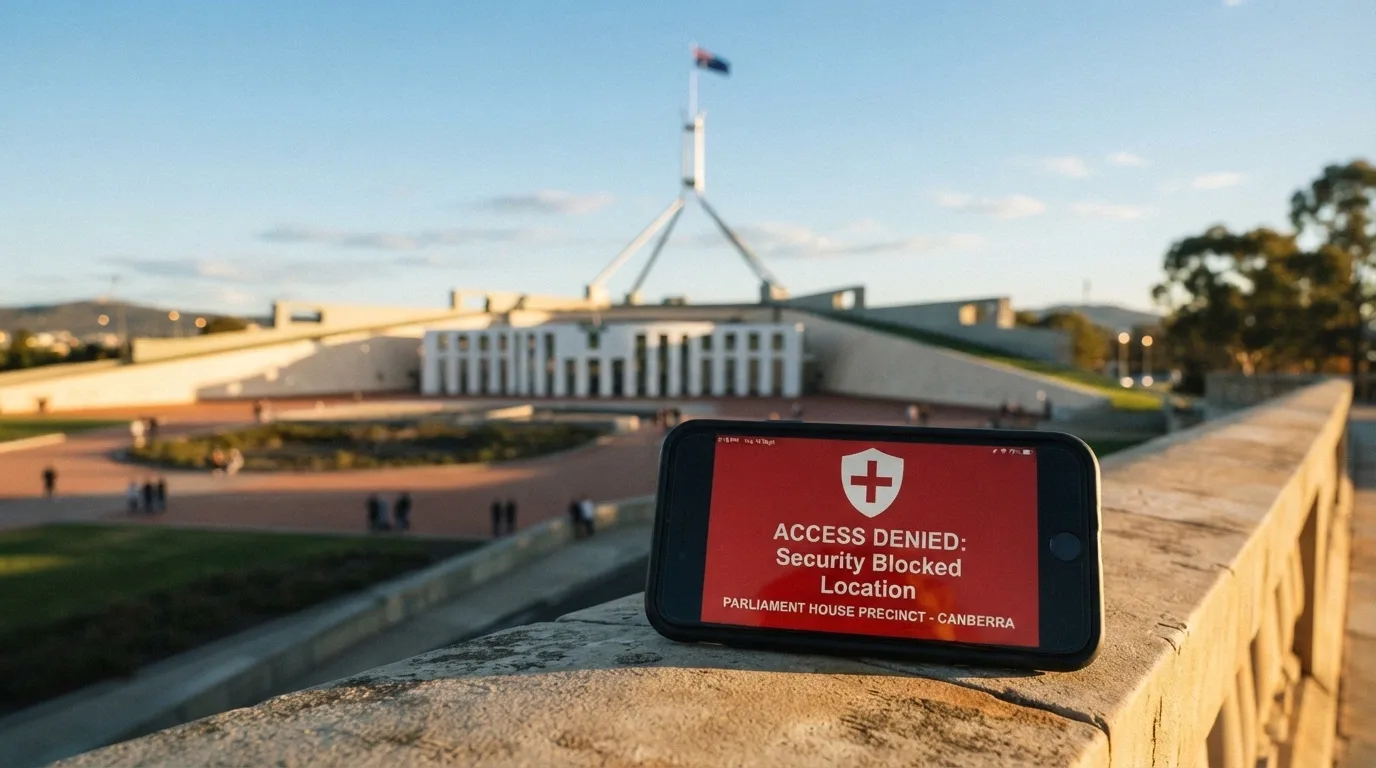
Online Casino Licensing in Australia: Why No Pokie Site Holds a Local Permit
The prohibition targets the provider, not the player. Section 15 of the Interactive Gambling Act makes it an offence to offer a prohibited interactive gambling service to a person in Australia; the individual player who accesses such a service is not prosecuted. That is the legal reality behind the comparison table above — the operator takes the regulatory risk, not the punter.
What IS licensed in Australia is wagering on racing and sport placed before the event begins, plus lotteries and keno. The state and territory wagering licences run through bodies like the Northern Territory Racing and Wagering Commission, which is the de facto national licensor for online wagering — brands like Sportsbet, Bet365 and Ladbrokes hold NT licences that run for terms of up to 20 years. None of those licences covers casino games or pokies. A wagering licence is a permit to take bets on races and pre-event sport; it is not a permit to run a roulette wheel, a blackjack table or a 7-reel grid slot.
From 11 June 2024, credit cards, credit-related products and digital currency are banned for online wagering in Australia. Penalties reach A$247,500. The legal deposit routes are debit card, bank transfer, PayID/Osko and BPAY. An operator accepting credit or crypto for Australian deposits is signalling that it operates outside Australian rules entirely, and that signal is one of the cheapest reads a player can do on an offshore casino’s compliance posture.
What “Legal” Means for the Australian Player — It Is Not What the Ads Say
“Not prosecuted” is not the same as “protected”. The Interactive Gambling Act’s section 15 framework protects the Australian market from new prohibited services; it does not protect the individual player who uses one. There is no Australian regulator to complain to if an offshore operator refuses a withdrawal, voids a win or closes an account. ACMA can direct ISPs to block the offending site — and has, 1,564 times since November 2019 — but blocking the site does not return the player’s balance.
From 1 January 2027, the Interactive Gambling Amendment (Gambling Reform) Bill 2026 — passed 19 August 2026 — tightens the picture further. Banks and payment providers gain express authority to block transactions to illegal gambling operators. Federal advertising restrictions cap wagering ads at three per hour between 6:00 am and 8:30 pm, with a live-sport blackout from 15 minutes before until 5 minutes after a live event. Athletes, celebrities and influencers will be barred from promoting wagering products; broadcasting of sporting odds is banned outright; radio wagering ads are barred during school drop-off and pick-up times.
Inducement prohibitions follow the same commencement date: a 14-day cooling-off after sign-up, a three-month ban on direct marketing after a BetStop deregistration, and an indefinite ban for customers identified as at risk of gambling-related harm. The AdStop opt-out register is not expected to be operational by 1 January 2027 and will commence on a later day fixed by proclamation.
Player Protection in a Market With No Local Casino Licence
The ACMA’s enforcement powers are real but narrow. The Authority investigates complaints, issues formal warnings and civil penalty proceedings, and directs Australian ISPs to block illegal sites — 1,564 of them since November 2019, with more than 225 illegal services withdrawing from the Australian market since 2017. What ACMA cannot do is recover player funds from an offshore operator. The Authority has no extraterritorial reach into Curacao, Anjouan or any other offshore jurisdiction.
The payment-method restrictions are a consumer-protection measure that works at the deposit stage rather than the dispute stage. Banning credit cards and crypto from online wagering cuts off the routes that funded the most aggressive offshore marketing in the early 2020s, and forces operators that want to look Australian-compliant to accept the same payment methods a licensed wagering operator accepts. A debit card, a bank transfer, PayID, Osko, BPAY — these are the rails an Australian player can move money through, and they leave a paper trail that an offshore dispute resolution process can follow.
Playing 7-Reel Slots Without Letting the Reels Play You
The tools exist. They just do not all reach the offshore casino in the comparison table.
Self-Exclusion and Deposit Limits: Tools That Work — and One Big Gap
Deposit caps, activity statements and take-a-break mechanisms are standard on Australian-licensed wagering platforms. A player can set a daily, weekly or monthly deposit ceiling; they can request an activity statement that itemises the last quarter’s deposits, withdrawals and net position; they can trigger a take-a-break period that closes the account for a defined window. Every one of those tools is enforceable because the operator holds an Australian wagering licence and is subject to the relevant code of practice.
None of those tools reaches an offshore casino. A player who sets a deposit limit on Sportsbet cannot enforce that same limit on SkyCrown or Royal Reels. A take-a-break request to a licensed wagering provider does not propagate to an offshore operator. The only self-exclusion tool with a national scope is BetStop, and BetStop does not connect to offshore sites — a self-excluded Australian who opens an account at one of the operators in the comparison table above will be accepted and their money will be taken.
BetStop: The National Register — Who It Covers and Who It Does Not
BetStop launched on 21 August 2023. A single registration excludes a person from every Australian-licensed online and phone wagering service — around 150 brands — for a minimum of three months up to a lifetime. As at 31 July 2026, BetStop had 67,480 registrations across its three years of operation, with 41,290 active exclusions. Seventy-eight per cent of registrants were under 40, and 38 per cent chose lifetime exclusion.

The awareness gap is the story the numbers do not tell. The Australian Gambling Research Centre found that only 33.5 per cent of wagerers know BetStop exists, and around one in four Australian adults have heard of the register at all. As Dr Kei Sakata, Executive Manager at AGRC, has noted: “Only one in three wagerers know BetStop exists” — and despite an estimated five million wagerers nationwide, including 400,000 high-risk gamblers, just 30,000 had registered at the time the data was published.
The hard truth for any reader using an offshore casino is this: BetStop does not reach any of the operators in this comparison. The register’s protection ends at the Australian licence boundary, and every operator in the table above is on the other side of it. Self-exclusion through BetStop is the right tool for a player who wants to stop wagering with Australian-licensed services; it is not the right tool for a player who also plays offshore, and that gap is the most concrete single harm of the offshore route.
Playing for Real Money Without Losing Control: Practical Guardrails
The format’s high volatility — the majority of 7-reel slots sit at medium to high volatility — makes session guardrails essential. The list below names the ones that work regardless of where the player chooses to play.

- Set a loss limit before the session starts. The 7-reel cascade structure rewards patience with rare, large payouts; a player without a pre-set ceiling will chase a long sequence of nothing with a stake they cannot afford to lose.
- Use a session timer. A 7-reel grid slot is built for continuous play, and a one-hour timer is the cheapest counter to the format’s design.
- Treat bonus clearance as a separate budget. A 40x wagering requirement turns a A$300 bonus into a A$12,000 turnover obligation, and the bonus’s real cost is the expected loss over that turnover, not the headline figure.
- Verify the operator’s withdrawal history before any deposit. A site that publishes recent payouts and resolves contact-channel enquiries is signalling operational accountability.
- Use BetStop if the wagering problem is the licensed-Australian side of it. For the offshore side, the practical guardrails above are the only ones the player controls.
For anyone whose gambling has moved from entertainment into something they cannot manage alone, the National Gambling Helpline is 1800 858 858 — free, confidential, staffed 24 hours a day, with online chat and counselling through Gambling Help Online. About 2.1 per cent of Australian adults — roughly 430,000 people — experience problem gambling, and the AIHW put high-risk gambling at 1.8 per cent in 2022. The format’s volatility does not change those numbers, but it makes the line between entertainment and harm sharper.
How We Evaluated Every 7-Reel Slot Site on This Page
The ranking is built from verifiable public data — licence registers, operator terms pages, slot-spec databases and independent casino-review archives — and from operator data this run’s research confirmed from a primary source. Where a figure could not be refreshed, the gap is named in the operator write-up rather than papered over with an estimate.
The criteria the ranking is built on are the ones in the ranking-criteria section above: licence jurisdiction, welcome-bonus terms, game-library composition, provider mix, and withdrawal and operational signals. None of the ten operators holds an Australian online casino licence, because no such licence exists, and that single fact shapes how each operator is described. Operators with confirmed Curacao or Anjouan registration are named with the registry number; operators without a confirmed jurisdiction are flagged in the table with an em dash.
Play’n GO’s catalogue is the benchmark for the 7-reel format — Reactoonz, Gemix, Wild Frames and Honey Rush are the cluster-pays titles that defined the category. Pragmatic Play’s Sugar Rush 1000 is the second benchmark. Where an operator’s catalogue includes both studios, the 7-reel selection tends to be deeper than where it includes only one.
Your 7-Reel Slots Game Plan for 2026
The format is the best it has ever been. The market an Australian player has to use it in has not changed — and the gap between those two facts is what this page is built around.
The slot-by-slot RTP data above gives the player a starting point. A 96.5 per cent RTP across twelve of the highest-rated 7-reel titles is unusually compressed by slot-category standards, and any one of them is a mathematically reasonable choice for a session. Atomic Kittens at 96.75 per cent with low volatility is the outlier for a player who wants routine small wins; Reactoonz at 96.51 per cent with high volatility and a four-state charge metre is the test case for a player who wants feature-driven play.
The bonus comparison tells a different story. A 40x wagering multiple on a A$300 bonus is a A$12,000 turnover obligation with an expected loss around A$420 — the bonus’s real cost. Royal Reels’ 35x bonus-only wagering is the lowest in the comparison; SkyCrown’s A$300 free-spin win cap per tier is the most disciplined ceiling. No headline figure on this page is the figure that matters; the wagering multiple, the bonus-only versus deposit-plus-bonus distinction, and the win cap are.
The legal framework tells the third story. Online pokies are prohibited to persons in Australia under the Interactive Gambling Act 2001; every operator in this comparison is offshore and every one of them is offering a product Australian law says should not be provided to Australian residents. The individual player is not prosecuted, but the protections Australian law provides — BetStop coverage, payment-method restrictions, complaints bodies, consumer-protection regimes — do not reach the offshore site. From 1 January 2027, banks and payment providers gain express authority to block transactions to illegal operators, and the practical effect is that some of the deposit routes an offshore casino has been using will start failing.
The concrete steps before a deposit are short. Check the licence register entry on the operator’s footer. Read the bonus T&Cs for the wagering multiple and the win cap. Set a session loss limit. Register with BetStop if a hard stop across every licensed service is the right tool. The offshore reality makes every one of those steps more important — not less — because the player is the only line of defence the operator’s regulator will not cover.
Frequently Asked Questions
Are 7-reel slots legal to play online in Australia?
No licence exists for online casino games or online pokies anywhere in Australia, under the Interactive Gambling Act 2001. The Act targets the provider of the service, not the player who accesses it, but every offshore casino offering 7-reel pokies to Australians is offering a prohibited product.
Which 7-reel slot has the highest RTP?
Fiesta Clusters (BGaming) has the highest confirmed RTP in this comparison at 97.00 per cent, with high volatility and a 5,000x max win. Sugar Rush 1000 (Pragmatic Play) offers a 97.5 per cent top configuration alongside its 96.53 per cent default.
How does the cluster-pays mechanic work on 7-reel grid slots?
A cluster-pays 7×7 grid pays when five or more identical symbols touch horizontally or vertically anywhere on the board, with no payline required. Winning clusters disappear, symbols tumble into the empty spaces, and new clusters can form on the same spin.
What happens if an offshore casino blocks my withdrawal?
There is no Australian regulator with extraterritorial reach to compel payment. ACMA can direct Australian ISPs to block the site but cannot recover the player’s balance. The dispute resolution process is the operator’s own, and the outcome depends on the operator’s terms.
Is BetStop connected to offshore casino sites?
No. BetStop binds Australian-licensed wagering services only, and none of the offshore operators in the comparison above are connected to the register. A self-excluded Australian who opens an offshore casino account will be accepted and their money will be taken.
Do I have to pay tax on 7-reel slot winnings in Australia?
Betting and gambling winnings are not assessable income under section 6-5 of the ITAA 1997, and losses are not deductible, unless the person is carrying on a business of betting or gambling. The winnings of an ordinary punter have not been held assessable in any Australian case.
Created by the ”No Deposit Bonus Casino AU” editorial team.