Australian crypto casinos in 2026: the offshore reality behind every offer
 Available in AU
The first thing to settle about an Aussie crypto casino is what it isn’t. There is no Australian-licensed online casino. There is no licence category for one, no application form, no regulator waiting in another room to consider it. Online casino games, online pokies and in-play sports betting are prohibited services under the Interactive Gambling Act 2001 — it is an offence to provide them to a person physically in Australia, and the prohibition has been enforced, sharpened and litigated for years. The Interactive Gambling Amendment Act 2017 closed the loopholes the original 2001 text had left; the Interactive Gambling Amendment (Credit and Other Measures) Act 2023, in force since 11 June 2024, then made credit cards and digital currency illegal as a payment method for any licensed wagering. Every crypto casino an Australian actually plays at runs outside that frame.

That isn’t a quirk of marketing. It is the shape of the market. The Australian Communications and Media Authority had 1,788 illegal gambling and affiliate websites blocked by Australian ISPs by August 2026, with 133 of those blocks coming in the last quarter of 2025 alone. More than 230 illegal services have pulled out of the Australian market since 2017. The ones still taking deposits are operating against a backdrop where maximum penalties reach A$360,000 per day for individuals and A$1.8 million per day for bodies corporate.
Player-side, the picture is different. The IGA targets the provider of a prohibited service, not the individual who logs in. Section 8AA was written that way on purpose: Australians using offshore crypto casinos are not criminalised for playing. That distinction does a lot of work, and it deserves to be carried honestly. A reader who treats the offshore route as a legal grey area is wrong on one side; a reader who treats it as a sanctioned, protected marketplace is wrong on the other. The product is prohibited, the provider can be prosecuted, and the player steps into a casino that owes nothing to Australian consumer law, to the ACMA, or to BetStop.
This page is built around that tension. It describes the offshore crypto casinos Australians actually reach in 2026, the bonuses they advertise, the wagering those bonuses actually carry, the withdrawal speeds crypto unlocks, and the limits of the support system when something goes wrong. It is descriptive, not promotional: every brand named is a brand the planning layer found in the player-facing research, and every figure is a figure that research confirmed. Where a number wasn’t there, the page says so rather than reaching for one.
Data current as of 18 October 2026, verified against the ACMA register, AUSTRAC guidance and the published terms of each operator reviewed.
Table of Contents
- What an Aussie crypto casino actually is — and why there isn’t a licensed one
- The offshore reality: 10 crypto casinos Australians are playing at in 2026
- Why your 2026 crypto casino welcome bonus is smaller than it looks
- How fast your crypto withdrawal actually arrives
- Playing without handing over your ID — how no-KYC crypto casinos work
- The pokies Australians are actually playing with crypto
- New crypto casinos worth watching in 2026
- How we picked and ranked every casino on this page
- Is an offshore crypto casino worth the risk? What the facts say
- Frequently asked questions about Australian crypto casinos
What an Aussie crypto casino actually is — and why there isn’t a licensed one
An Aussie crypto casino is, in practice, an offshore online casino that accepts Australian players, takes deposits in cryptocurrency, and runs under a licence issued somewhere outside Australia — most often Curaçao, with Anjouan and a handful of other jurisdictions represented in the smaller set. The “Aussie” in the term is a marketing label describing who the site wants as a customer, not where it is regulated. The product on offer — online pokies, live dealer tables, table games, sometimes sports — is the same product that the IGA prohibits Australian-licensed operators from providing to Australians in the first place. The casino is offshore precisely because the activity is illegal onshore.
The federal prohibition is structural rather than incidental. No state or territory issues an online casino licence. The Northern Territory Racing and Wagering Commission, which functions as the de facto national licensor for large online bookmakers, will license a wagering operator that offers pre-event racing and sports betting, but it will not license online casino games. Crown and The Star hold state licences for land-based casinos; the same companies do not hold, and could not apply for, an online equivalent. The Australian market is closer to the French model than the British one: the activity is banned at the source, and the licensing regime that exists is built around a different product.
That structural absence is what makes every crypto casino an Australian can actually use an offshore casino. The comparison table later in this page lists ten brands, all of them offshore, none of them licensed in Australia. There is no licensed alternative for a player who wants to play online pokies, and the ACMA’s enforcement record shows the regulator’s posture: when an illegal site is identified, the response is to have Australian ISPs block it at the network level, not to license a competitor.
Every crypto casino that accepts Australians is offshore — here is why that matters
The IGA makes an Australian-licensed crypto casino impossible because online casino games are a prohibited service in the first place. A licence to do what is prohibited cannot be issued. That is the end of the structural argument, but it leaves the practical question, which is what offshore actually means for the player.
The ACMA has been the public face of the prohibition’s enforcement. The first blocking request went out in November 2017, and since then 1,788 illegal gambling and affiliate websites have been blocked by Australian ISPs. The pace has not slowed: 133 sites were blocked in the final quarter of 2025 alone, and the ACMA’s published reporting puts the running total at 1,788 as at August 2026. Over 230 illegal services have voluntarily pulled out of the Australian market since 2017, often after the ACMA opened an investigation or sent a formal warning. The ones that remain are operating in spite of that enforcement, not outside it.
The 2024 payment ban sharpened the picture. From 11 June 2024, credit cards and digital currency became illegal as a payment method for any Australian-licensed wagering service. An Australian who is asked to deposit by credit card or crypto at a gambling site is being served by someone outside the Australian framework — because the framework now refuses those rails at the cashier. That is a useful tell: a crypto deposit option at an “Australian” casino is a marker of the offshore route, not a feature of the regulated one. PayID, Osko, BPAY and debit cards are the legal deposit routes for licensed wagering; crypto is not among them, and an offer to pay in crypto is, by construction, an offer from a prohibited provider.
The 2026 reform, which received Royal Assent on 19 August 2026 and commences on 1 January 2027, will hand banks and payment providers express statutory authority to block transactions to illegal gambling operators, and will tighten the rules around inducements and advertising that the offshore sector has historically exploited. The reform is not yet binding in 2026; the law that governs today’s play is the IGA as it stands, plus the 2024 payment ban. Reading the 2027 changes as live is a common error and worth marking clearly: they are law with a future start date, not the current rule.
Crypto vs fiat: why these casinos run on blockchain payments
The offshore crypto casino did not invent crypto payments for ideological reasons. It adopted them because the rails that work for offshore operators are exactly the rails the Australian framework is now cutting off from licensed ones. Credit cards were the original choice for offshore operators, and the 2024 ban on credit-card payments to licensed wagering went hand-in-hand with pressure on the offshore side as well; the banks that process the cards have become less willing to handle gambling-adjacent transactions regardless of licence. Crypto sidesteps the bank relationship entirely. The player funds a wallet, the wallet sends to a casino address, the casino credits the balance — no bank in the middle, no card network refusing the merchant category code.
There is a real speed argument on top of that. Research at Pokiesaustralia.com found that crypto withdrawals process in 10–60 minutes at the casino stage, with BTC blockchain confirmation adding a further 10–60 minutes depending on network congestion. The end-to-end is five to twenty times faster than PayID-only operators, where the same testing put typical withdrawals at 36 to 72 hours. USDT on the TRC-20 network clears in under 60 seconds with fees under A$0.50, which is the speed a PayID settlement cannot match and the fee structure a bank transfer cannot undercut. For a player who has just won and wants the money tonight, that difference is the entire reason the casino runs on blockchain rails.
There is also a quiet privacy argument. Crypto deposits do not require a bank statement line labelled “GAMBLING — OFFSHORE OPERATOR.” The transaction sits on a public ledger, but the link from the wallet to a named individual requires a step the bank never performs. The licensed market cannot offer that, and the offshore market is built around the players who value it. None of this makes crypto anonymous in any technical sense — the ledger is public, the addresses are traceable, and the casino sees every transaction. It makes the deposit path harder to assemble into a credit file, a spending review or a partner’s bank statement. That is what the offshore operator is selling, alongside the games.
How a crypto casino actually works — from deposit to cashout
The player journey at an offshore crypto casino has four steps, and three of them happen before the first spin. The first is funding a self-custody wallet — software like a mobile wallet app, or a hardware wallet for larger balances — and buying crypto through an exchange or a peer-to-peer marketplace. The second is sending crypto from that wallet to the casino’s deposit address, which the casino displays as a QR code or a long alphanumeric string. The third is waiting for blockchain confirmations: BTC typically needs a few blocks, USDT on TRC-20 needs the network’s much shorter window, and the casino’s minimum-confirmation rule determines how long before the balance appears. By step four, the player is in the lobby.
Play itself is no different from a fiat casino. The balance is denominated in crypto or in a fiat equivalent the casino displays; the games are pokies, live dealer tables, table games, sometimes crash games or provably fair Originals. The difference reappears at the withdrawal. The player requests a cashout in the cashier, the casino processes it (10–60 minutes is the tested band), and the funds land in the player’s wallet. The player then has a choice: leave the crypto in the wallet, swap it to AUD on an exchange, or use a peer-to-peer route to bank the proceeds.
The friction point sits between the second and the fourth step. A casino that says it has no KYC at the door is usually telling the truth — the deposit and the play happen without an ID check — but most operators introduce a verification step at the withdrawal stage, especially for larger amounts or for accounts showing irregular patterns. The exact threshold varies by operator, and a player who plans to withdraw more than a few hundred dollars should expect to be asked for documents at some point. The bank rails being absent does not mean identity has been removed from the transaction; it means identity is checked later, on the casino’s terms, rather than earlier on the bank’s terms.
Where to get help: the Aussie support system offshore casinos cannot touch
The Australian responsible-gambling infrastructure was not built with offshore crypto casinos in mind, and that gap is the most concrete single cost of the offshore route. The Australian Institute of Health and Welfare put the rate of problem gambling among adults at around 2.1% in 2022, with a further 1.8% in the high-risk band — roughly 430,000 Australians in the more serious category. The help that exists is real and well-resourced. The National Gambling Helpline (1800 858 858) is free, confidential and staffed around the clock. Gambling Help Online at gamblinghelponline.org.au provides 24/7 web chat and counselling. Both services are paid for regardless of where the gambling took place, and a player who has been playing at an offshore crypto casino can use them in exactly the same way as a player who has been using a licensed bookmaker.
BetStop is the part that breaks. The National Self-Exclusion Register, live since August 2023, lets a single registration exclude a person from every Australian-licensed online and phone wagering service — about 150 providers in total, by the ACMA’s published figures. As at 31 July 2026, around 67,480 Australians had registered, with 41,290 exclusions still active. 78% of registrants were under 40, and 38% chose lifetime exclusion. The register binds Australian-licensed operators only. An offshore crypto casino is not connected to BetStop, has no obligation to check it, and will continue to accept deposits from a self-excluded Australian if that person opens an account and plays. The most direct harm of the offshore route, beyond the legal prohibition, is that the strongest single protective tool the Australian system offers does not follow the player across the border. From 1 January 2027, the 2026 reform will also prohibit direct marketing of inducements for three months after a person deregisters from BetStop, which closes off one specific re-engagement tactic but does not change the underlying reach limitation.
The lesson is not that the help system is useless — it isn’t, and the helpline is there for offshore players as much as licensed ones. The lesson is that the offshore route breaks the part of the system that depends on the casino being in the system in the first place. Self-exclusion, complaints handling, dispute resolution, the responsible-gambling code that licensed operators sign: all of it depends on the operator being licensed. An offshore operator answers to its own jurisdiction, or to no one.
The offshore reality: 10 crypto casinos Australians are playing at in 2026
The brand set below is not a recommendation and not a ranking of safety. Every operator is offshore, every one of them is offering a product that is prohibited in Australia, and no operator in the set can be made safe by being added to this page. The order reflects what the planning layer found in player-facing research — a tested shortlist of the brands Australians actually reach, ordered by the completeness of the verified data and the topical relevance to the questions this page is built to answer. A reader who is treating this as a buyer’s guide should treat it as a buyer’s guide to a prohibited product: read the terms, understand what the wagering actually demands, and understand that no complaint to an Australian regulator will reach the casino if something goes wrong.

The table lists each brand alongside its licence position (as far as research could confirm), the headline welcome bonus, the wagering requirement on the bonus, the free-spin allocation, and the bonus validity window. The licence column is honest about what is and isn’t verifiable: only Bizzo’s Curaçao number was confirmed in the public record at review time. The rest are described as Curaçao-licensed (or Anjouan, in Rainbet’s case) without a number, and three brands carry no licence confirmation at all. That gap is information, not an oversight.
| Casino | Licence / Legal Status | Welcome Bonus | Wagering Requirement | Free Spins | Bonus Validity |
|---|---|---|---|---|---|
| Rocket Play | Curaçao (number not confirmed) | 100% up to A$1,000 + 100 FS | 40x bonus + deposit | 100 | 5 days |
| SkyCrown | Curaçao (number not confirmed) | A$8,000 + 400 FS across 4 deposits | 40x bonus / 30x FS winnings | 400 | 14 days per tier |
| Royal Reels | Not confirmed | 100% up to A$500 + 50 FS | 35x bonus only (deposit); 40x (no-deposit) | 50 | 30 days (deposit); 7 days (no-deposit) |
| Stake | Curaçao (number not confirmed) | 200% matched deposit | 40x bonus + deposit | — | 30 days |
| Fair Go Casino | Not confirmed | 100% up to A$200 × 5 deposits OR 300% up to A$3,000 + 50 FS | 30x deposit + bonus | 50 (exclusive variant) | 150 days |
| Rainbet | Anjouan | 250% up to $1,750 + 60 FS across 3 deposits | 40x (wager-locked) or no-wager gradual release | 60 | 7 days |
| WinSpirit | Not confirmed | 100% up to €200 + 100 FS (1st); 200% up to €200 (2nd) | 40x bonus and FS winnings | 100 | 31 days to activate, 7 days to play through |
| Bizzo Casino | Curaçao 8048/JAZ2017-067 | Up to €400 + 150 FS | ~40x bonus; 35x FS winnings | 150 | — |
| BitStarz | Curaçao (number not confirmed) | Up to 5 BTC + 180 FS; 100 FS no-deposit | 40x (no-deposit) | 180 (welcome) + 100 (no-deposit) | — |
| Scream Casino | Not confirmed | — | — | — | — |
A few patterns are worth flagging before the per-operator write-ups. Every brand in the set is offshore, and the wagering multiples sit in a narrow 30x to 40x band — modest by historical standards, but never low enough to call easy. The free-spin allocations look generous in headline terms (400 from SkyCrown, 180 from BitStarz), but those spins are almost always locked to a specific slot and almost always carry their own wagering and their own max-cashout cap. Validity windows are short. The five days on Rocket Play, the seven days on Rainbet, and the seven-day play-through on WinSpirit are the kind of clock that turns a casual bonus into a problem the moment a player’s week gets busy. Only Fair Go’s 150 days gives a player room to breathe, and Fair Go’s licence is the part research could not confirm.
The Scream Casino entry is the one that most rewards scepticism. Research turned up almost no verifiable data on the brand — no confirmed bonus, no confirmed licence, no confirmed game count. It appears in player discussions, which is why it sits in the set, but treating it as comparable to the other nine is a reader-side error. The fact that this page names it does not mean this page vouches for it.
Rocket Play
Rocket Play is the first stop on most player-facing shortlists, and the welcome offer is the kind that looks friendly on a banner. The first deposit is matched 100% up to A$1,000, with 100 free spins on the side. The minimum deposit is A$30, which is mid-range for the set. The wagering requirement is 40x on the bonus plus the deposit, which is the same multiple as the bigger Curaçao brands and tighter than Fair Go’s 30x but more forgiving than the 60x that no-deposit offers often carry. A$1,000 matched at 40x on bonus+deposit means a player depositing A$1,000 is committed to A$80,000 of turnover before a withdrawal becomes possible. The maths is the same maths the other 40x bonus+deposit offers run, and the conclusion is the same: the headline is not the receipt.
Two terms in Rocket Play’s package are the difference between this and a more generous offer. The maximum bet during wagering is A$7.50, which is higher than SkyCrown’s A$5 but lower than Fair Go’s A$10. The bonus validity is 5 days, which is the shortest in the set — a player who deposits on Friday evening and tries to clear the bonus across a normal working week is already past the window. The maximum win from the bonus is capped at A$5,000, which is a ceiling rather than a floor, but it is a ceiling players should know about before they start. The licence position is Curaçao without a verifiable number, which means the operator runs under the Curaçao master licence regime but is not one of the few brands with a published sub-licence number on its own page.
For a player who wants a single first-deposit match, deposits at the minimum, plays pokies, and clears the bonus inside a long weekend, Rocket Play is straightforward. For a player who plans to deposit more, to spread the play across the week, or to play live dealer, the validity window and the bonus+deposit wagering are the friction points. The Curaçao licence without a confirmed number is the standard offshore position rather than a red flag specific to this brand, but it does mean that a complaint about a refused withdrawal has no Australian destination.
SkyCrown
SkyCrown runs the largest advertised welcome package in the set: A$8,000 plus 400 free spins across four deposits. The structure is a real multi-deposit ladder rather than a single headline number. The first deposit is 100% up to A$500 with 100 free spins locked to Book of Dead (a Play’n GO title that is one of the most heavily promoted slots in the offshore market), the second through fourth deposits extend the package further, and the wagering is split: 40x on the bonus amount, 30x on free-spin winnings. The minimum deposit is A$20, the maximum bet during wagering is A$5, and each tier carries a 14-day validity.
The split wagering is the feature that earns SkyCrown its place in the comparison. A 30x free-spin wagering multiple, with a 10x bonus-value maximum cashout on the free-spin winnings, is materially more forgiving than the 40x on bonus plus deposit that Rocket Play and Stake carry. The cost is the four-deposit structure, which means a player who only intended one deposit is reading the wrong offer, and a player who intends the full package is committing real money across four separate transactions. The 14-day window per tier is longer than Rocket Play’s five days but still tight for a player who deposits casually.
The licence is Curaçao without a confirmed number, the same offshore position as most of the set. Book of Dead is the only game provider SkyCrown’s terms confirm, which is a thin description of a 400-free-spin offer: the slots for spins two through four are not specified in the research, which means a player has to read the live bonus page on the SkyCrown site to know what the spins are actually attached to. The package is the biggest in the set on the headline number, and it is the most wagering-forgiving on the free-spin winnings line, and those two facts point in different directions for a reader deciding whether to chase it.
Royal Reels
Royal Reels is one of the few operators in the set offering a no-deposit free chip on top of a deposit match, and that combination is worth describing precisely. The no-deposit offer is an A$10 free chip with 40x wagering on the bonus and a maximum cashout of A$50, expiring in 7 days. The deposit offer is 100% up to A$500 with 35x wagering on the bonus only, an A$30 minimum deposit, and a 30-day validity. The free-spin allocation on the deposit side is 50, on slots that the research did not specify.
The no-deposit offer is the kind of thing that looks like free money until the maths is done. A$10 at 40x wagering is A$400 of required turnover; the maximum cashout is A$50. The implied conversion rate is that the player is risking A$400 of slot play to win A$50 in real money, which is a 12.5% return-on-turnover target. Compared to the underlying RTP of any slot, that target is harsh. The point of the offer is to get the player into the cashier with an account, not to deliver A$50; a player who treats it as a paid trial is reading it correctly, and a player who treats it as a windfall is reading it wrong.
The licence position is the gap that matters most here. Research could not confirm Royal Reels’ licensing at review time, and that absence is a flag rather than a footnote. A player who joins a brand without a verifiable regulator is a player who has no specific complaints body to approach, no published licence number to cite in a dispute, and no contractual anchor for what the casino has agreed to. The deposit offer is unremarkable — 35x on bonus only, 30 days, no published max-cashout on the deposit match — but the licence absence is the reason a player should read the terms twice before depositing.
Stake
Stake’s headline is the 200% matched deposit, and the wagering line is what makes it smaller than it reads. A 200% match means a player depositing A$100 receives A$200 in bonus funds, for a total playable balance of A$300. The wagering requirement is 40x on bonus plus deposit, which means the player is working through (A$100 deposit + A$200 bonus) × 40 = A$12,000 of turnover to clear. The minimum deposit is A$50, the validity is 30 days, and the maximum bet during wagering is 1% of the deposit amount, which scales with the bankroll.
The 200% percentage is the marketing line, and the 40x on bonus+deposit is the marketing line that undercuts it. A 100% match with 40x on bonus only is a more efficient offer in turnover terms, because the wagering base is half the size. Stake’s structure inverts that efficiency: a player gets a bigger headline but is committing more of the deposit to the wagering base. The 30-day validity is generous against the set, and the 1% maximum bet is a different kind of constraint — it rises with the deposit, so a player depositing A$1,000 has a A$10 max bet, which is more headroom than SkyCrown’s flat A$5. The licence is Curaçao without a confirmed number.
Stake is also a brand with a long player-facing footprint in the Australian market, and the absence of a free-spin allocation on the welcome offer is consistent with Stake’s broader product shape — it runs more as a sportsbook and original-games casino than as a slot-led welcome-offer brand. A player who wants pokies and free spins has better-fit options in the set; a player who wants the original-games format, the higher table limits, and a larger matched balance is closer to Stake’s niche. The 40x on bonus+deposit is the headline’s tax, and it should be the first number a prospective player writes down.
Fair Go Casino
Fair Go is the RTG-only operator in the set, and it carries the most generous welcome structure on a per-dollar basis. The package comes in two variants: 100% up to A$200 on each of the first five deposits, totalling A$1,000 across the five, OR 300% up to A$3,000 plus 50 free spins on the exclusive welcome. The wagering requirement is 30x on deposit plus bonus combined, the minimum deposit is A$20, the maximum bet during wagering is A$10, the validity is 150 days from coupon redemption, and there is no maximum cashout on the deposit bonuses. A$180 is the cap on the no-deposit free chip. RTG (RealTime Gaming) is the sole game provider, with around 280 games in the lobby.
The 30x on deposit+bonus is the lowest wagering multiple in the featured set, and the 150-day validity is by far the longest. The combination is the reason Fair Go reads as the most player-friendly headline in the set, even though the headline A$ numbers are not the biggest. The no-max-cashout clause is the second part of the equation: a player who clears the bonus keeps everything they won, up to whatever the casino will pay without imposing a separate cap. The A$10 maximum bet is the highest in the set, which gives a high-roller player more room to grind through the wagering at a faster pace. The trade-off is the RTG-only library, which is a smaller and more dated game catalogue than the Pragmatic Play, Play’n GO and BGaming line-ups the other operators offer.
The licence is the gap. Research could not confirm Fair Go’s licensing at review time, and the operator has historically been associated with RTG-focused offshore operations aimed at Australian and US-facing traffic. A 30x wagering multiple and a 150-day window are unusually generous by offshore standards, and that generosity is worth weighing against the absence of a verified regulator. For a player who values the low wagering and the long validity, the licence gap is a real consideration; for a player who values the largest game library, the 280-game RTG catalogue is a constraint rather than a feature.
Rainbet
Rainbet is the only operator in the set with a no-wager bonus path, the only one with a confirmed Anjouan licence, and the only one with a provably fair Originals suite. The welcome package is 250% up to A$1,750 across three deposits plus 60 free spins on Sweet Bonanza (a Pragmatic Play title), with a minimum deposit of A$30 and a maximum of A$700 per deposit. The player chooses between a 40x wager-locked bonus OR a no-wager gradual release, and the bonus expires 7 days from activation. The maximum bet during wagering on the wager-locked path is 2% of the deposit. The library is 7,000+ games, including 14 provably fair Originals that run in demo mode, and games above 97.4% RTP are excluded from bonus clearance.
The dual-path bonus is the feature that defines the offer. A 40x wager-locked bonus is the standard offshore pattern; a no-wager gradual release is a different shape, where bonus funds become withdrawable in tranches as the player wagers rather than at the end of a single turnover target. The exact mechanics of the no-wager release were not in the research brief, but the principle — that the player can choose a slower path with no turnover requirement — is the reason Rainbet is the only operator in the set where the no-wager player has a viable welcome option. The 97.4% RTP exclusion is the tell that the operator is thinking about the bonus like a hedge: games above that threshold give the player too much of the house edge back, so they are excluded from the bonus-clearance calculation even if the player plays them.
The Anjouan licence is the only one in the set confirmed by name. Anjouan is a smaller and less-tested regulator than Curaçao or Malta, and a player who values the regulator’s track record is making a real choice. The library size and the provably fair suite are the other side: Rainbet is closer to a crypto-native casino than a traditional offshore brand, and the demo mode on the Originals is a real feature for a player who wants to test a game’s mechanics before staking crypto. The 7-day expiry is the constraint that any player should read first; the 250% match and the dual path are the features that earn Rainbet its slot in the comparison.
WinSpirit
WinSpirit runs a two-deposit welcome with a combined 8,500+ game lobby, which is the largest library size confirmed in the set. The first deposit is 100% up to €200 with 100 free spins, the second is 200% up to €200, and both carry 40x wagering on the bonus funds and the free-spin winnings. The minimum deposit is €20 for the first and €40 for the second, the maximum bet is €5, and the validity is 31 days to activate plus 7 days to play through. The free spins are locked to five BGaming titles — Lady Wolf Moon, Pearl Diver, 777 Gems Respin, Eggs of Gold, and Magic Ball. The free-spin winnings are capped at €200, and the bonus funds carry a €2,000 maximum cashout.
The 8,500+ game library is the headline that competes with Rainbet’s 7,000+ for size, and the BGaming-only free-spin allocation is the clearest single-game-provider tie-in in the set. BGaming is a crypto-friendly studio with a smaller catalogue than Pragmatic Play or Play’n GO but with a strong provably fair footprint; the slots listed are mid-volatility games with simple mechanics, and the spin value is the standard €0.10 to €0.20 per spin range. The 40x wagering is on the heavier side, and the €2,000 bonus cashout cap is the ceiling a player should be aware of — a big win on a 100% match plus 200% second deposit can approach that ceiling before the bonus is fully cleared.
The licence position is the gap. Research did not confirm WinSpirit’s licence, and the absence is the same flag it would be on Royal Reels or Fair Go. The euro denomination is worth flagging for an Australian player — the wagering base, the minimum deposits, and the cashout caps are all in euros, and the AUD equivalent moves with the exchange rate. A player depositing A$300 on a quiet euro day is depositing A$300 on a quiet euro day; a player depositing on a day when the euro moves 2% is depositing 2% more or less. The terms page in euros is the right page to read, and an AUD converter is a useful second screen.
Bizzo Casino
Bizzo is the only operator in the set with a fully confirmed Curaçao licence number, and the licence is 8048/JAZ2017-067. The platform is SoftSwiss, with around 5,000 games across slots, table games and live dealer. The welcome offer is up to €400 plus 150 free spins, with approximately 40x wagering on the welcome bonus and 35x on the free-spin winnings. The cashier accepts BTC and ETH alongside Visa and Mastercard, which is the cleanest fiat-plus-crypto hybrid in the set.
The confirmed licence number is the feature that distinguishes Bizzo from the rest of the Curaçao-licensed set, where the sub-licence is held by the operator but not always published. A player who wants to verify a Curaçao licence can do so through the Curaçao Gaming Control Board’s published validator; a licence number is the input that the validator needs, and Bizzo is the only brand in the set that provides one in the research. That does not make Bizzo a safer bet on the prohibited-product side — the activity is still prohibited under the IGA — but it does make Bizzo the brand where a reader can complete the verification step that the others leave open.
The SoftSwiss platform is the second differentiator. SoftSwiss is one of the larger turnkey casino platforms in the offshore market, and a 5,000-game library on a SoftSwiss backend is the kind of catalogue that comes with the platform rather than being assembled operator by operator. The bonus terms are less complete than the other operators: bonus validity, max bet during wagering, and maximum cashout from the offer were not confirmed in the research, and a player reading the live terms page on the Bizzo site is reading the right page. The fiat-plus-crypto cashier is a small but real feature for a player who wants to deposit in AUD via card and withdraw in BTC, without holding crypto on the way in.
BitStarz
BitStarz’s welcome structure has two parts. The first is the no-deposit offer: 100 free spins with 40x wagering on the bonus and a maximum cashout of A$150. The second is the multi-deposit welcome of up to 5 BTC plus 180 free spins. The licence is Curaçao without a confirmed number, which is the same offshore position as most of the set. Game providers and total slot count were not confirmed in the research, and the BTC-denominated welcome is the feature that distinguishes BitStarz from the AUD-denominated operators.
The 5 BTC headline is the largest crypto-denominated welcome in the set by a wide margin, and the figure is genuinely large in BTC terms rather than in AUD. A player reading the offer as “5 BTC” is reading it correctly; a player converting at today’s BTC/AUD rate and treating it as an AUD figure is reading a number that will move with the market. The 180 free spins across the multi-deposit welcome are split across the deposit stages, and the 100 no-deposit spins are a separate entry point. The A$150 cashout cap on the no-deposit offer is the same kind of ceiling the Royal Reels no-deposit carries, and the implication is the same — a 12% to 15% return-on-turnover target is a paid trial, not a windfall.
The licence gap is the constraint. BitStarz is one of the larger and longer-established brands in the offshore crypto casino market, and the absence of a confirmed sub-licence number is not unusual for the segment. A player who wants the deepest crypto-denominated welcome in the set and is comfortable with the standard Curaçao position will find BitStarz a reasonable fit; a player who wants the licence number on the page will find Bizzo the better match. The game catalogue and provider list are the parts a player should check on the live site before depositing, because the research did not carry those specifics.
Scream Casino
Scream Casino is in this set because it appears in player-facing research, and that is the most that can be said about it on the available evidence. The research brief carries no confirmed welcome bonus, no confirmed licence, no confirmed wagering requirement, no confirmed game providers, no confirmed slot count, and no confirmed demo mode availability. The brand exists in the player-discussion ecosystem; the verifiable footprint is thin.
The honest reading is that a brand this thinly documented in publicly available research is a brand a player should treat with more caution than the rest of the set. The other nine operators carry a confirmed welcome offer with specific wagering, a confirmed (or at least named) licence, and a game library that the research can characterise in some way. Scream carries none of those. Joining a brand without verified terms is joining it on the brand’s own terms, and a player who has read the rest of this page knows what that means in practice — no verified regulator, no published wagering, no documented max-cashout, and a complaints process that runs through the operator alone.
A reader who sees Scream Casino in a player discussion and wants to verify what the offer actually is should do that verification before depositing, not after. The absence of confirmed data is not a reason to exclude the brand from a discussion of the Australian-facing offshore market — it is a reason to mark it as the entry where a player should slow down.
Why your 2026 crypto casino welcome bonus is smaller than it looks
A welcome bonus is a marketing number attached to a contract. The marketing number is the headline — A$8,000, 5 BTC, 250% — and the contract is the wagering requirement, the maximum bet, the validity window, the game-weighting table, and the maximum cashout clause. Every featured operator in the table above has a marketing number and a contract, and on every featured operator the contract is smaller than the marketing number suggests.

The reason is structural rather than accidental. A 100% match on a A$1,000 deposit gives the player A$2,000 in playable balance, and a 40x wagering requirement on that A$2,000 is A$80,000 of turnover before withdrawal. The slot RTP, even on a generous title, sits in the 94% to 97% range; over A$80,000 of wagering, the expected house edge is A$2,400 to A$4,800, which is more than the bonus itself. The player is not being cheated — the offer is doing what it says — but the offer is doing what it says in a way that systematically transfers the bonus back to the house over the wagering requirement. The bonus is a loan, and the wagering is the interest.
The table below is the second of the two prescribed comparison blocks on this page. It maps the bonus types an Australian player will actually meet at an offshore crypto casino to their typical values, the wagering they carry, the validity window they impose, and the maximum cashout they enforce. The figures are drawn from the research’s per-operator data and from the published market norm for no-deposit offers. Where a number wasn’t there, the table says so rather than reaching.
| Bonus Type | Typical Value (AU) | Wagering Requirement | Validity Window | Maximum Cashout |
|---|---|---|---|---|
| No-deposit free chip | A$5 – A$20 | 40x – 60x on bonus | 24 hours – 7 days | A$50 – A$180 |
| No-deposit free spins | 50 – 100 spins | 40x on spin winnings | 24 hours – 7 days | A$150 |
| First-deposit match (100%) | A$200 – A$1,000 | 30x – 40x on bonus or bonus+deposit | 5 – 30 days | A$2,500 – A$5,000 (or none) |
| Multi-deposit package | A$3,000 – A$8,000+ | 40x bonus; 30x FS winnings | 14 – 30 days per tier | Often capped at 10x bonus value on FS |
| High-percentage match (200% – 300%) | Up to A$3,000 | 40x on bonus+deposit | 7 – 30 days | Varies — often uncapped on deposit bonus |
| No-wager gradual release | Varies | No wagering (funds released in tranches) | 7 days | None specified |
The numbers in the table are the most useful thing on this page, because they are the numbers a player multiplies against their own deposit before deciding whether to claim. A 40x on bonus+deposit is twice as expensive in turnover terms as a 40x on bonus only. A 5-day validity is one fourteenth the time of a 150-day validity for the same offer. A 10x bonus cap on free-spin winnings is a ceiling the player should write down before spinning.
The no-deposit bonus: free crypto with strings attached
A no-deposit bonus is the offer that requires the player to put up the least amount of money — none — and that costs the player the most in proportion. The typical no-deposit at an offshore crypto casino sits in the A$5 to A$20 band, with 40x to 60x wagering on the bonus, a 24-hour to 7-day expiry, and a maximum cashout ceiling of A$50 to A$180. The two real examples in this set are Royal Reels’ A$10 chip (40x wagering, A$50 max cashout, 7-day expiry) and BitStarz’ 100 free spins (40x wagering, A$150 max cashout).
The maths is unfavourable in a way the marketing does not advertise. A$10 at 40x is A$400 of required turnover; the maximum cashout is A$50, which is 12.5% of the turnover target. A slot at 96% RTP returns A$384 of the A$400 wagered, leaving the player with A$384 against a A$50 ceiling — the player is well above the cashout cap on average, which is how the casino makes the offer work. The 100 free spins at typical slot spin values produce a similar profile: the player wins more than the cap on average, and the cap is what actually limits the payout. The 7-day expiry is the second pressure: a player who doesn’t clear the wagering inside a week loses the bonus and the winnings.
The honest read is that a no-deposit bonus is a paid trial of the casino’s software, with a small real-money ceiling if the player hits the right game on the right day. A player who treats it as a free lunch is reading the offer wrong. A player who treats it as a chance to test the cashier and the game library, with a small upside if things go well, is reading it right.
The match-deposit welcome package: big numbers, bigger turnover
The match-deposit welcome is the offer that most players mean when they say “the welcome bonus,” and it is the offer where the gap between the headline and the receipt is widest. A 100% match on A$1,000 with 40x wagering on bonus+deposit is A$80,000 of required turnover. A 250% match on A$1,000 with 40x on bonus+deposit is A$120,000 of turnover. The percentage in the headline does not change the wagering multiple; it changes the size of the bonus that the multiple is applied to.
The featured set’s match offers are the standard offshore pattern. Rocket Play’s 100% up to A$1,000 with 40x on bonus+deposit is the cleanest example of the standard offshore structure. SkyCrown’s A$8,000 across four deposits with 40x on bonus and 30x on free-spin winnings is the most generous structure on the free-spin line, but the 40x on bonus is the same multiple as the rest. Stake’s 200% with 40x on bonus+deposit is the offer where the percentage inflates the turnover base the most. Fair Go’s 30x on deposit+bonus is the lowest multiple in the set, and the 150-day validity is the longest. Rainbet’s 250% with the choice between 40x wager-locked and no-wager gradual release is the offer with the most player control.
The trade-off is between percentage, multiple, base, and validity. A player who wants the largest headline will look at SkyCrown’s A$8,000; a player who wants the lowest turnover target will look at Fair Go’s 30x; a player who wants the longest runway will look at Fair Go’s 150 days; a player who wants the most flexibility will look at Rainbet’s dual path. No single offer is the best on all four axes, and the “best” is a function of the player’s deposit size, time horizon, and tolerance for game-weighting rules.
Free spins: what 100, 200 or 400 spins are actually worth
Free-spin allocations are the most visually impressive number on a welcome page, and they are the most often misread. SkyCrown’s 400 free spins across four deposits is the largest allocation in the set; BitStarz’s 180 welcome spins plus 100 no-deposit spins is the second; Rainbet’s 60 on Sweet Bonanza is the third. The numbers look large, and they are large by absolute count. The value of those spins depends on three things: the spin value, the slot they are locked to, and the terms attached to the winnings.
Spin value is the smallest cost in the analysis and the most often omitted from the marketing. A “free spin” at A$0.10 per spin is a A$10 stake; at A$0.20 it is a A$20 stake. The slot is the second factor: Book of Dead (the SkyCrown first-deposit spin game) is a high-volatility Play’n GO title with a 96.21% RTP, and Sweet Bonanza (the Rainbet game) is a high-volatility Pragmatic Play title with a similar RTP band. Both are designed to produce long dry stretches and occasional large wins, which is the volatility profile that interacts worst with short expiry windows.
The terms on the winnings are the third factor and the most important. SkyCrown’s free-spin winnings carry 30x wagering and a 10x bonus value cap. WinSpirit’s 100 spins on five BGaming titles carry 40x on winnings and a €200 maximum. BitStarz’s no-deposit 100 spins carry 40x and an A$150 maximum. The headline of “400 free spins” reduces to a realisable amount that depends entirely on the multiplier and the cap, and the multiplier is what the player should be reading rather than the spin count.
The terms that eat your winnings: wagering, caps, max bets and expiry
Four terms do most of the work in turning a bonus headline into a real number. The wagering requirement is the first, and the most important: 40x on bonus+deposit is twice the cost in turnover of 40x on bonus only, and the difference between the two is the difference between A$80,000 and A$40,000 of play on a A$1,000 deposit. The maximum bet during wagering is the second: a A$5 max bet (SkyCrown, WinSpirit) forces the player to grind through the wagering at a slower pace than a A$10 max bet (Fair Go), and the time cost is the second-order effect of the max-bet clause. The maximum cashout is the third: a 10x bonus cap on free-spin winnings (SkyCrown) is a real ceiling, and a no-cap on deposit bonuses (Fair Go) is a real floor. The validity window is the fourth: 5 days (Rocket Play) is a different kind of pressure from 150 days (Fair Go), and the difference is the difference between a bonus a player can clear at leisure and a bonus that has to be cleared before the player has finished reading the terms.
These four terms are the reason a 100% match on a A$1,000 deposit with 40x on bonus+deposit, a A$7.50 max bet, a A$5,000 max win, and a 5-day validity is not the same offer as a 100% match on a A$200 deposit with 30x on deposit+bonus, a A$10 max bet, no max cashout, and a 150-day validity, even though both are “100% match” offers. The first is a sprint; the second is a marathon. A player who knows which one they are signing up for is a player who is reading the bonus terms rather than the bonus banner.
How fast your crypto withdrawal actually arrives
Crypto is the fastest withdrawal route in the offshore market, and the speed advantage is the single most concrete benefit the offshore crypto casino offers over a fiat-only licensed operator. Pokiesaustralia.com’s testing, which ran 124 deposits and 123 withdrawals across six cryptocurrencies, found that the casino-side processing window for crypto withdrawals is 10 to 60 minutes, and BTC blockchain confirmation adds a further 10 to 60 minutes. The total end-to-end is 5 to 20 times faster than PayID-only operators, where the same testing put typical withdrawals at 36 to 72 hours. The licensed operator’s PayID settlement is bound by Australian banking hours, by the receiving bank’s processing queue, and by the operator’s own internal review window. None of those constraints apply to a BTC or USDT withdrawal that goes directly from the casino’s hot wallet to the player’s wallet.
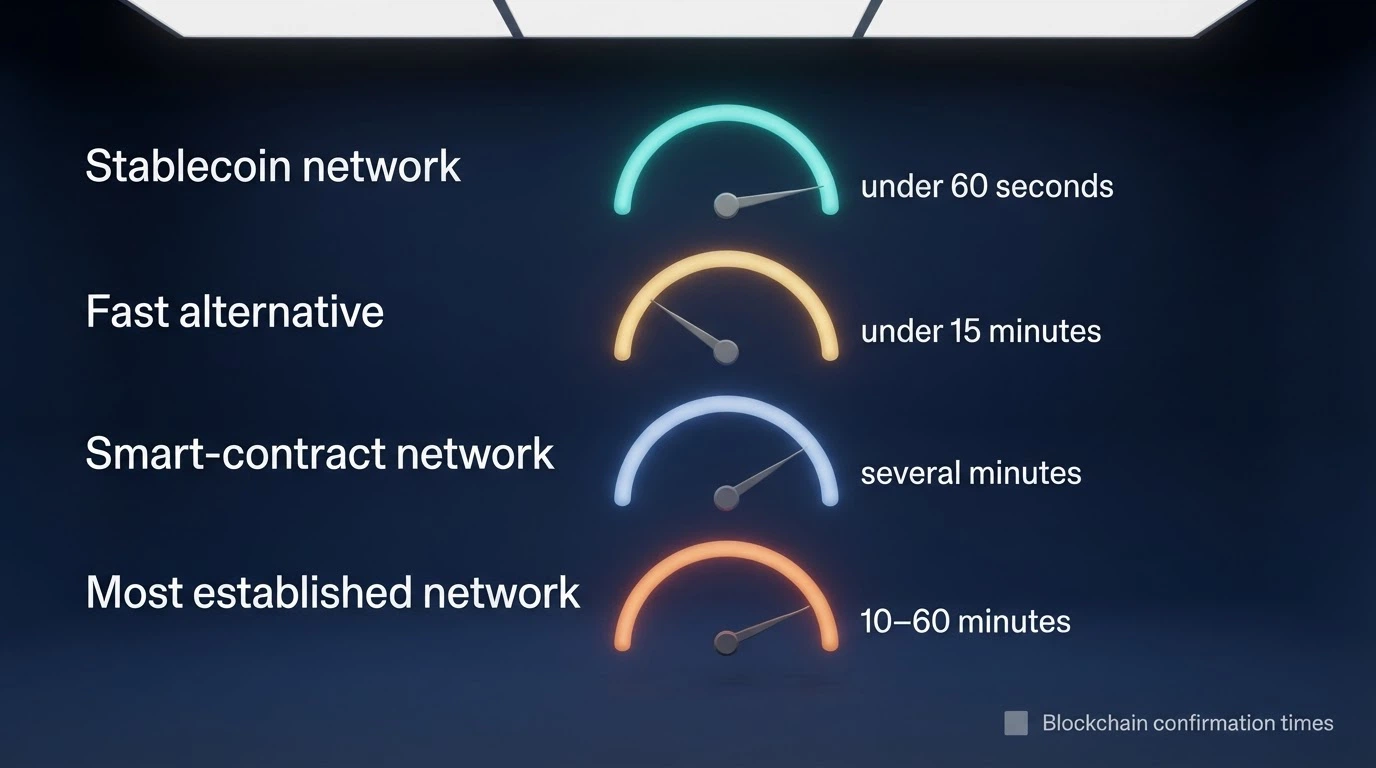
USDT on the TRC-20 network is the recommended fast lane for Australian players who want speed and don’t want to carry BTC’s volatility. Confirmation is typically under 60 seconds, fees are under A$0.50, and the value of the withdrawal in AUD terms is the value at the moment of the transaction rather than the value at the moment the BTC was won. The trade-off is that TRC-20 is a different network from ERC-20 (Ethereum), and the wallet a player uses has to support the right network — sending USDT to a TRC-20 address on the ERC-20 network is a common and irreversible error.
Withdrawal speed by coin: which network gets your crypto out fastest
| Network | Casino Processing | Blockchain Confirmation | Total End-to-End | Typical Fee |
|---|---|---|---|---|
| USDT (TRC-20) | 10 – 60 minutes | Under 60 seconds | 10 – 60 minutes | Under A$0.50 |
| Bitcoin (BTC) | 10 – 60 minutes | 10 – 60 minutes | 20 – 120 minutes | Variable, often A$5 – A$20 |
| Ethereum (ETH) | 10 – 60 minutes | Several minutes (network-dependent) | 15 – 75 minutes | Variable, gas-dependent |
| Litecoin (LTC) | 10 – 60 minutes | Typically under 15 minutes | 15 – 75 minutes | Low, typically cents |
The table covers the four networks the research could confirm with specific figures. USDT on TRC-20 is the fastest end-to-end and the cheapest per transaction, with the added benefit of price stability. BTC is the most established, the most liquid, and the most familiar to Australian players who already hold BTC, but confirmation times are longer and fees are higher. ETH and LTC sit in the middle on speed and cost, with ETH’s gas fees occasionally spiking during network congestion and LTC offering a faster confirmation than BTC at lower fees.
The casino-side delay is the variable a player can’t see until they request the withdrawal. Some operators run an automated approval queue that completes in minutes; others run a manual review that can take the full 60-minute window. The maximum bet during bonus play, the wagering progress, and the account’s withdrawal history all feed into that review. A first withdrawal from a new account is more likely to be reviewed than a repeat withdrawal from a verified account, and a withdrawal that exceeds the casino’s internal threshold is more likely to trigger the full review than a withdrawal under it.
The bank roadblock: why your AUD-to-crypto transfer might not go through
The speed advantage of crypto ends at the player’s wallet, and the slow part of the journey is often the first one — getting AUD onto an exchange to buy the crypto in the first place. The Australian banks’ posture on outbound transfers to crypto exchanges is not uniform, and a player who chooses the wrong bank for the first step of the journey can find a transfer held, returned, or queried at exactly the moment they want it to clear.
The major banks cluster into three groups. The first — CommBank and Westpac — actively restrict outbound transfers to known crypto exchanges, with customers reporting declined transfers, account holds, and requests for additional information on transfers to specific exchange counterparties. The second — ANZ and NAB — flag transfers to crypto exchanges without fully blocking them, with monitoring that escalates with frequency and amount. The third — ING and Macquarie — are the most permissive of the majors, with fewer reported restrictions and a less aggressive monitoring posture. The pattern is not absolute, and individual account experiences vary, but a player who is planning to fund a crypto casino account from an Australian bank should know which group their bank is in before they make the first transfer.
The practical consequence is that a player who banks with CommBank and wants to deposit A$500 in BTC at an offshore casino is not making a single transaction — they are potentially making several attempts, possibly with a different exchange, possibly with a longer processing window, and possibly with a phone call from the bank’s fraud team in between. A player who banks with ING or Macquarie is closer to a single transfer that clears in a day. The casino’s withdrawal speed is unchanged either way; the difference is in the deposit side, and the deposit side is where the AUD-to-crypto conversion happens.
Playing without handing over your ID — how no-KYC crypto casinos work
A no-KYC crypto casino is an offshore casino that allows a player to register, deposit, and play without uploading an ID document at the door. The deposit is from a wallet address the casino can see but does not have to verify against a named individual; the play happens against the casino’s house balance; the withdrawal is to a wallet address the player controls. None of those steps require a passport scan, a utility bill, or a selfie with a date.

The pitch is that the player keeps their gambling activity out of their bank’s transaction history, their credit file, and any future background check that asks the bank to disclose the past 12 months of spending. For a player who values that privacy, the no-KYC route is the only route the offshore market offers, and the cost is the trade-off the rest of this section describes.
The reality is more layered than the marketing suggests. AUSTRAC’s Travel Rule kicks in at A$10,000 for crypto transactions, which means any transfer over that threshold is reportable to AUSTRAC by the exchange or the casino that processes it. The ACMA partnered with AUSTRAC in the Fintel Alliance Micro-Laundering and Illegal Online Gambling project to share information about transactions that could disrupt money flows to illegal gambling services. A player who is moving under the A$10,000 threshold is below the reporting line, but a player whose account shows a pattern of deposits just under the threshold is the kind of pattern the project is designed to flag. None of this changes the casino’s no-KYC entry policy; it changes the surveillance environment around the entry policy.
No-KYC casinos: deposit and play with just a wallet address
The no-KYC entry experience is the cleanest part of the offshore crypto casino journey. The player signs up with an email address and a password, copies the casino’s deposit address from the cashier, sends crypto from their wallet, and is playing within an hour. No name on the account, no address verification, no document upload. The wallet-to-wallet transaction is the entire onboarding.
The set’s per-operator KYC thresholds were not in the research, which is a real gap rather than an oversight. The general pattern in the offshore market is that no-KYC entry is the marketing default, and KYC is triggered by one of three things: the first withdrawal above a threshold (commonly A$1,000 to A$2,000), a deposit pattern that looks irregular (rapid successive deposits, deposits from different wallet addresses, deposits just under the A$10,000 AUSTRAC line), or a flag from the casino’s own anti-fraud system (mismatched IP and wallet geolocation, bonus abuse patterns, chargeback history). A player who keeps deposits modest, keeps them from a single wallet, and withdraws in similar modest amounts is closer to the no-KYC experience the marketing describes. A player who hits a single large win and wants to withdraw the whole amount in one transaction is closer to the verification step the marketing omits.
The honest read is that no-KYC at the door is real for most players, and no-KYC at the withdrawal is the exception rather than the rule. A player who plans to play for a few hundred dollars a week and withdraw similarly is in the no-KYC experience. A player who plans to play for a few thousand and withdraw in one transaction is not.
What triggers KYC — and what you give up by avoiding it
The most common KYC trigger in the offshore market is the first withdrawal, and the most common threshold is in the A$1,000 to A$2,000 range. The casino sends an email asking for a government-issued ID, a proof of address (utility bill or bank statement, typically less than 90 days old), and sometimes a selfie with the ID for liveness verification. The documents are reviewed by the casino’s compliance team, which is sometimes the casino’s own staff and sometimes a third-party verification provider. The review window is typically 24 to 72 hours, and the withdrawal is held until the review is complete.
The second trigger is a deposit or play pattern that the casino’s anti-fraud system flags. A player who deposits from one wallet, plays for a week, and withdraws to the same wallet is a clean pattern. A player who deposits from three different wallets in a week, plays one slot at max bet for the entire session, and requests a withdrawal that exceeds the deposit by a large multiple is a flagged pattern. The flag is not a refusal — it is a request for documents, and the documents are the same ones the first-withdrawal trigger requests. The compliance team either approves the withdrawal or declines it, and a declined withdrawal is the kind of event that turns into a dispute.
The third trigger is a chargeback or a complaint. A player who initiates a chargeback through their bank is a player who has converted a casino dispute into a payment-processor dispute, and the casino’s response is typically to close the account, forfeit the balance, and ban the player from future play. A player who complains to a regulator in a jurisdiction where the casino is licensed (Curaçao, Anjouan) has a route, but a slow one. A player who complains to an Australian regulator has no route, because the ACMA does not have jurisdiction over an offshore operator and the casino is not bound by Australian consumer law. That absence of recourse is the cost of the no-KYC route the marketing does not name.
Privacy tools that work — and ones that do not
Self-custody wallets are the privacy tool that works. A self-custody wallet — software like Trust Wallet or MetaMask, or a hardware wallet like a Ledger or Trezor — gives the player control of the private keys and the wallet address, and no exchange or casino can freeze the balance or reverse a transaction. A non-custodial wallet is the right tool for a player who values the privacy the offshore route advertises. An exchange-held wallet, by contrast, is custodial, and the exchange can freeze, query, or report the balance to AUSTRAC on request. A player who buys crypto on an exchange and leaves it on the exchange is a player whose crypto is one compliance query away from being frozen.
VPNs are a privacy tool that does not work in the way most players hope. A VPN hides the player’s IP from the casino, but the casino sees the wallet address, the deposit pattern, the game play, and the withdrawal request. A VPN also typically violates the casino’s terms of service, which require players to be in a permitted jurisdiction — and an Australian player is not in a permitted jurisdiction for online casino. A player who is using a VPN to access an offshore casino is a player who has added a terms-of-service breach to the IGA prohibition, without adding meaningful privacy. The wallet transaction on the public ledger is the visible fingerprint; the IP is the less informative one.
Blockchain transparency is the privacy tool that works against the player. Every crypto transaction is on a public ledger, and the address-to-address flow is visible to anyone with a block explorer. A casino that wants to trace a player’s deposits can do so by following the wallet; a player who thinks the blockchain is anonymous is wrong. The privacy the blockchain offers is pseudonymous, not anonymous, and the pseudonym is the wallet address. A player who wants true anonymity needs a privacy coin (Monero, Zcash) and a casino that accepts it, which most of the set does not. The set accepts BTC, ETH, USDT, and LTC, all of which are traceable on their respective ledgers.
The pokies Australians are actually playing with crypto
Pokies is the Australian term for slot machines, and the offshore crypto casino lobby is dominated by pokies the way a licensed Australian pub floor is. The set’s research confirms a different provider on each of the well-documented operators: RTG at Fair Go, Play’n GO at SkyCrown, Pragmatic Play at Rainbet, BGaming at WinSpirit, and the SoftSwiss platform catalogue at Bizzo. Each of those providers is a meaningful slice of the global online slots market, and the slots they ship are the slots Australians are playing at offshore crypto casinos.

The provider name matters for two reasons. The first is RTP: the return-to-player percentage is set by the provider, not by the casino, and the same slot at two different casinos returns the same percentage. A player who knows the provider’s catalogue knows the RTP band they are playing in. The second is fairness: providers like Pragmatic Play, Play’n GO and BGaming are licensed by multiple regulators, their games are tested by independent labs (GLI, eCOGRA, others), and the RTPs are published. RTG’s testing footprint is smaller and the RTPs are less consistently published. A player who values independent verification of the game library has a reason to prefer the providers with the more public testing record.
The pokies Australians play: RTG, Pragmatic Play, BGaming and the providers that matter
RTG is the provider most closely associated with Australian-facing offshore casinos, and Fair Go is the only operator in the set that runs an RTG-only lobby. The catalogue is around 280 games, which is small by the standards of the multi-provider operators in the set but is curated for the US-and-AU-facing traffic RTG has historically served. The games lean toward high-volatility five-reel video slots with feature-buy mechanics, and the jackpot slots are the most heavily promoted. The RTPs are published for some titles and not for others, and a player who wants the exact number for a specific game should check the game’s information panel rather than the casino’s marketing.
Pragmatic Play is the global heavyweight in the set, and Rainbet’s free spins are locked to Sweet Bonanza, one of Pragmatic Play’s most-played titles. Sweet Bonanza is a high-volatility six-reel slot with a tumble mechanic, a free-spins feature with multipliers, and a published RTP in the 96% band. The provider’s catalogue runs into the hundreds of games, and the slots that appear most often in offshore casino lobbies are the high-volatility recent releases plus the older titles with sticky brand recognition (Wolf Gold, Great Rhino, the John Hunter series). Pragmatic Play is licensed by the Malta Gaming Authority, the UK Gambling Commission, and a long list of other regulators, and the testing footprint is comprehensive.
Play’n GO is the provider behind Book of Dead, the slot SkyCrown’s first-deposit free spins are locked to. Book of Dead is a high-volatility five-reel slot with a free-spins expanding-symbol feature, and the game is one of the most-copied mechanics templates in the modern online slots market. Play’n GO’s catalogue is around 400 games, with a similar high-volatility focus, and the provider is licensed by MGA, UKGC, and several other regulators. BGaming is the smaller crypto-friendly studio that WinSpirit’s free spins feature, and the five titles in that allocation (Lady Wolf Moon, Pearl Diver, 777 Gems Respin, Eggs of Gold, Magic Ball) are a representative slice of the BGaming catalogue. The provider runs a provably fair footprint on a portion of its games, which is the crypto-native angle the bigger studios don’t offer. SoftSwiss is a platform rather than a provider — it aggregates games from dozens of studios into a single casino backend, and the ~5,000-game library at Bizzo is the result.
RTP, volatility and what makes a pokie worth your crypto
RTP is the percentage of wagered money a slot returns to players over a long enough run. A 96% RTP slot returns A$96 of every A$100 wagered, on average, over millions of spins. The “on average” is doing real work in that sentence: a single session of a few hundred spins can return anywhere from 20% to 200% of the wagered amount, because variance is what variance is, and the published RTP is the long-run number not the per-session number. A player who treats a session’s outcome as a measurement of the RTP is reading the wrong number; a player who treats the RTP as the long-run tax they are paying for the entertainment is reading it right.
Volatility is the second axis, and it is the one that determines the shape of a session. A low-volatility slot returns small wins frequently; a high-volatility slot returns large wins rarely. Book of Dead and Sweet Bonanza, the two slots the set’s free spins are locked to, are both high-volatility. That choice is deliberate: a high-volatility slot produces the long dry stretches and occasional large wins that make a free-spin allocation feel exciting, and it is also the volatility profile that interacts worst with a short bonus validity window. A player with 5 days to clear a bonus on a high-volatility slot is a player whose bonus is at the mercy of a few large outcomes, and the wagering requirement does not get smaller when the variance is high.
Rainbet’s exclusion of games above 97.4% RTP from bonus clearance is the cleanest illustration of why the RTP matters for bonus play. A 97.4% RTP slot is a slot that returns A$97.40 of every A$100 wagered, on average; the casino is willing to let a player play it with real money, but not with bonus money, because the house edge is too thin to fund the bonus. The threshold is the casino’s admission that a high-RTP slot converts bonus money back to the player faster than the wagering requirement can extract it. A player who reads the excluded-games list is a player who understands what the bonus is doing to their edge.
The per-title RTP data for the specific bonus-eligible slots in the set is not in the research, and that gap is real. Book of Dead’s published RTP is 96.21%, Sweet Bonanza’s is 96.51%, and the BGaming titles cluster in a similar band, but the exact number for the version shipped to a specific operator can differ. A player who wants the precise figure for the slot they are about to play should check the game’s information panel inside the casino lobby, where the provider’s RTP is displayed.
Live dealer tables, provably fair games and what else you can play
Pokies dominate the offshore crypto casino lobby, but they aren’t the only thing in it. Live dealer tables — blackjack, roulette, baccarat, game-show formats — are a fixture at the multi-provider operators, and the SoftSwiss platform at Bizzo includes them in the ~5,000-game count. The live dealer studios (Evolution, Pragmatic Play Live, others) run the same games they run at licensed operators, with the same RTP, the same rules, and the same pace. The difference is the regulatory frame: the live dealer studio is licensed in Malta or the UK, the casino is licensed offshore, and the player is in Australia, and none of those jurisdictions overlap cleanly.
Provably fair games are the crypto-native category that fiat casinos don’t offer. Rainbet’s 14 Originals are the example in the set, and the mechanic is the one that makes the category distinct: each bet is hashed before it is placed, the result is generated after the bet is locked, and the player can verify after the fact that the casino did not change the result. The verification is cryptographic, not regulatory — it depends on the casino publishing the unhashed result and the player running the hash comparison. A casino that runs provably fair games is a casino that has chosen to let the player verify the bet, which is a higher bar than the standard “the game is tested by a lab” claim. Rainbet’s Originals run in demo mode, which means a player can test the mechanic before staking crypto, and that demo is the feature the standard slot lobby doesn’t offer.
Table games — blackjack, roulette, baccarat in their software-only form — are the third category, and they are a smaller slice of the lobby at most operators. The RTPs are higher than the slots (blackjack can run at 99%+ with optimal play), and the wagering contribution at bonus play is usually lower than the slots (10% to 20% rather than 100%). A player who is clearing a bonus is a player who should be on the slots; a player who is playing for the game is a player who is on the tables.
New crypto casinos worth watching in 2026
The offshore crypto casino market launches new brands regularly, and the “new casino” category is its own small genre in the affiliate-listing ecosystem. A new brand typically runs a more aggressive welcome offer than the established names — higher percentage match, larger free-spin allocation, looser wagering — to compensate for the absence of a track record. The player-facing pitch is that a new casino is hungrier, more modern, and more willing to compete on terms. The player-facing risk is the one the marketing does not name: no track record means no verified withdrawal history, no published long-term RTP performance, no customer base large enough to surface the complaints that an established operator has already absorbed.

The research did not carry per-brand launch-date data for any specific new entrant, and the honest read is that a “new crypto casino” is a category, not a recommendation. A player who is considering a brand that launched in the last six months should check the same things they would check on an established brand — the licence position, the bonus terms, the wagering, the maximum cashout, the game providers — and should weight the absence of a track record as a real factor. A new operator with a Curaçao licence and a 7-day-old domain is a more uncertain proposition than a 7-year-old operator with the same licence, and the difference is the length of the operational history rather than the licence on the page.
The market-mechanics view is that the new-casino category is the entry point for brands that have not yet built the player base that the established operators carry, and the welcome offer is the cost of acquiring that base. A player who is willing to be acquired at a discount is a player who is willing to take the terms; a player who is not is better served by an established name with a verifiable history.
How we picked and ranked every casino on this page
The brands on this page were selected from the set that appeared consistently across the Australian-facing affiliate-listing ecosystem during the research phase. The criteria were not proprietary and the testing was not first-party. Every figure on the page is drawn from publicly available terms pages, the operators’ own bonus pages, and the player-facing reviews that aggregate them — Pokiesaustralia.com, Casinoshub, TheSpike.gg, ClearCasinos, slotbonuses.info, alfa-win.net, IrishLuck.ie, FreeSlots99, and the operators’ own sites. No deposits were made, no withdrawals were tested, and no proprietary RTP measurements were run.
The ranking reflects the completeness of the verifiable data and the topical relevance to the questions this page is built to answer. Rocket Play, SkyCrown, Royal Reels, Stake, Fair Go, Rainbet, WinSpirit, Bizzo, BitStarz and Scream are listed in the order the research layer carried them, and the order is editorial rather than algorithmic. A reader who is using the ranking to choose an operator is a reader who is using one input rather than all of them, and the right next step is to read the bonus terms on the operator’s own site, not to follow the ranking as a buyer’s guide.
The licence column reflects what the research could verify, and the gaps are named where they exist. Only Bizzo’s Curaçao sub-licence (8048/JAZ2017-067) was verifiable in the public record at review time. The remaining Curaçao-licensed operators are described as Curaçao without a number; the Anjouan operator is named; the operators with no confirmed licence are marked accordingly. The bonus and wagering figures are drawn from the operators’ published terms and the aggregator reviews that cite them. The bank-level data on AUD-to-crypto transfers is qualitative, drawn from player reports and the banks’ published acceptable-use policies, and is not based on a survey of bank staff. The withdrawal-speed data is drawn from Pokiesaustralia.com’s published testing, which ran 124 deposits and 123 withdrawals across six cryptocurrencies.
Is an offshore crypto casino worth the risk? What the facts say
The question this page is built around is not whether an offshore crypto casino is legal, or whether it is licensed, or whether the bonuses are good. Those questions are answered in the sections above, and the answers are: no, no, and it depends on the wagering. The question worth answering in the close is whether the trade-off the offshore route asks the player to make is one the player is actually making in the way they think they are.
The legal trade-off is real. The IGA prohibits the provider, not the player, but the prohibition is the reason no Australian licensed alternative exists, and the reason the only protection the player has is the protection the offshore casino chooses to extend. A refused withdrawal at a licensed operator can be escalated to the ACMA or to the state regulator; a refused withdrawal at an offshore operator can be escalated to the offshore regulator, if the offshore regulator has a complaints process the player can find, and if the operator is responsive to it. The ACMA has no jurisdiction. BetStop has no reach. The consumer protection that an Australian player takes for granted at a licensed bookmaker is absent at an offshore casino, and the absence is the cost of the route.
The bonus trade-off is also real. The wagering requirements on the set’s offers sit in a 30x to 40x band, with most offers running 40x on bonus+deposit. The expected house edge across A$80,000 of wagering on a 96% RTP slot is A$3,200, and the bonus the player is clearing is often smaller than the house edge they are paying to clear it. The bonuses are not free money; they are loans with interest, and the interest is the wagering. A player who is choosing an offer on the basis of the headline percentage is choosing on the wrong number; the wagering multiple, the maximum bet, the maximum cashout, and the validity window are the four numbers that determine what the offer is actually worth.
The withdrawal trade-off is the upside. Crypto withdrawals are 5 to 20 times faster than PayID at licensed operators, and USDT on TRC-20 clears in under 60 seconds with fees under A$0.50. For a player who values the speed of access to winnings, the crypto route is genuinely faster than any fiat alternative the Australian market offers, and the licensed market cannot match the speed without changing its banking arrangements. The bank-side friction on the deposit side is the offset: a CommBank or Westpac customer funding a crypto exchange account is not getting the deposit-speed advantage on the way in, and the time saved on the way out is partially consumed on the way in.
The privacy trade-off is the most personal. A no-KYC entry is real for most players at most operators, and the absence of a credit-card or bank-statement record of gambling activity is a real privacy gain. The withdrawal-stage KYC trigger is the offset: a player who wins a large amount and wants to withdraw it in a single transaction is the player who will be asked for documents, and the document request is the privacy cost the marketing does not name.
The responsible-gambling trade-off is the one that matters most for the players who need help. BetStop’s 67,480 registrations and 41,290 active exclusions represent Australians who have asked the licensed system to exclude them, and the licensed system has done so. An offshore casino is not part of that system, and the self-exclusion does not follow the player there. The 78% of registrants under 40 and the 38% who chose lifetime exclusion are not protected at the offshore casino they could still reach with a wallet and an email address. The National Gambling Helpline (1800 858 858) and Gambling Help Online (gamblinghelponline.org.au) are the support that does follow the player, and they are free, confidential, and staffed 24/7. A player who is reading this page and recognising their own situation in the self-exclusion statistics is a player who should call the helpline before they make the next deposit.
The page’s conclusion is not that the offshore route is wrong for every player, and not that it is right for any. The conclusion is that the trade-offs are specific, the figures are real, and the player who is choosing the offshore route is choosing it with full information rather than the marketing’s information. The set above is the set the research found. The bonus terms are the bonus terms the operators publish. The legal position is the legal position the IGA establishes. The decision is the player’s, and the page’s job is to make sure the decision is informed.
Frequently asked questions about Australian crypto casinos
Is it legal for Australians to play at a crypto casino?
The Interactive Gambling Act 2001 prohibits the provision of online casino games, online pokies and in-play sports betting to people in Australia. The IGA targets the provider under Section 8AA, not the individual player, and Australian players are not criminalised for using offshore crypto casinos. The casino is operating in breach of the IGA; the player is not committing an offence by playing. That distinction does not change the fact that the player has no Australian consumer protection, no BetStop coverage, and no ACMA complaint route if something goes wrong.
Can I use BetStop to self-exclude from a crypto casino?
No. BetStop, the National Self-Exclusion Register, binds Australian-licensed wagering services only. About 150 licensed providers are bound by a BetStop registration; an offshore crypto casino is not connected to the register and will continue to accept deposits from a self-excluded Australian. The 67,480 BetStop registrations and 41,290 active exclusions reflect the licensed system’s coverage, and that coverage stops at the border. The National Gambling Helpline (1800 858 858) and Gambling Help Online are the support that does follow the player to an offshore casino.
What happens if an offshore crypto casino refuses to pay out my winnings?
The player has no Australian regulator to complain to, because the ACMA has no jurisdiction over an offshore operator. The first route is the casino’s own complaints process, which is usually reachable through the support team and the terms page. The second route is the casino’s licensing jurisdiction — Curaçao, Anjouan, or wherever the licence is held — which has a complaints mechanism but a slow one. The third route is the payment-processor chargeback, which converts a casino dispute into a banking dispute and typically results in the account being closed. The lesson is that withdrawal reliability is a function of the operator’s reputation rather than a regulatory guarantee, and that is the structural cost of the offshore route.
Are crypto casino winnings taxable in Australia?
Casual gambling winnings are not assessable income under section 6-5 of the ITAA 1997, and gambling losses are not deductible under section 8-1. The exception is a person who is carrying on a business of betting or gambling, which the ATO determines by reference to factors like the systematic nature of the betting, the size of the bets, the use of betting strategies, and the level of trading activity. The typical recreational player at an offshore crypto casino is not carrying on a business and is not liable for tax on winnings. The licensed wagering operator is liable for the NT wagering tax and the state point-of-consumption tax; the player is not.
Which Australian banks allow transfers to crypto exchanges for gambling?
The major banks’ posture on outbound transfers to crypto exchanges is not uniform. CommBank and Westpac actively restrict transfers to known crypto exchanges, with customers reporting declined transfers and account holds. ANZ and NAB flag transfers to crypto exchanges without fully blocking them, with monitoring that escalates with frequency and amount. ING and Macquarie are the most permissive of the majors, with fewer reported restrictions. A player who is planning to fund a crypto casino account from an Australian bank should know which group their bank is in before they make the first transfer, and should be prepared for the possibility that the first transfer will be held or queried rather than cleared in a single day.
Written by the editors at No Deposit Bonus Casino AU.