What $300 No-Deposit Bonuses Actually Cost Australian Players in 2026
 Available in AU
Current as of 18 October 2026 · Verified against the ACMA register, AIHW 2022 data and operator-published terms.

The marketing pitches a $300 no-deposit bonus like a gift. The terms read more like a contract drawn up by the gift’s recipient. A genuine A$300 free chip with no deposit required is rare in Australia, and where it appears, it comes wrapped in conditions that shrink the headline figure long before any of it reaches a bank account. Every casino offering one to an Australian player is doing so from offshore, outside the Australian rules, which means there is no Australian consumer protection behind the offer. This guide sets out what a $300 no-deposit bonus really delivers at AU-facing casinos in 2026: how the terms work, what the maths costs the player, which operators are actually accessible, where the law stands, and what help exists if the chase for a free chip turns into something the player wants to stop.
Table of Contents
- What a $300 No-Deposit Bonus Casino Actually Delivers in Australia
- The Real Cost of a $300 No-Deposit Bonus — What the Terms Actually Mean
- Every $300 No-Deposit Bonus Operator Australians Can Access in 2026
- Paying and Cashing Out at AU-Facing Offshore Casinos
- The Law: Every $300 Bonus Comes from Outside Australian Rules
- Responsible Gambling Tools Every Australian Player Should Know
- How We Evaluated These Operators
- What the $300 No-Deposit Bonus Means for Your Next Move
- Frequently Asked Questions About $300 No-Deposit Bonuses
What a $300 No-Deposit Bonus Casino Actually Delivers in Australia
A “no-deposit bonus” — an NDB in the trade’s shorthand — is a casino credit offered without the player funding an account first. It is the headline product in nearly every affiliate review for Australian readers, and it is the most mismarketed figure in the space. The promise is a chip you can play with for nothing. The reality is a chip you must clear at a steep multiplier before any winnings can be withdrawn, capped at a small fraction of what the bonus can theoretically pay out, on a clock that often gives the player five days to do it in.
Why the ‘$300 free chip’ label overpromises
The $300 figure is, in practice, a ceiling rather than a starting bankroll. A genuine A$300 free chip with no deposit attached is offered by only a handful of operators reaching Australian players, and the marketing around it tends to elide the conditions. Those conditions arrive once the player claims the bonus.
The wagering requirement is the first wall. Industry reporting on AU-facing NDBs in 2026 puts the multiplier on a $300 bonus at anywhere from 50x to 70x. That means a player who claims a $300 chip at 50x must cycle A$15,000 in total bets before any winnings convert to withdrawable cash; at 70x the figure climbs past A$21,000. On a $300 bonus at 35x — the lowest end of the standard band — the required turnover is A$10,500. The “free” part of the bonus stops looking free the moment the player starts working through the wagering.
The second wall is the cashout cap. The same reporting puts the maximum withdrawal from a $300 NDB at somewhere between A$50 and A$200, regardless of how high the player’s balance runs during play. A player can ride the chip to a balance of A$2,000 on a hot session and still walk away with A$200 — if they walk away at all.
A free-spin NDB makes the gap visible in dollar terms. A hundred free spins at A$0.05 each are worth A$5 of play in raw value. Fifty free spins at A$0.25 each total A$12.50. Both are routinely marketed as “$300 bonuses” once the wagering and cap arithmetic is dressed up. The label and the value are not the same number, and that is the first thing a player should internalise before claiming one.
Who these no-deposit offers are really for
NDBs are pitched at every reader. They are designed, specifically, for a narrower audience.
The casual punter dipping into a new casino to see whether the lobby suits them is the closest fit. A$40 or A$75 in capped winnings from a no-deposit spin offer is a low-cost way to test a platform’s withdrawal process and game selection. If the operator passes that test, the player can deposit on their own terms rather than chasing a sign-up incentive.
The bonus hunter, who treats NDBs as a small side income, fits only if the wagering and cashout maths work in their favour at scale. With caps pinned at A$50–A$200 and wagering at 30x–50x on most free-spin offers, the realistic hourly yield from claiming every available NDB is modest. It is work that pays in coupons, not in salary.
The player who hits the cashout cap on the first withdrawal is the figure the offer is built around. Most readers leave an NDB session with the bonus cleared and the cap reached, or with the bonus intact but the clock run out — and the wagering requirement unmet. In either case the operator keeps the difference.
The high-volume player skips NDBs. A deposit match with ordinary wagering produces a larger realisable sum than a no-deposit chip capped at A$200. The NDB is a small front door; the welcome package is the actual showroom, and the reader with a budget treats them as separate decisions rather than stacked offers.
The Real Cost of a $300 No-Deposit Bonus — What the Terms Actually Mean
The bonus is free to claim. Converting it to cash is anything but. Every NDB carries a stack of conditions, and the player who reads only the headline figure has already agreed to them.
No-deposit free chips and free spins — what lands in your account
Two shapes turn up under the $300 NDB label. The first is a free chip: a fixed dollar amount credited as bonus funds, with wagering attached. The second is a bundle of free spins on a named pokie, with the spin winnings treated as bonus funds and the same multiplier applied.
The chip is the rarer offer at the $300 mark. Skycrown runs a 20-free-spin no-deposit bonus on Aztec Clusters by BGaming — 25x wagering on the winnings, a seven-day activation window, five days of validity after that, an A$3 maximum bet, and an A$40 cap on cashable winnings. The actual cashable value, if the player clears the wagering in full, tops out at A$40. Rocket Play’s NDB is 25 free spins on Coin Volcano by Playson, with 50x wagering, an A$75 maximum withdrawal and a five-day validity window. A second Rocket Play offer appears at 20 free spins on Book of Pyramids at 40x wagering with an A$85-equivalent cap — a different rotation on the same kind of product.
In raw value, the free-spin NDB is small. A$40 to A$85 of cashable winnings from a 20-to-25 spin bundle. The headline often reads as a “$300 bonus” because it includes the wagering-driven theoretical ceiling rather than the cashable sum; the cashable sum is the smaller number above. The two are not the same thing, and a player who reads only the marketing one is being misled.
Deposit-match and welcome packages — the fine print beyond the $300
The welcome offer that carries the largest dollar figure on the AU-facing shortlist is usually a deposit match, not a no-deposit bonus. The distinction matters because the two convert differently.
Skycrown’s four-stage welcome package can add up to A$8,000 in matched deposits plus 400 free spins across the four deposits, with a 14-day validity window per stage, 40x wagering on the deposit bonus plus the winnings from the free spins, an A$7.50 maximum bet while wagering, and a free-spin cashout cap of A$300. The headline number is large; the playable amount depends on how much the player chooses to deposit and how far through the four stages they go.
Rocket Play’s first-deposit bonus is a 100% match up to A$500 plus 100 free spins, with 40x wagering on the bonus amount alone — not on deposit plus bonus — and a 14-day validity window. The minimum deposit to trigger it is A$25. The maximum bet while wagering is A$7.50. A second-deposit bonus at 200% up to A$500 is offered on the next stage.
The deposit match and the no-deposit chip live on opposite ends of the same scale. The NDB asks nothing of the player but gives very little back. The welcome match asks for a deposit and gives back a multiple — but the multiple carries its own wagering, its own cap and its own clock. Treating them as the same kind of offer is a misreading; treating them as comparable only when the wagering and cap are laid out side by side is the honest comparison.
Wagering requirements: the multiplier your balance has to survive
Wagering — also called playthrough or rollover — is the total amount a player must bet before bonus winnings become withdrawable. On a $300 no-deposit bonus, the standard multiplier for AU-facing offers in 2026 runs from 40x at the lenient end to 60x in the middle of the band, with outliers pushing past 70x. At 50x, the player must cycle A$15,000 in bets; at 35x, A$10,500.

The difference between wagering on the bonus alone and wagering on the deposit plus bonus changes the turnover by the deposit amount. Skycrown’s 40x applies to the bonus plus free-spin winnings. Rocket Play’s 40x applies to the bonus alone. Two operators, the same multiplier, different bases, different totals. The player should check which base the wagering applies to before reading the headline percentage.
Game weighting is the second move on the wagering board. A $15,000 turnover requirement is not the same workload in every game. Pokies typically count 100% of every dollar wagered toward the requirement; table games count 5–10%, sometimes nothing; live dealer and jackpot pokies are excluded entirely. A player running the bonus on a live blackjack table needs to bet A$150,000 to clear what A$15,000 clears on pokies. The wagering figure on the offer page assumes the player is playing pokies. A player who drifts onto a different game will see the wagering meter barely move.
The worked example sits here, because every figure on this page is a number until it does the work of one. A $300 no-deposit bonus at 50x wagering on the bonus alone, played through at a 96.50% return-to-player — a mid-range figure for a popular pokie such as Sweet Bonanza — produces a required turnover of A$15,000 and an expected loss of A$525 over the lifetime of the bonus. That figure is the bonus’s real cost: the house edge multiplied out across every spin the player must make to clear the wagering. It sits in addition to the cashout cap that limits what survives to be withdrawn. A player who clears the wagering and lands at the A$200 cap has had A$525 of theoretical turnover value consumed by the edge, in return for a maximum cashable sum of A$200. The bonus, in plain words, pays the player less than the player pays the house to play it.
That is the maths of a single offer. The size of the gap varies with the multiplier, with the pokie chosen, and with how much of the bonus balance survives to the end. A higher multiplier stretches the turnover; a higher-RTP pokie compresses the edge; an early bonus-bust forfeits whatever the player has not yet worked through. Every claim on a $300 NDB is a separate run of the same arithmetic, and the arithmetic does not improve with repetition.
Cashout caps, expiry clocks and the terms that void your win
Three traps sit between a cleared bonus and a withdrawal. Each one can convert a successful run into a zero balance.
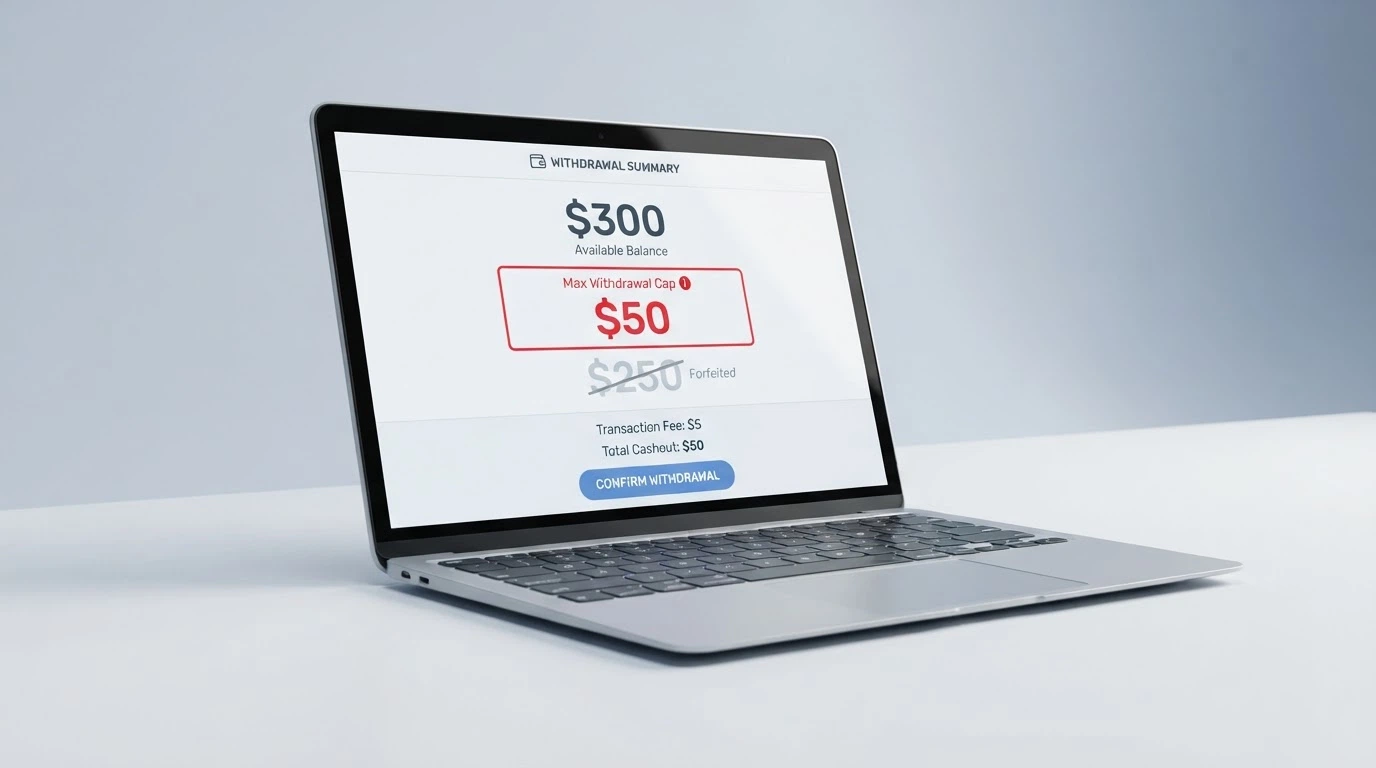
The cashout cap is the first. It is the maximum amount a player can withdraw from a no-deposit bonus, regardless of how high the in-session balance has climbed. The standard band at AU-facing casinos in 2026 is A$50 to A$200; Rocket Play’s Coin Volcano offer is capped at A$75, the Skycrown Aztec Clusters NDB at A$40, and Royal Reels’ NDB at A$200. A player who rides a 25-spin bonus to an in-session balance of A$2,000 still walks away with the cap. The rest is forfeit.
The expiry clock is the second. Most NDBs at AU-facing casinos demand playthrough inside one to seven days of activation. Skycrown’s Aztec Clusters NDB activates inside seven days and is valid for a further five; Rocket Play’s Coin Volcano offer is valid for five days from issue. A player who works through the wagering requirement at a leisurely pace over a working week will hit the cap or the clock; a player who doesn’t finish by the deadline forfeits bonus funds and any winnings still attached to them.
The bet-limit tripwire is the third. While the bonus is active, the player is bound by a maximum bet per spin — Skycrown sets A$3 on its NDB, A$5 is typical at AU-facing offers, A$7.50 is the standard on most deposit-match bonuses. A single spin above the ceiling voids the bonus and the winnings attached to it. There is no warning before the voiding takes effect, and no partial recovery. The wagering meter is reset; the cap is irrelevant; the bonus is gone.
A player who reads only the headline $300 figure has agreed to all three of those conditions by claiming the offer. A player who reads the terms page first knows the shape of the obstacle course before stepping onto it.
Which pokies actually count toward playthrough — and which ones are blocked
Game weighting turns the wagering requirement into a workload that depends on what the player is actually playing. The standard contribution at AU-facing casinos in 2026 is pokies at 100%, table games at 5–10% and live dealer and jackpot titles at zero. A spin on a pokie counts the full dollar toward the wagering meter; a hand of blackjack counts a tenth or nothing.
The pokie-specific NDB sharpens that constraint further. Skycrown’s 20 free spins are locked to Aztec Clusters by BGaming; Rocket Play’s 25 free spins are locked to Coin Volcano by Playson; the secondary Rocket Play NDB is locked to Book of Pyramids. The free spins can only be played on the named title. Any wagering requirement those spins generate must then be cleared on a game that contributes 100% — which is what pokies do, and what table games and live dealer do not.
A short list of high-contribution, high-RTP pokies gives the player the best clearance odds — though “best” here means lower house edge rather than a winning strategy. The theoretical return to player on the pokies below sits well above the industry average.
| Pokie | Provider | RTP | Volatility | Max Win |
|---|---|---|---|---|
| Mega Joker | NetEnt | 99.00% | — | — |
| Blood Suckers | NetEnt | 98.00% | Low | 900x |
| 1429 Uncharted Seas | Thunderkick | 98.60% | — | — |
| Razor Shark | Push Gaming | 96.70% | Very High | — |
| Gates of Olympus | Pragmatic Play | 96.50% | — | 5,000x |
| Gates of Olympus 1000 | Pragmatic Play | n/a | — | 15,000x |
| Sweet Bonanza | Pragmatic Play | 96.51% | High | 21,100x |
| Sweet Bonanza 1000 | Pragmatic Play | 96.53% | High | 25,000x |
| Starburst | NetEnt | 96.09% | Low | — |
| Piggy Riches | NetEnt | 96.38% | Medium | — |
Mega Joker at 99.00% return-to-player is the highest figure on the list, followed by 1429 Uncharted Seas at 98.60% and Blood Suckers at 98.00%. Razor Shark, Gates of Olympus and the Sweet Bonanza pair sit at the industry mid-band of around 96.5%; Starburst at 96.09% is the lower edge of the standard range; Piggy Riches at 96.38% is close to the average. None of these figures changes the wagering workload. They change how much of the turnover is returned to the player as winnings rather than kept by the house.
Volatility shapes the player’s experience of the wagering. Low-volatility pokies such as Blood Suckers and Starburst return small wins frequently, which keeps the balance moving and the wagering meter advancing at a steady pace. High-volatility pokies such as the Gates of Olympus and Sweet Bonanza pair hold the balance flat through long dry stretches and pay larger sums in clusters. A player with a 50x wagering requirement and a five-day window has reasons to prefer one over the other — the steady drip of a low-volatility pokie is generally a faster path to clearing the wagering than the feast-or-famine pattern of a high-volatility one, though neither pattern improves the expected return.
The pokies above are not a recommendation. They are the titles on which research confirmed RTP, volatility and max-win figures at AU-facing casinos in 2026. The list is shorter than the AU-facing catalogue, and the titles on it reflect what research verified rather than what the market offers.
Every $300 No-Deposit Bonus Operator Australians Can Access in 2026
There is no Australian-licensed online casino. The Interactive Gambling Act 2001 has banned the product since 2001, and the 2017 amendments closed the offshore loopholes the industry used to reach Australian players. Every operator on the table below is offshore, serves Australian players from outside the country, and holds no licence from an Australian regulator because none can exist. The $300 no-deposit bonus is one of the products the IGA prohibits offering. Every brand here is offering it.
| Operator | Status in Australia | Domain |
|---|---|---|
| Rocket Play | Offshore (no AU casino licence) | Rocket Play’s website |
| Skycrown | Offshore (no AU casino licence) | Skycrown’s website |
| Royal Reels | Offshore (no AU casino licence) | — |
| Stake | Offshore (no AU casino licence) | Stake’s website |
| WinSpirit | Offshore (no AU casino licence) | — |
| Scream Casino | Offshore (no AU casino licence) | — |
| FairGO | Offshore (no AU casino licence) | — |
| Rainbet | Offshore (no AU casino licence) | Rainbet’s website |
| Bizzo Casino | Offshore (no AU casino licence) | — |
| Rocket Casino | Offshore (no AU casino licence) | — |
No domain in the table was verified against a regulator register during research for this guide. The domains confirmed from operator pages are listed by name; the rest appear as em dashes, which is what the absence of a verified domain looks like on this page.
Offshore vs licensed — the split every Australian punter needs to see
The licensed Australian wagering market covers sports and racing. Sportsbet, the TAB operators, Bet365, Ladbrokes — those are NT-licensed bookmakers offering a product the IGA permits: pre-event wagering on sport and racing. Land-based casinos (Crown, The Star and the state-licensed clubs) are a separate, venue-based market; their licences do not extend to an online casino product.
Online casino — the pokies, the blackjack, the roulette, the live dealer — is the product every operator in the table above offers. It is the product the IGA prohibits. The licensed-versus-offshore split is not a matter of one group being more reputable than the other. It is a matter of one group existing inside Australian law and the other group operating outside it.
The distinction matters to the player in three concrete ways. There is no Australian complaints body that can recover a disputed balance from an offshore operator — the ACMA cannot refund a single player. BetStop, the National Self-Exclusion Register, does not extend to offshore casinos, so a player who has self-excluded from Australian wagering remains free to deposit at every brand on this list. And the ACMA’s site-blocking power — exercised against 1,564 sites as at March 2026 — can cut a player off from an offshore casino’s website at any time, including with a balance still in the account.
The player is not prosecuted under the IGA. The provider is targeted. That distinction is real, and it is also narrow: it leaves the player with no consumer protection, no recourse on a withheld withdrawal and no guarantee that the operator they are depositing with tomorrow is the same operator they deposited with today.
Rocket Play: 100% first-deposit match and a 25-spin no-deposit starter
Rocket Play’s welcome pack is the cleaner shape on this shortlist. The first deposit unlocks a 100% match up to A$500 plus 100 free spins, with 40x wagering on the bonus amount alone — not on deposit plus bonus — a 14-day validity window and an A$7.50 maximum bet while wagering. The minimum deposit to trigger the offer is A$25. A second-deposit bonus at 200% up to A$500 follows for players who return.
The no-deposit side is a 25-free-spin starter on Coin Volcano by Playson, at 50x wagering on the winnings and an A$75 maximum withdrawal, with a five-day validity window. A separate offer at 20 free spins on Book of Pyramids runs at 40x wagering with an A$85-equivalent cap, surfaced through some affiliate channels rather than the operator’s main page. The two are the same kind of product — free spins on a named pokie, with a wagering multiplier, a cashout cap and a clock — rotated across different titles.
The label “no-deposit” applies cleanly to the 25 free spins, not to a $300 free chip. A player who arrives looking for the latter will not find it here. What they will find is a low-friction way to test the cashier, the game lobby and the withdrawal process before committing a deposit.
For an Australian player comparing the AU-facing shortlist, Rocket Play is the operator whose welcome pack terms are most legible: a clear multiplier, a clear base (bonus only, not bonus plus deposit), a clear minimum deposit and a clear max bet. The NDB is modest in cashable terms but transparent in structure. That is the trade a player is making.
Skycrown: A$8,000 across four stages and a 20-spin no-deposit teaser
Skycrown’s welcome package is the largest on the AU-facing shortlist by headline figure — up to A$8,000 in matched bonuses plus 400 free spins across four deposit stages. Each stage carries a 14-day validity window, 40x wagering on the deposit bonus plus the winnings from free spins, an A$7.50 maximum bet while wagering, and an A$300 cap on free-spin winnings per stage. The package is structured as a sequence, and a player who does not complete all four stages captures only the matched amount they actually deposited against.
The no-deposit side runs as the Skycrown “Meet & Spin” offer: 20 free spins on Aztec Clusters by BGaming, with 25x wagering on the winnings, a seven-day activation window, a five-day validity window after activation, an A$3 maximum bet and an A$40 maximum cashable winnings. The 25x multiplier is on the lenient end of the free-spin NDB band; the A$40 cap is on the lower end.
The headline gap is the point to weigh. Skycrown markets the welcome package as an A$8,000-plus-400-free-spins offer; the no-deposit side is a separate A$40-cap teaser. A player who confuses the two will arrive expecting the welcome figure and leave with the NDB’s smaller realisable sum. Reading the offer pages separately is the only way to see what each one is.
For a player with a budget large enough to fund four deposits and clear 40x wagering within the 14-day windows, Skycrown’s welcome pack is the largest matched-bonus structure available from this shortlist. Those without such a budget might prefer the no-deposit starter, which provides A$40 in capped winnings.
Royal Reels: no-deposit bonus listed with 30x–40x wagering and A$200 cashout cap
Royal Reels is listed by AU-facing affiliate channels as offering a no-deposit bonus, with the wagering on bonus funds in the 30x–40x range, a maximum cashout of A$200 and a validity window of 7–14 days. The 30x lower bound is below the standard 40x–60x band, which makes the multiplier one of the cheaper NDB wagering requirements on the AU-facing shortlist — though “cheaper” here means a smaller turnover target rather than a better deal.
The welcome-package specifics for Royal Reels were not confirmed from snippets during research for this guide. The operator is identified as offshore, with no AU casino licence possible under the IGA, but the size and structure of its deposit-match package and its full NDB terms were not retrievable from the verified set. A player considering Royal Reels should treat the unconfirmed fields as gaps rather than assumptions and check the operator’s own terms page before claiming.
The NDB cap of A$200 is the largest on the verified shortlist, and the 30x–40x multiplier is on the lower end. Together they describe an offer that is closer to clearable than a 50x-A$75-cap structure — though the cleared-bonus ceiling of A$200 is still well below the $300 figure in the marketing.
For an Australian player prioritising the largest cashable ceiling among verified NDBs, Royal Reels is a strong contender on those two fields, provided they are comfortable with the unconfirmed welcome-package terms. Players who prefer a fully verified welcome structure may find Rocket Play and Skycrown more suitable options.
Stake
Stake is one of the larger offshore casino-and-sportsbook brands and is widely visible in AU-facing market-share data. The operator runs a Curaçao-licensed offshore product; its specific licence was not independently verified during research for this guide. The Australian-facing product is a casino-and-sportsbook combination, with the sportsbook side licensed separately where required by jurisdiction.
Stake’s no-deposit bonus and welcome-package terms were not confirmed from snippets during this research run. The operator is named here because it appears in AU-facing listings and in industry market-share data, not because the bonus terms were verified. A player considering Stake should treat the bonus side as unconfirmed and check the operator’s own promotions page before claiming.
The trade a player is making with Stake is brand familiarity and product breadth, not verified bonus terms. A wider game lobby and an integrated sportsbook are real features; the absence of confirmed bonus specifics in this guide is a gap a player should close before claiming rather than after.
WinSpirit
WinSpirit is an offshore casino brand with Australian-facing marketing; bonus terms and licence status were not independently verified for this guide.
The operator’s presence in the AU-facing shortlist reflects its visibility in affiliate channels rather than the verification state of its bonus terms. The same applies to several of the brands below.
A player considering WinSpirit should treat the bonus side as unconfirmed and read the operator’s current terms page before committing a deposit. The page-by-page comparison that this guide offers on Rocket Play and Skycrown is not available here, because the figures were not retrievable from the verified set.
Scream Casino
Scream Casino is an offshore operator with AU-facing reach; bonus terms and licence status were not independently verified for this guide.
The brand name is distinct from the operator’s product position, which is a standard offshore casino offering pokies, table games and live dealer. As with WinSpirit, the inclusion in this guide reflects AU-facing visibility, not verified bonus terms.
A player considering Scream Casino should treat the offer specifics as unconfirmed and read the operator’s own terms before claiming. The verified bonus detail that this guide provides for Rocket Play, Skycrown and Royal Reels is not available here.
FairGO
FairGO is an offshore casino brand that markets itself to Australian players. Its license and bonus terms are not independently verified.
The brand familiarity is real. The verified bonus terms behind the brand are not. A player arriving at FairGO from an AU-facing review should read the operator’s current promotions page directly and treat the offer specifics as unconfirmed until they have done so.
Rainbet
Rainbet is an offshore casino and sportsbook brand; licence status and bonus terms were not independently verified for this guide.
Rainbet’s product covers casino games and sports wagering in a single account, similar to Stake’s structure. The verified domain is Rainbet’s website. The verified bonus detail behind that domain is not available in this guide.
A player considering Rainbet should treat the bonus side as unconfirmed and check the operator’s promotions page directly before claiming.
Bizzo Casino
Bizzo Casino is an offshore casino brand with AU-facing reach; licence status and bonus terms were not independently verified for this guide.
The brand is one of several on this shortlist whose visibility in AU-facing listings is the reason for inclusion, rather than the verification state of its bonus terms. A player considering Bizzo should read the operator’s own current promotions page before committing a deposit, because the verified bonus detail that this guide offers on Rocket Play, Skycrown and Royal Reels is not available here.
Rocket Casino
Rocket Casino is an offshore brand distinct from Rocket Play; licence status and bonus terms were not independently verified for this guide.
The confusion between the two brands is a real risk for a player scanning a shortlist like this one. Rocket Play’s terms are verified and laid out above. Rocket Casino’s terms are not. The two should not be treated as the same operator on the strength of a shared first word.
A player considering Rocket Casino should treat the offer specifics as unconfirmed and verify the operator’s identity — including the domain — before claiming any bonus.
Paying and Cashing Out at AU-Facing Offshore Casinos
Depositing at an AU-facing offshore casino in 2026 runs through a narrower set of rails than it did two years ago. The Australian rules tightened in 2023 and again in 2024, and the payment-method list that remains is the list a player should work from.
PayID — the fast rail for deposits at AU-facing casinos
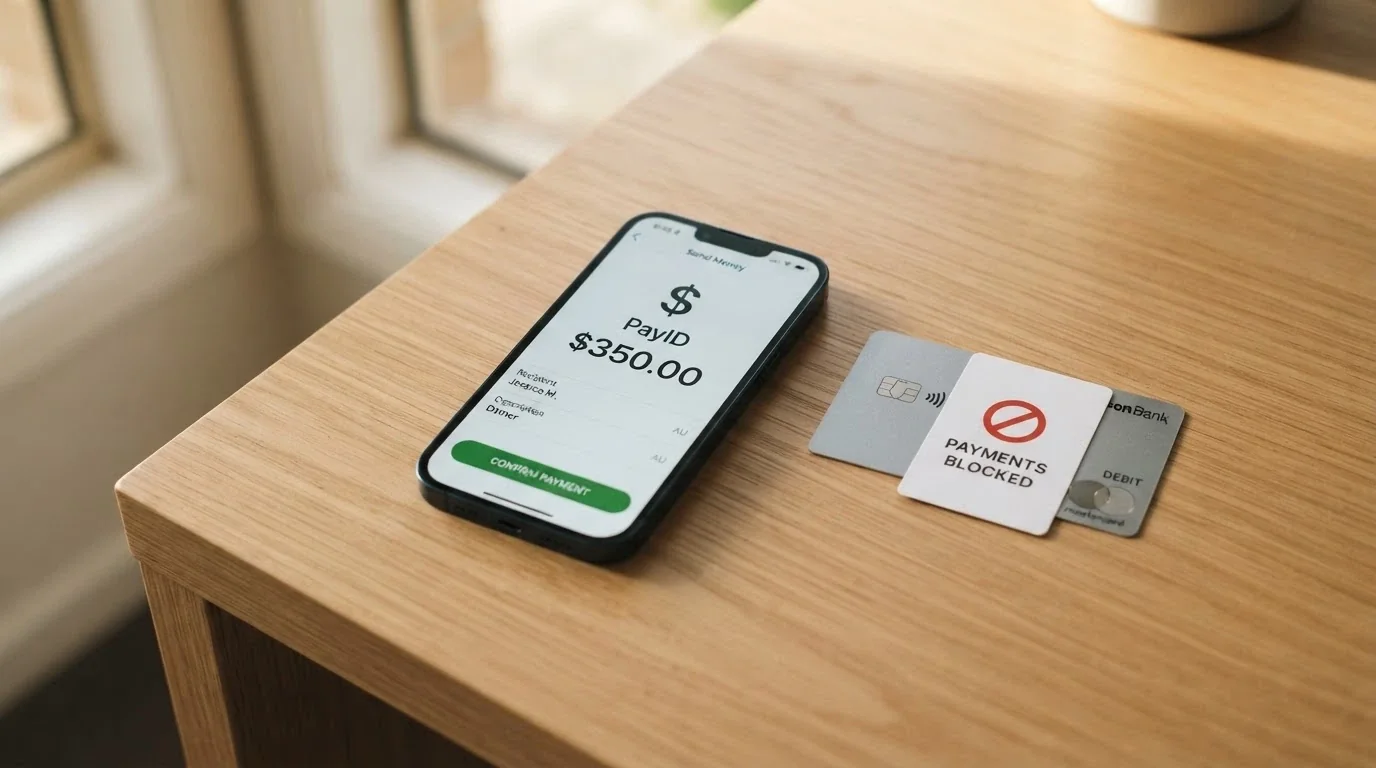
PayID, paired with the Osko instant-payment service operated by the New Payments Platform, is the default Australian deposit rail for online wagering in 2026. Settlement is near-instant — typically under a minute — and the rail is tied to the player’s own bank account through their PayID, which can be a mobile number, an email address or an ABN. There is no fee on the player’s side, and the rail is operated inside the Australian banking system rather than through a third-party processor.
PayID’s predecessor for casino deposits was POLi, an Australian payment service that was decommissioned on 30 September 2023. The migration since then has been to PayID for instant deposits, with debit cards and bank transfers handling the slower or larger transactions. Crypto and credit cards, both once common at AU-facing casinos, are no longer legal rails at all — see the section on payment bans below.
The deposit limits at AU-facing offshore casinos vary by operator and are not publicly confirmed per operator in the data behind this guide. A player who needs a specific deposit cap — for bankroll reasons or for the operator’s own terms — should check the cashier page before committing a transfer. The deposit is the part that is fast; the verification of the receiving account is the part that decides whether the funds land in the playable balance or sit pending while the operator runs its checks.
Withdrawal speed and the payout reality at offshore casinos
Fast deposits do not mean fast withdrawals. The reverse is closer to true at AU-facing offshore casinos, and the gap is where most player frustrations live.
A typical withdrawal timeline at an offshore casino looks like this. The player requests the withdrawal in the cashier. The operator runs a KYC check — a verification of the player’s identity, address and payment method, often with a document upload. The withdrawal sits in “pending” or “processing” status while that check runs. Once the check clears, the funds are released to the chosen payment method. The release itself is fast on PayID, slower on bank transfer, and variable on debit-card withdrawals.
KYC is the bottleneck. A first-time withdrawal from a new operator triggers a full verification; subsequent withdrawals may be quicker or may be re-run at the operator’s discretion. A player who provided clean documents at registration and has not changed payment methods can expect a faster run than a player who has not.
The offshore gap is the second part of the withdrawal reality. There is no Australian consumer protection body that can recover funds from an offshore operator that refuses a withdrawal, voids a win on a terms technicality, or closes an account without explanation. The ACMA’s role is to enforce the prohibition against the operator offering the service, not to act as a dispute-resolution body for individual players. A player who is refused a withdrawal from an offshore casino has, as a practical matter, the operator’s own internal dispute process and whatever consumer protection the operator’s home-jurisdiction regulator offers. Neither of those is an Australian body.
This is the gap that BetStop was designed to fill on the licensed side — a one-registration exclusion from every Australian-licensed wagering service — and the gap that no equivalent mechanism closes on the offshore side. A self-excluded Australian can still deposit, lose, and be refused a withdrawal at every brand on the operator table above.
The Law: Every $300 Bonus Comes from Outside Australian Rules
Every $300 no-deposit bonus offered to an Australian player comes from outside Australian rules. The product those bonuses are attached to — online casino, online pokies, in-play betting — is prohibited under the Interactive Gambling Act 2001. The IGA has been in force for a quarter of a century; its 2017 amendments closed the offshore loopholes and gave the ACMA its enforcement powers; the 2026 reform tightens the advertising and inducement rules further. None of that creates a licensed online casino, and none of it makes an offshore operator legal.
The IGA prohibition — no online casino licence exists in Australia
The Interactive Gambling Act 2001 makes it illegal for a gambling provider to offer online casino games, online pokies, and in-play sports betting to a person physically in Australia. There is no licence to apply for, because the IGA does not provide for one. Online wagering on sport and racing is permitted and is licensed at state and territory level — primarily through the Northern Territory Racing and Wagering Commission — but the casino product is not in the licensable category.

The 2017 amendments gave the ACMA the enforcement and blocking powers it has used since. The current regulator of the prohibition is the Australian Communications and Media Authority. The ACMA investigates complaints, issues formal warnings, runs civil-penalty proceedings against providers, and directs Australian internet service providers to block illegal sites. The ACMA’s blocking requests have covered 1,564 illegal gambling and affiliate websites as at March 2026, and more than 225 illegal services have withdrawn from the Australian market since the 2017 amendments took effect.
The individual player is not prosecuted under the IGA. The Act targets the provider. That distinction is the source of the practical risk the player carries: an offshore operator offering a prohibited service to an Australian is breaking the law, and the player using that service has no Australian consumer protection behind the offer. The provider can be blocked, the provider’s bank and payment-processing relationships can be cut, and the player’s balance can be caught in the cut.
ACMA enforcement, site blocking and the offshore operators who keep appearing
The ACMA’s enforcement record against offshore operators is substantial. As at March 2026, the regulator has directed the blocking of 1,564 illegal gambling and affiliate websites through Australian internet service providers, and more than 225 illegal services have withdrawn from the Australian market since the 2017 amendments came into force. The withdrawal figures are not the same as the blocking figures — a service that withdraws does so voluntarily, often under formal warning, while a blocked site has had its domain name added to the ISP-level block list.
The mechanism is DNS-level: the site is unreachable through Australian ISPs on its primary domain, and on the affiliate domains that marketed it. The block does not require an account-level action; it does not freeze balances; it does not pay out winnings. A player who has a balance at a blocked site at the moment the block is imposed cannot reach the cashier to withdraw that balance. Some operators rotate domains or surface new ones faster than the ACMA can list them. Some do not, and the player bears the cost.
The consumer-protection gap is the part no enforcement action closes. The ACMA cannot refund a player, cannot force a withdrawal, and cannot act as a dispute-resolution body. There is no Australian ombudsman for offshore casino disputes. The Northern Territory Racing and Wagering Commission’s role is licensing and supervising NT-licensed wagering operators; it does not reach offshore casinos. State and territory gambling regulators supervise their own licensed wagering and casino operators; they do not reach offshore casinos either.
A player using an offshore casino has, as the practical matter of recourse, the operator’s own internal dispute process and whatever consumer protection the operator’s home-jurisdiction regulator offers. Neither is an Australian body.
The gambling reform passed in 2026 — what changes when it takes effect
The Interactive Gambling Amendment (Gambling Reform) Bill 2026 passed Parliament on 19 August 2026. Its measures commence on 1 January 2027. The reform rewrites the advertising and inducement rulebook for Australian-licensed wagering operators, and it gives banks and payment providers express authority to block transactions to illegal operators. None of the reform legalises online casino; the prohibition remains. What it does is restrict the licensed side further and tighten the tools the ACMA and the banks have against the offshore side.

The advertising caps are the headline. From 1 January 2027, no more than three wagering advertisements may run in any single hour between 6:00 am and 8:30 pm on television. A live-sport blackout prohibits wagering advertising from fifteen minutes before a live sporting event until five minutes after it ends. Radio wagering advertisements are barred during school drop-off and pick-up times. Broadcasting sporting odds is banned outright. No wagering advertising may appear inside sports venues or on the uniforms of players and officials. Athletes, celebrities and influencers are barred from promoting wagering products. Online wagering advertisements may be shown only to a user who is logged in, who is verified as over 18, and who is offered an opt-out.
The inducement restrictions tighten the marketing around bonuses. From 1 January 2027, direct marketing of inducements is prohibited for fourteen days after a customer signs up with an Australian-licensed wagering operator; for three months after a person deregisters from BetStop; and indefinitely for customers identified as being at risk of gambling-related harm. The reform also prohibits foreign-matched lotteries and online keno under the IGA, narrowing two further product categories that had previously sat in a grey zone.
The payment-provider authority is the move that changes the practical risk for offshore operators. From 1 January 2027, banks and payment providers gain express statutory authority to block transactions to illegal gambling operators. A PayID transfer to an offshore casino flagged by the bank’s transaction-monitoring system can be held or returned at the bank’s discretion. The reform is not retrospective; the authority activates with the commencement date. What it does is give the banks a cleaner legal basis for the transaction blocks they have already been applying at their discretion.
For an Australian player at an AU-facing offshore casino in 2026, the reform changes nothing about the legal status of the offer or the protection behind it. It does change the trajectory. The licensed side becomes more tightly bounded. The offshore side becomes harder to transact with. The shape of the market at the end of the reform’s first year is likely to be different from the shape today.
Credit cards, crypto and the payment bans — what you cannot use
Since 11 June 2024, credit cards, credit-related products and digital currency — including cryptocurrency — have been banned as payment methods for online wagering in Australia. The ban was put in place by the Interactive Gambling Amendment (Credit and Other Measures) Act 2023 and commenced on 11 June 2024. An operator that fails to enforce the ban faces penalties of up to A$247,500.
The legal deposit routes are narrower than they were before the ban. They are debit card, bank transfer, PayID/Osko, and BPAY. POLi was decommissioned on 30 September 2023; PayID, paired with Osko, is the primary AU rail in 2026.
The offshore casino side does not always honour the Australian ban. Some AU-facing offshore operators accept credit cards and crypto because their home-jurisdiction rules do not prohibit it, and because the ACMA’s enforcement reach is against the operator rather than against the payment. A player who is asked for a credit card or a crypto deposit by a casino is being served by someone outside the Australian rules, and that operator’s relationship with the Australian payment system is on its own terms rather than on the Australian ones.
The payment-method choice is therefore a signal. A casino that asks for a debit card or a PayID transfer is operating through the Australian banking system and may be subject to the bank-level transaction-monitoring that the 2027 reform codifies. A casino that asks for a credit card or a crypto wallet is operating outside that system, and the player is operating outside Australian protection.
Responsible Gambling Tools Every Australian Player Should Know
The Australian responsible-gambling infrastructure is real, it is well-funded, and it is free. It is also bounded in a way that matters to this page: it covers Australian-licensed wagering services. The offshore casinos on the operator table above sit outside that coverage.
BetStop and its offshore blind spot
BetStop is the National Self-Exclusion Register, administered by the ACMA and live since August 2023. One registration excludes a person from every Australian-licensed online and phone wagering service in a single step. The licensed operator must not accept the excluded person’s wagers and must not send them marketing material. The exclusion can run for a minimum of three months and can be set for longer periods up to a lifetime exclusion.
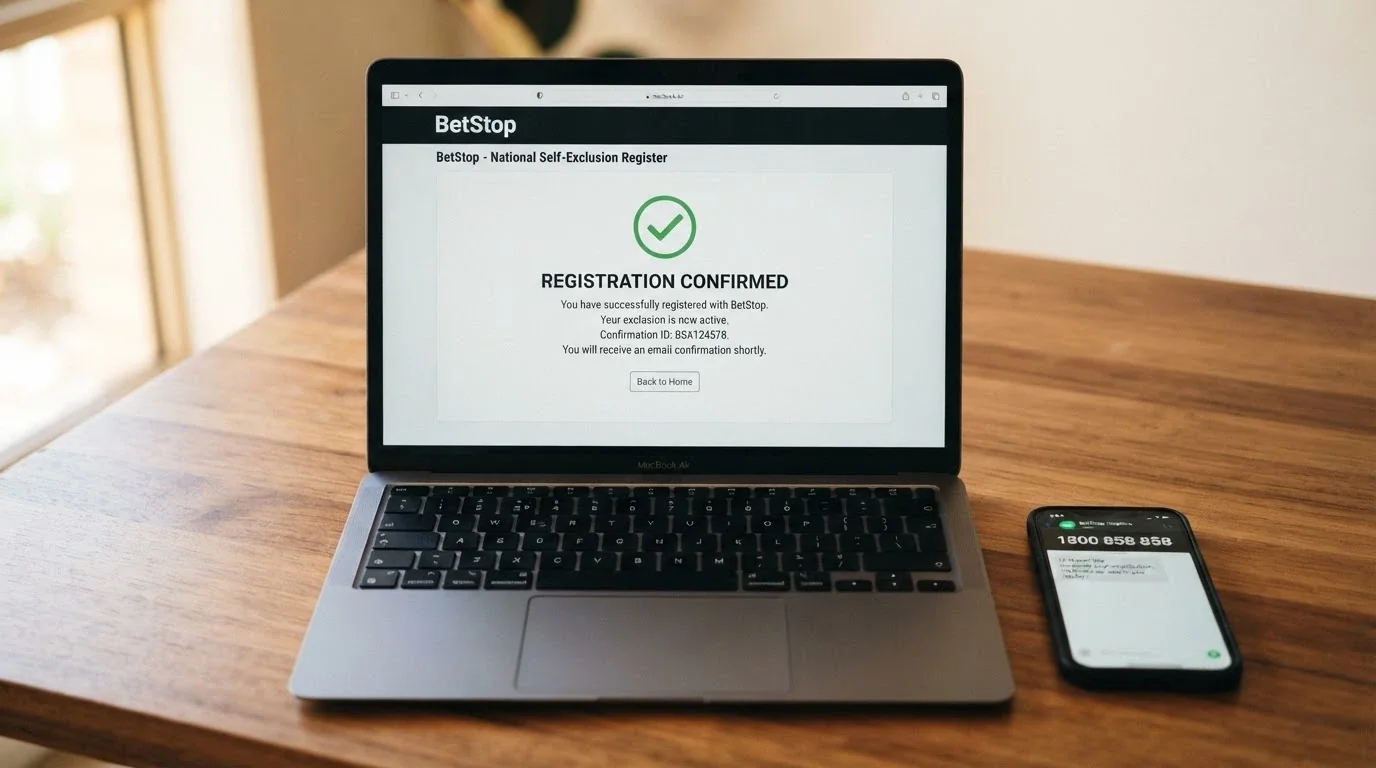
The register has recorded 67,480 registrations in its first three years of operation, with 41,290 exclusions still active as at 31 July 2026. More than 60% of everyone who ever registered remained excluded at the most recent count. Of those who registered, 78% were under 40, and 38% chose lifetime exclusion. The figures describe a tool that is used and that holds: people register, and most of them stay registered.
The offshore blind spot is the part that matters on this page. BetStop binds Australian-licensed wagering services. An offshore casino is not licensed here, is not connected to the register, and will keep taking a self-excluded person’s money. A player who has self-excluded through BetStop is, in practical terms, excluded from Sportsbet, the TAB operators, Bet365, Ladbrokes and the rest of the licensed bookmaker market. They are not excluded from Rocket Play, Skycrown, Stake, or any of the other brands on the operator table above.
From 1 January 2027, the 2026 reform strengthens the register’s operation. Direct marketing of inducements is prohibited for three months after a person deregisters from BetStop — a cooling-off window that addresses the risk of a person deregistering under pressure from a marketing campaign and then immediately re-depositing. The reform does not extend BetStop to offshore operators. The gap remains.
For a player looking to stop, combining BetStop with banking-level transaction blocks is the most effective approach. Recognizing that offshore operators require a separate decision-making process is essential, as the register itself does not reach them.
Help services and the harm prevalence numbers
The Australian gambling-help infrastructure is free, confidential, and available 24 hours a day.
- The National Gambling Helpline is 1800 858 858, free and confidential, staffed 24 hours a day, 7 days a week.
- Gambling Help Online, at gamblinghelponline.org.au, provides online chat, counselling and self-test tools.
- BetStop, at betstop.gov.au, is the National Self-Exclusion Register for Australian-licensed wagering.
- Licensed wagering operators offer customer-set deposit limits, session controls, activity statements and take-a-break options; the specifics vary by operator and by the state or territory licence conditions.
The harm numbers behind the infrastructure are sobering. The Australian Institute of Health and Welfare’s 2022 data put problem gambling among Australian adults at approximately 2.1% — roughly 430,000 people — with high-risk gambling at 1.8%. The minimum age for any commercial gambling in Australia is 18. The infrastructure exists for those who use it; the harm it addresses is measured in hundreds of thousands of Australians.
The help lines are answered regardless of which casino the player used. The offshore operators on this page’s shortlist do not change the path to 1800 858 858, and they do not change the support available once a player calls.
How We Evaluated These Operators
This guide draws on the ACMA register and the ACMA’s published enforcement record, the AIHW 2022 gambling-harm prevalence data, the published parliamentary record on the Interactive Gambling Amendment (Gambling Reform) Bill 2026, the Australian Government’s published terms of the credit-card and cryptocurrency ban, and the operator-published terms pages for the bonus specifics in the table above. Where a figure was not retrievable from the verified set, the page marks the gap rather than estimating around it.
Three operators on the shortlist had substantive bonus terms verified from snippets during research: Rocket Play, Skycrown and Royal Reels. For those three, the wagering multiplier, the cashout cap, the validity window and the eligible-game list are reported from the operator’s own terms. For the remaining seven operators, those fields were not confirmed from the verified set, and the page states that directly rather than carrying placeholder figures.
No operator’s licence was verified against a regulator register during this research run. The operators on the shortlist are sourced from AU-facing affiliate listings and from the BLASK BRANDS market-share data as the AU-tab shortlist; market-share figures are not carried on this page as facts. The offshore status of every operator on the list is verified: none holds an Australian casino licence, because none can exist under the IGA.
The ranking criteria used to order the operator list above were qualitative: the bonus terms’ transparency, the term structure’s fairness relative to the verified shortlist, and the AU-player accessibility indicated by the operator’s market presence. No invented weightings are applied; the ordering reflects the depth of verified information rather than a numerical score. Players comparing the shortlist on their own terms should weight the same three fields — bonus transparency, term fairness and AU accessibility — in the order that matches their own priorities.
What the $300 No-Deposit Bonus Means for Your Next Move
The $300 no-deposit bonus is real as a marketing label. It is small as a cashable sum. At the verified AU-facing offers, the cashout cap sits between A$40 and A$200; the wagering requirement ranges from 25x to 50x and demands turnover of A$7,500 to A$15,000; the validity window is one to seven days. The arithmetic in the wagering section above describes what those terms cost the player in expected loss, and the cashout cap describes what survives to be withdrawn. The two figures are not the same number, and the gap between them is the operator’s margin on the offer.
The offshore status is the larger fact behind every offer on this page. The Interactive Gambling Act 2001 prohibits the product those bonuses are attached to. Every operator on the shortlist is offering it from outside Australia. The player is not prosecuted for using those operators. The player is also without Australian consumer protection, without BetStop coverage, and without recourse on a disputed balance. The ACMA’s site-blocking power can cut a player off from an operator’s website at any time, including with a balance still in the account.
The decision framework, before any player claims one of these offers, runs through five checks. Read the wagering multiplier and the base it applies to (bonus alone, or deposit plus bonus). Read the cashout cap and ask whether the cap is the player’s realistic ceiling on the bonus. Read the validity window and ask whether the wagering can be cleared inside it on the player’s available time. Read the game weighting and confirm the player will be playing pokies at 100% contribution. Read the payment methods and confirm none of them is on the banned list. Each check is one paragraph of the operator’s terms page; each check is also the difference between claiming an offer the player has chosen and being claimed by an offer the player has not read.
The responsible-gambling exit sits outside the offer decision. BetStop at betstop.gov.au is the one-registration exclusion from Australian-licensed wagering services; it does not reach the offshore operators on this page, and a player who needs it should pair it with the bank-side and card-side blocks. The National Gambling Helpline at 1800 858 858 is free, confidential and answered 24 hours a day. Gambling Help Online at gamblinghelponline.org.au offers chat, counselling and self-test tools. The decision to claim an NDB is reversible. The decision to keep playing past the point the player wanted to stop is the one the help lines exist to address.
Frequently Asked Questions About $300 No-Deposit Bonuses
Is it legal to play at online casinos offering $300 no deposit bonuses in Australia?
The provider is breaking the law. The Interactive Gambling Act 2001 prohibits offering online casino games, online pokies and in-play betting to a person in Australia, and there is no licence any operator can hold because the Act does not provide for one. The individual player is not prosecuted — the IGA targets the provider — but the practical consequence is that the player has no Australian consumer protection behind the offer. There is no Australian complaints body that can recover a disputed balance from an offshore operator; BetStop does not reach offshore casinos; and the ACMA’s site-blocking power can cut the player off from an operator’s website at any time, including with a balance still in the account.
Which payment methods can I use to deposit and withdraw at AU-facing online casinos, and are credit cards allowed?
The legal deposit routes at Australian-licensed wagering operators are debit card, bank transfer, PayID/Osko and BPAY. Credit cards, credit-related products and cryptocurrency have been banned as payment methods for online wagering since 11 June 2024, and an operator that fails to enforce the ban faces penalties of up to A$247,500. POLi was decommissioned on 30 September 2023, so PayID is the primary AU rail in 2026. From 1 January 2027 the 2026 reform gives banks and payment providers express authority to block transactions to illegal gambling operators. An AU-facing offshore casino that asks for a credit card or a crypto wallet is operating outside the Australian rules.
What is BetStop and how does it protect Australian players who gamble at offshore casinos?
BetStop is the National Self-Exclusion Register, administered by the ACMA and live since August 2023. One registration excludes a person from every Australian-licensed online and phone wagering service in a single step, with exclusions running from three months to lifetime. The register has recorded 67,480 registrations, with 41,290 exclusions still active as at 31 July 2026; 78% of registrants were under 40 and 38% chose lifetime exclusion. The critical limitation for this page is that BetStop binds Australian-licensed wagering services only. An offshore casino is not licensed here, is not connected to the register, and will keep taking a self-excluded person’s money. From 1 January 2027 the 2026 reform strengthens the register’s operation with a three-month post-deregistration marketing ban; it does not extend the register to offshore operators.
How long do I have to clear the wagering requirements on a $300 no deposit bonus before it expires?
The standard validity window at AU-facing no-deposit bonuses in 2026 is one to seven days from activation. The Skycrown Aztec Clusters NDB activates inside seven days and is valid for a further five; the Rocket Play Coin Volcano NDB is valid for five days from issue; Royal Reels’ NDB runs on a 7–14 day window. A player who does not clear the wagering requirement inside the window forfeits the bonus and any winnings attached to it. The clock starts at activation, not at registration, and most offers let the player delay activation but not delay playthrough once the bonus is live. The expiry window is short because the offer is structured for a quick clearance rather than a long session.
Can I use a $300 no deposit bonus on any pokie, or are there game restrictions?
No. Game weighting at AU-facing casinos in 2026 typically counts pokies at 100% of every dollar wagered toward the playthrough requirement, table games at 5–10% or zero, and live dealer and jackpot pokies at zero. A player running the wagering on a live blackjack table would need to bet ten times the pokies-equivalent turnover to clear it. Free-spin NDBs are tighter still: Skycrown’s 20 free spins are locked to Aztec Clusters by BGaming, Rocket Play’s 25 free spins are locked to Coin Volcano by Playson, and Rocket Play’s secondary NDB is locked to Book of Pyramids. The spins can only be played on the named title, and any wagering those spins generate must then be cleared on a game that contributes 100% — which is what pokies do.
Bonus codes — do you need one?
Most $300 NDBs require a code. It is entered either during the registration form — typically a field labelled “bonus code” or “promo code” — or in the cashier before making a deposit. The code determines which offer is credited to the new account; an account opened without the right code lands on the default sign-up bonus, which is often smaller or carries a different wagering structure.
The mechanics vary by operator. Some codes are universal and stable across weeks or months. Others rotate weekly, tied to the affiliate or review site the player came in through, and the page they were advertised on may be the only place that code is currently valid. A code that has expired returns an error at the cashier; the bonus is not credited, and the player’s first deposit — if they have already made one — sits in the account without the matched offer behind it.
A no-code NDB exists at some operators, applied automatically on registration. It is the friendlier shape for a player who would rather not have to track a string of characters across browser tabs. It is also the rarer shape.
The rule that holds regardless of whether a code is required: read the bonus terms before entering any code. The wagering, the cap, the validity window and the eligible games are the same whether the bonus was triggered by a code or by default. Knowing them up front is what separates a player who chose the offer from a player who was chosen by it.
Published by the No Deposit Bonus Casino AU team.